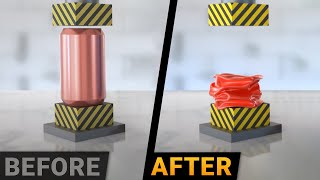
Dr. Zsolnai demonstrates a physics simulation that handles a million particles realistically, testing it on crushed cans, a snow castle hit by a flying fish, and Playdough through a noodle maker. The simulation matches real-world results and runs faster than previous methods, making it useful for animation and games.
Questions this video answers
November 23, 2022
Dr. Zsolnai
Gergai Klar and colleagues
Nature Physics
$1.10 per hour for 100 instances (versus $4.10 per hour with AWS), claimed as 73% savings.
Chapters
Dear fellow scholars, this is Two Minute Papers with Dr. Zsolnai. Today we are going to crash a lot of things. Play with these. Play doh noodles, destroy snow castles, and more. All this in a realistic simulated world. So what is this? This is a new and really advanced research paper in computer graphics that can create a little world. And within this little world, it. It creates accurate physical simulations. So let's run three scholarly experiments and find out how realistic these simulations really are compared to the real world. Experiment number one. You know what? Let's crash a few metal soda cans. Oh, it immediately gets interesting as we change the hardening coefficient of these cans. Look, the patterns are different. So cool. And it gets so accurate. It can also simulate snap through instability, which is this little pop. Loving it. Now wait, so how do we judge the quality of such a simulation? Is this just for show or is it truly what would happen in reality? Well, there is only one way to find out, which is comparing these videos to real tests done with real hydraulic presses. So does it match? Now hold on to your papers and wow. Look at that. That is an incredible result. Outstanding. And not only that, but beyond being super fun, this is also super useful. Why? Well, if we would like to crash something in real life, we can instead create a simulated version of the same situation and do it for free. And since we can compute many of these simulations inexpensively at home, we can do many of them and then choose whichever we like. We can just look at the physical parameters and materials required for that result and all that without needing to touch any real objects. And it gets better. If you stay until the end of the video, I will show you two more simulation versus reality experiments. Now, experiment number two. This one really speaks for itself. Let me quote the paper. We simulate a snow castle hit by a high speed elastic fish. This is beyond amazing because simulating snow is notoriously difficult. Look, these scenes require simulating many different physical attributes of these materials realistically. However, this is not only a challenge, but this also has a huge advantage. What is that? Well, in reality some things are possible, but in a simulation, everything is possible. The rules of this virtual world can be changed with just one click. For instance, here we can choose the cohesion physical parameter and the simulator will create a world where snow gets significantly more chunky. How cool is that? And we are even getting paid for writing algorithms like this and having so much fun. I can't believe it. And now, experiment number three. Playdough. This is a challenging scene where Playdough is being squeezed through a cylindrical noodle mold. And. And this requires an elaborate plasticity simulator. As you can see, this can pull it off beautifully. Wow. Isn't this scene incredible? Isn't humanity amazing, being able to create a computer program like this? And of course, here are the promised simulation versus reality experiments. Both match really well. And wait. We are not done yet. Not even close. Here is the legendary Armadillo crash scene. Yes, we computer graphics people like to destroy virtual objects on a regular basis. It is our favorite pastime. It has a pronounced soothing effect on us, which is welcome when paper deadlines are looming. By the way, if you are interested in finding out how realistic these simulations can become, make sure to read my latest paper in Nature Physics on this topic. The link is available in the video description. And just imagine all of these high quality simulations in a computer game or in any kind of virtual world or animation movie. There are so many possibilities. Now this is going to take some more time because these simulations still take seconds per time step. And one frame in a video often requires simulating through a few of those time steps. However, wait a second. This new technique supports using bigger time steps, which is an incredible feature. Why is that? Well, look, if we use a previous technique and try to advance the time slowly and carefully between two simulation steps, this happens. That looks good, but takes a long time to simulate. Now, if we choose a larger time step, we can skip ahead quicker. So why not do that? Well, because then this happens. Whoa. And with this new technique, we can raise the time step size and thus cut down the simulation time considerably and it still behaves correctly. That is an amazing achievement. What a time to be alive. By the way, this previous technique was from Gergai Klar and colleagues. And. And it could simulate these kinds of really advanced scenes six years ago. Bravo for that too. Isn't it amazing that it took six years to make something so good that it makes this work? The before part of a before after comparison. Oh, and this new method can simulate a memory foam pillow too. So what do you think? Does this get your mind going? Let me know in the comments below. If you're looking for inexpensive cloud GPUs for AI or Lambda now offers the best prices in the world for GPU cloud compute. No commitments or negotiation required. Just sign up and launch an instance. And hold on to your papers. Because with Lambda GPU Cloud you can get on demand a 100 instances for $1.10 per hour versus $4.10 per hour with AWS. That's 73% savings. Did I mention they also offer persistent storage. So join researchers at organizations like Apple, MIT, and Caltech in using Lambda Cloud instances, workstations or servers. Make sure to go to lambdalabs.compapers to sign up for one of their amazing GPU instances today. Thanks for watching and for your generous support, and I'll see you next time.