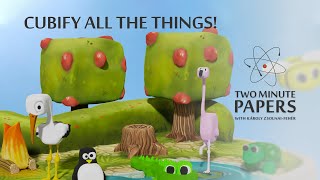
Researchers developed a method to stylize 3D shapes into cube-like forms while preserving fine details. The technique uses a tunable strength parameter to control how much cubification happens, works on high-resolution meshes in real time, and can apply different levels of stylization to different parts of the same object.
Chapters
Dear fellow scholars, this is two minute papers with I apologize for my voice today. I am trapped in this frail human body and sometimes it falters. But the papers must go on. This is one of those papers where I find that the more time I spend with it, the more I realize how amazing it is. It starts out with an interesting little value proposition that in and of itself would likely not make it to a paper. So what is this paper about? Well, as you see here, this one is about cubification of 3D geometry. In other words, we take an input shape and it stylizes it to look more like a cube. Okay, that's cute. Especially given that there are many, many ways to do this and it's hard to immediately put into words what a good end result would be. You. You can see a comparison to previous works here. These previous works did not seem to preserve a lot of fine details, but if you look at this new one, you see that this one does that really well. Very nice indeed. But still, when I read this paper at this point I was thinking I'd like a little more. Well, I quickly found out that this work has more up its sleeve. So much more. Let's talk about seven of these amazing features. For instance, 1. We can control the strength of the transformation with this lambda parameter. As you see, the more we increase it, the more heavy handed the smooshing process is going to get. Please remember this part. 2. We can also cubify selectively along different directions or select parts of the object that should be cubified differently. Hmm, okay. 3. We can even use it to fix flaws in the input 3D geometry. 4. This transformation procedure also takes into consideration the orientations. This means that we can perform it from different angles, which gives us a large selection of possible outputs for the same model. 5. It is fast and works on high resolution geometry. And. And you see different settings for the lambda parameter here. That is the same parameter as we talked about before, the strength of the transformation. 6. We can also combine many of these features interactively until a desirable shape is found. Seven is about to come in a moment, but to appreciate what that is, we have to look at this. To perform what you have seen here so far, we have to minimize this expression. This first term says arap as rigid as possible, which stipulates that whatever we do in terms of smooshing, it should preserve the fine local features. The second part is called a regularization term that encourages sparser, more axis aligned solutions so we don't destroy the entire model during this process. The stronger this term is the bigger say it has in the final results, which in return become more cube like. So how do we do that? Well, of course with our trusty little lambda parameter. Not only that, but if we look at the appendix, it tells us that we can generalize this second regularization term for many different shapes. So here we are finally. 7. It doesn't even need to be cubification. We can specify all kinds of polyhedra. Look at those gorgeous results. I love this paper. It is playful, it is elegant, it has utility, and it generalizes well. It doesn't care in the slightest what the current mainstream ideas are and invites us into its own little world. In summary, this will serve all your cubification needs and turns out it might even fix your geometry and more I would love to see more papers like this in this series. I try to make people feel how I feel when I read these papers. I hope I have managed this time, but you be the judge. Let me know in the comments. This episode has been supported by Linode. Linode is the world's largest independent cloud computing provider. They offer you virtual servers that make it easy and affordable to host your own app, site, project, or anything else in the cloud. Whether you are a Linux expert or just starting to tinker with your own code, Linode will be useful for you. A few episodes ago we played with an implementation of OpenAI's GPT2, where our excited viewers accidentally overloaded the system with Linode's load balancing technology and instances ranging from shared nanodes all the way up to dedicated GPUs. You don't have to worry about your project being overloaded. To get $20 of free credit, make sure to head over to linode.com papers and sign up today using the promo code PAPERS20. Our thanks to Linode for supporting the series and helping us make better videos for you. Thanks for watching and for your generous support and I'll see you next time.