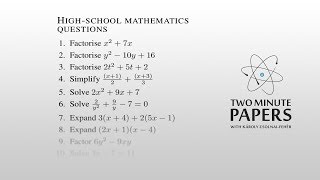
DeepMind created a dataset of 2 million procedurally generated math problems to test whether neural networks actually learn math or just memorize. Transformer models scored 76% on familiar problem types but dropped to 50% when asked to solve harder variations, struggling most with primality testing and factorization.
Questions this video answers
2 million
76%
50%
June 4, 2019
Károly Zsolnai-Fehér (channel: LARRUZ)
Chapters
Dear fellow scholars, this is two minute papers with. This paper from DeepMind is about taking a bunch of learning algorithms and torturing them with millions of classic math questions to find out if they can solve them. Sounds great, right? I wonder, what kind of math questions would an AI find easy to solve? What percentage of these can a good learning algorithm answer today? Worry not. We'll discuss some of the results at the end of this video. These kinds of problems are typically solved by recurrent neural networks that are able to read and produce sequences of data. And to even begin to understand what the question is here, an AI would have to understand the concept of functions, variables, arithmetic, operators, and of course, the words that form the question itself. It has to learn planning and precedence, that is it. In what order do we evaluate such an expression? And it has to have some sort of memory in which it can store the intermediate results. The main goal of this paper is to describe a data set that is designed in a very specific way to be able to benchmark the mathematical reasoning abilities of an AI. So how do we do that? First, it is made in a way that it's very difficult to solve for someone without generalized knowledge. Imagine the kind of student at school who memorized everything from the textbooks, but has no understanding of the underlying tasks. And if the teacher changes just one number in a question, the student is unable to solve the problem. We all met that kind of student, right? Well, this test is designed in a way that students like these should fail at it. Of course, in our case, the student is the AI. Second, the questions should be modular. This is a huge advantage because a large number of these questions can be generated procedurally by adding a different combination of subtasks such as additions, function evaluations, and more. An additional advantage of this is that we can easily control the difficulty of these questions. The more modules we use, typically the more difficult the question gets. Third, the questions and answers should be able to come in any form. This is an advantage because the AI has to not only understand the mathematical expressions, but also focus on what exactly we wish to know about them. This also means that the question itself can be about factorization, where the answer is expected to be either true or false, and the algorithm is not told we are looking for a true or false answer. It has to be able to infer this from the question itself and to be able to tackle all this properly. With this paper, the authors released 2 million of these questions for training an AI free of charge. To foster more future research in this direction, I wonder what percentage of these Can a good learning algorithm answer today? Let's have a look at some results. A neural network model that goes by the name transformer network produced the best results by being able to answer 50% of the questions. This you find in the extrapolation column here. When you look at the interpolation column you see that it successfully answered 76% of these questions. So which one is it? 50% or 76%? Actually, both. The difference is that interpolation means that the numbers in these questions were within the bounds that was seen in the training data, which where extrapolation means that some of these numbers are potentially much larger or smaller than others that the AI has seen in the training examples. I would say that given the difficulty of just even understanding what these questions are, these are really great results. Generally in the future we will be looking for algorithms that do well on the extrapolation tasks because These are the AIs that have knowledge that generalizes well. So which tasks were easy and which were difficult? Interestingly, the AI had similar difficulties as we fellow humans have, namely rounding decimals and integers comparisons. Basic algebra was quite easy for it, whereas detecting primality and factorization were not very accurate. I will keep an eye out on improvements in this area if you're interested to hear more about it. Make sure to subscribe to this series. If you and if you just push the red button, you may think that you're subscribed, but you're not. You are just kind of subscribed. Make sure to also click the bell icon to not miss these future episodes. Also, please make sure to read the paper. It is quite readable and contains a lot more really cool insights about this dataset and the experiments. As always, the link is available in the video Description thanks for watching and for your generous support and I'll see you next time.