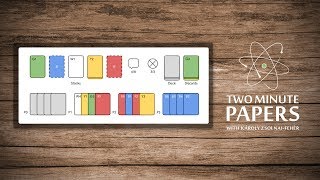
DeepMind proposes Hanabi, a card game where players see everyone's cards but not their own, as a benchmark for teaching AI to cooperate and communicate. Current algorithms underperform skilled humans even when paired with copies of themselves, and the open-source framework runs on consumer GPUs.
Questions this video answers
March 19, 2019
LARRUZ (Károly Zsolnai-Fehér / Two Minute Papers channel)
Two to five players
Cooperate to build five card sequences
Chapters
Dear fellow scholars, this is two minute papers with zsolnai. Now get this. After defeating Chess Go and making incredible progress in Starcraft 2, scientists at DeepMind just published a paper where they claim that Hanabi is the next frontier in AI research. And we shall stop right here. I hear you asking me, Karoi, after defeating all of these immensely difficult games, now you're trying to tell me that somehow this silly card game is the next step? Yes, that's exactly what I'm saying. Let me explain. Hanabi is a card game where two to five players cooperate to build five card sequences. And to do that, they are only allowed to exchange very little information. This is also an imperfect information game, which means the players don't have all the knowledge available needed to make a good decision. They have to work with what they have and try to infer the rest. For instance, poker is also an imperfect information game because we don't see the cards of the other players and the game revolves around our guesses as to what they might have in Hanabi. Interestingly, it is the other way around. So we see the cards of the other players, but not our own ones. The players have to work around this limitation by relying on each other and working out communication protocols and infer intent in order to win the game. Like in many of the best games, these simple rules conceal a vast array of strategies, all of which are extremely hard to teach to current learning algorithms. In the paper, a free and open source system is proposed to facilitate further research works and assess the performance of currently existing techniques. The difficulty level of this game can also be made easier or harder at will from both inside and and outside the game. And by inside I mean that we can set parameters like the number of allowed mistakes that can be made before the game is considered lost. The outside part means that two main game settings are proposed. One self play. This is the easier case where the AI plays with copies of itself. Therefore it knows quite a bit about its teammates. And two ad hoc teams can also be constructed, which means that a set of agents need to cooperate that are not familiar familiar with each other. This is immensely difficult. When I looked at the paper, I expected that as we have many powerful learning algorithms, they would rip through this challenge with ease. But surprisingly I found out that even the easier self play variant severely underperforms compared to the best human players and handcrafted bots. There is plenty of work to be done here and luckily you can also run it yourself at home and train some of these agents on a consumer graphics card. Note that it is possible to create a handcrafted program that plays this game well, as we humans already know good strategies. However, this project is about getting several instances of an AI to learn new ways to communicate with each other effectively. Again, the goal is not to get a computer program that plays Hanabi well. The goal is to get an AI to learn to communicate effectively and work together towards a common goal. Much like chess, Starcraft 2 and Dota, Hanabi is still a proxy to be used for measuring progress in AI research. Nobody wants to spend millions of dollars to play card games at work, so the final goal of DeepMind is to reuse this algorithm for other applications where even we humans falter. I have included some more materials on this game in the video description. Make sure to have a look. Thanks for watching and for your generous support and I'll see you next time.