DeepMind’s AlphaStar: A Grandmaster Level StarCraft 2 AI!
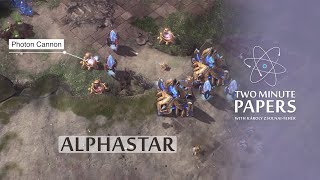
DeepMind's AlphaStar reached Grandmaster level in StarCraft II, ranking above 99.8% of human players across all three races. The AI used self-play and a novel exploiter technique to expose and fix weaknesses, achieving over 99% win rates per race.
Questions this video answers
December 3, 2019.
All three races reported over 99% win rate; ranked above 99.8% of officially ranked human players.
Weights & Biases (WandB).
Chapters
Dear fellow scholars, this is two minute papers with the paper we are going to cover today in my view is one of the more important things that happened in AI research lately. In the last few years we have seen DeepMind's AI defeat the best Go players in the world. And after OpenAI's venture in the game of Dota 2, DeepMind embarked on a journey to defeat pro players in Starcraft ii, a real time strategy game. This is a game that requires a great deal of mechanical skill, split second decision making and we have imperfect information as we only see what our units can see. A nightmare situation for any AI. The previous version of AlphaStar we covered in this series was able to beat at least mid Grandmaster level players, which is truly remarkable. But as with every project of this complexity, there were limitations and caveats. In our earlier video the paper was still pending and now it has finally appeared. So my sleepless nights have officially ended at least for this work and now we can look into some more results. One of the limitations of the earlier version was that DeepMind needed to further tune some of the parameters and rules to make sure that the AI and the players play on an even footing. For instance, the camera movement and the number of actions the AI can make per minute hand has been limited some more and are now more human like TLO, a professional StarCraft II player noted that this time around it indeed felt very much like playing another human player. The second limitation was that the AI was only able to play Prodas, which is one of the three races available in the game. This new version can now play all three races and here you see its MMR ratings, a number that describes the skill level of the AI and and for non experts, win percentages for each individual race. As you see it is still the best with Prodos. However, all three races are well over the 99% win rate mark. Absolutely amazing. In this version there is also more emphasis on self play and the goal is to create a learning algorithm that is able to learn how to play really well by playing against previous versions of itself millions and millions of times. This is again one of those curious cases where the agents train against themselves in a simulated world and then when the final AI was deployed on the official game servers, it played against human players for the very first time. I promise to tell you about the results in a moment, but for now please note that relying more on self play is extremely difficult. Let me explain why. Self play agents have a well known drawback of forgetting which which means that as they improve they might forget how to win against previous versions of themselves Since Starcraft II is designed in a way that every unit and strategy has an antidote, we have a rock, paper, scissors kind of situation where the agent plays rock all the time because it has encountered a lot of scissors lately. Then when a lot of papers appear, no pun intended, it will start playing scissors more often and completely forget about the olden times when the rock was older age and on and on. This circle goes without any real learning or progress. This doesn't just lead to suboptimal results. This leads to disastrously bad learning, if any learning at all. But it gets even worse. This situation opens up the possibility for an exploiter to take advantage of this information and easily beat these agents. In concrete StarCraft terms, such an exploit could be trying to Defeat the AlphaStar AI early by rushing it with workers and warping in photon cannons to their base. This strategy is also known as a cannon rush. And as you can see here, the red agent performing this, it can quickly defeat the unsuspecting blue opponent. So how do we defend against such exploits? Deep might use a clever idea here by trying to turn the whole thing around and use these exploits to its advantage. How? Well, they proposed a novel self play method where they additionally insert these exploiter AIs to expose the main AI's flaws and create an overall more knowledgeable and robust agent. So how did it go? Well, as a result, you can see how the green agent has learned to adapt to this by pulling its worker line and successfully defended the cannon rush of the red AI. This is proper machine learning progress happening right before our eyes. Glorious. This is just one example of using exploiters to create a better main AI. But the training process continually creates newer and newer kinds of exploiters. For instance, you will see in a moment that it later came up with a nasty strategy including attacking the main base with cloaking units. One of the coolest parts of this work in my opinion is is that this kind of exploitation is a general concept that will surely come useful for completely different test domains as well. We noted earlier that it finally started playing humans for the first time on the official servers. So how did that go? In my opinion, given the difficulty and the vast search space we have in Starcraft ii, creating a self learning AI that has the skills of an amateur player is absolutely incredible. But that's not what happened. Hold on to your papers because it quickly reached Grandmaster level with all three races and ranked above 99.8% of the officially ranked human players. Bravo DeepMind. Stunning work later it also played Serol, a decorated world champion Zerg player, one of the most dominant players of our time. I will not spoil the results, especially given that there were limitations as Serol wasn't playing on his own equipment. But but I will note that Artosis, a well known and beloved Starcraft player and commentator, analyzed these matches and said the results are so impressive and I really feel like we can learn a lot from it. I would be surprised if a non human entity could get this good and there was nothing to learn. His commentary was excellent and is tailored towards people who don't know anything about the game. He'll often pause the game and slowly explain what is going on in these matches. I love the fact that so many times it makes so many plays that we consider to be very poor and somehow overall it still plays outrageously well. It has unit compositions that nobody in their right minds would play. It is kind of like a drunken Kung fu master, but in Starcraft ii. Love it but no more spoilers. I think you should really watch these matches. And of course I put a link to his analysis videos in the video description. Even though both this video and the paper appears to be laser focused on playing StarCraft 2, it is of utmost importance to note that this is still just a testbed to demonstrate the learning capabilities of this AI. As amazing as it sounds, DeepMind wasn't just looking to spend millions and millions of dollars on research just to play video games. The building blocks of alphastar are meant to be reasonably general, which means that parts of this AI can be reused for other things. For instance, Demis Hassabis mentioned weather prediction and climate modeling as examples. If you take only one thought from this video, let it be this one. There's really so much to talk about, so make sure to head over to the video description, watch the matches and check out the paper as well. The evaluation section is as detailed as it can possibly get. What a time to be alive. This episode has been supported by Weights and Biases. Weights and Biases provides tools to track your experiments in your deep learning projects. It can save you a ton of time and money in these projects and is being used by OpenAI, Toyota Research, Stanford and Berkeley. Here you see a technical case study they published on how a team can work together to build and deploy machine learning models in an organized way. Make sure to Visit them through wendb.com papers, wandb.com papers or just click the link in the video description and you can get a free demo today. Our thanks to Weights and Biases for helping us make better videos for you. Thanks for watching and for your generous support. And I'll see you next time.










