DeepMind’s Insane AI Breakthroughs With CEO Demis Hassabis
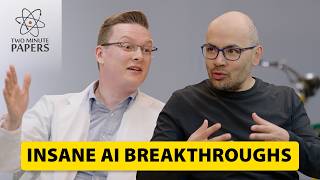
In this extensive interview, Two Minute Papers host Károly Zsolnai-Fehér engages DeepMind CEO Demis Hassabis in a conversational tour of DeepMind’s latest AI systems and their real‑world impact. Hassabis recounts personal anecdotes of using Gemini to analyze a massive health‑scan video for his mother, describing how the model’s long‑context abilities delivered a correct assessment that was later confirmed by doctors. He explains that he primarily uses Gemini as a brainstorming and sparring partner for project ideas, literature summarisation, and hypothesis critique. The discussion then moves to CoScientist, a fine‑tuned Gemini variant equipped with extra tools for hypothesis generation, data analysis, and literature summarisation, which Hassabis describes as an emerging research assistant that has already helped generate ideas in ray‑tracing and global illumination. Hassabis outlines DeepMind’s broader vision for AI‑driven drug discovery: building a platform of AlphaFold‑level models that predict protein structures, interactions, ADME properties, and synthesis pathways, aiming to accelerate pre‑clinical discovery and eventually streamline clinical trials, while acknowledging regulatory hurdles. He likens the expected exponential progress to the AlphaFold breakthrough and suggests AI could also aid patient stratification and dosage prediction. The interview also covers DeepMind’s partnership with the massive‑multiplayer game EVE Online, using its rich economy and player‑driven narratives as a sandbox for testing AI agents that could assist or interact with players. Hassabis touches on the notion of AI achieving an “Einstein test” – inventing Nobel‑worthy breakthroughs from a historical knowledge cutoff – and reflects on current AI‑assisted inventions such as more efficient matrix multiplication. The conversation concludes with a rapid‑fire lightning round where Hassabis gives brief personal preferences (discrete vs. continuous math, favorite scientists, Two Minute Papers episodes, Asimov novels) and a light‑hearted behind‑the‑scenes segment promoting Lambda’s GPU cloud for running large models. Throughout, Hassabis balances enthusiasm for AI’s potential with realistic assessments of technical and regulatory challenges.
Chapters
Quick and easy questions. Please try to answer in one sentence, sometimes one word.
Oh wow, that's hard.
Feynman or Newton?
Wow, that's even harder.
Denis, I don't know if I told you, but my mother recently got some health scan results. It was a massive video file and we had to wait for weeks for the evaluation and we were really anxious. And then I thought, wait, Gemini. Long context, you know, why not give it a look? And it analyzed the scan and said, don't worry, it's fine. And later the doctor verified that. Oh, fantastic. That it nailed it. And I am really grateful for that. And I was about to say thank you. But in the meantime, you also released Gemma 4, free local AI that can likely do the same with a little compression. Just wanted to say these are a gift to humanity. And thank you so much for doing this for the little man.
Fantastic. Well, I'm glad to hear that. It's— and I'm glad to hear your mom's fine. But it's— we've had a lot of anecdotes like that of people using Gemini for health reasons and actually in some cases life-saving advice. So I think it's an incredible use case. So I'm glad it helped. Yeah.
Yeah. Thank you very much. Now, Jensen Huang of NVIDIA says that he uses LLMs as a confidant for decision-making. What about you? Do you use Gemini for things beyond research?
Yes. I don't use it quite as a confidant yet, although maybe at some point I will. I use it a lot for brainstorming. So, you know, project ideas, project names, you know, think creative ideas. I quite like it as a kind of sparring partner for that. And that's probably the main use. And then I also use it for enter you know, look at, summarize some new area of research, some new body of research I'm not so expert in, but I want to get a quick take on, you know, the main key points.
Do you use it to get your ideas criticized? Like fire up DeepThink, you know, mathematical Olympiad, and now criticize my idea.
Yes, I have, yes, I mostly use it for helping me kind of think through some of the steps I've been thinking of as well. I mean, I guess you could call it critiquing it, but I try in a more collaborative frame rather than, "Maybe I should try it with more like..." Be harsher, come up with the flaws in this. But I definitely use it as a kind of sparring partner.
Amazing. Now, when I heard you got the Nobel Prize, I thought, "Finally, some proper recognition for the theme park AI." Yeah, exactly.
Exactly. Took a while.
Yes. And then I heard John Jumper say something that really stuck with me. He said that he's looking forward to seeing someone use your AlphaFold technique to invent something to win the prize. I thought, let's call it the second order Nobel.
Yeah.
So do you expect that to happen? Second order Nobel?
That's a really interesting idea. I think it's possible given the number of researchers who are using AlphaFold, you know, over 3 million at this point, and they're all doing incredibly important work and impactful work. So yeah, I guess that John's right. That may happen at some point. That would be an amazing thing. Moment.
Amazing. Now you have a system called CoScientist that can invent new things. Can you tell me about it?
Yeah, you can think of CoScientist as a sort of, um, fine-tuned version of Gemini that's specifically, uh, with extra tools and extra harnesses on top that, uh, is specific for helping with hypothesis generation, helping you analyze data, helping you, uh, summarize literature as well. So it's the beginnings of a kind of almost like having a great research assistant that's helping you in your daily work.
It's incredible, by the way, the new hypothesis generator. I also tried it.
Oh, great.
Gave it some ideas.
Yes.
And then it was interesting, interesting, because it wants you to narrow down the idea because you just, you just say something.
Yes.
And then just the result was absolutely amazing. Like, wait, wait the 8 hours. And then I was like, This is incredible. And I tried it on my original area.
What area?
Yeah, ray tracing, global illumination.
Okay.
Very little training data, very few people do that. So I think it's pretty cool to see it perform on that.
On that?
Okay.
And it came back with some interesting, sensible ideas? Hope so. Okay.
I wish I had more time.
Me too. Me too. This is the problem, is actually finding the time now to do that. We almost need— I feel like we almost need really good AI assistants to help deal with our admin work. We have to do all of that stuff. So we have more time for using CoScientist, right? This is my dream too.
On April 20th, 2025, you said, I think one day maybe we can cure all disease with the help of AI. Maybe within the next decade. I don't see why not. When I saw that, I got so excited. I made a website for that.
Oh, cool.
Curealldisease.com.
Okay.
And I have some data in there and I wrote, check back often because I will update it with new data.
Fantastic.
And never updated.
We're working hard. No, yeah, but it won't be, it won't be a gradual thing. It will be more like AlphaFold is the way I'm thinking about it. We're building at Isomorphic Labs and also our spin-out and also at DeepMind as well in our science group. More and more tools. You can think of it as building a platform. AlphaFold's one of the components of that, the advanced versions of AlphaFold. But as you know, protein structure is only one component. It's an important component, but it's only one step in the drug discovery process. So we are building, you can think another half dozen to a dozen AlphaFold-level models that are on different parts of the of the drug discovery process. And then we've gotta put that all together and of course test it on some disease profiles, which is what we're doing now in preclinical stage. And then once we've proven that out, which I think will take a few more years, then we may have an engine that can be applied to, a platform that can be applied to almost any disease area. That's the hope. So a bit like with AlphaFold 2, you get it accurate enough and then suddenly you can fold all 200 million proteins in one year. So it's going to be more like that. So you may not have any updates on your website for a few years, and then suddenly I hope there will be some big breakthroughs where then you'll have, you know, you won't be able to— you have to update it every day.
Okay, I think I've heard something similar from Watson's talk. He said that the process is going to be exponential, and then at year 5 they said that, well, you're only at, I don't know, 8%. What are you doing? And he said, no, that's fantastic. Yes, I mean, if it's —exactly doubling every year. We are way ahead.
Yes, he may, he may be talking about the Genome Project, probably, or, or the Human Genome Project. That's exactly right. And, and we've already seen this once with AlphaFold. So, um, we need to rep, you know, replicate that success. Obviously it's much, much more complex. Um, and I also meant by that as well that we would potentially have a, a, a platform that could come up with those, uh, potential cures. You still would need to test them in the clinic and and go through that process. That could still take more time. Can you speed that up? I think actually AI could also help with that too. Like stratify patients, maybe predict dosages better, all of those things. So I actually think AI could probably speed that up too. So there's two parts to drug discovery. You've gotta do the drug discovery process and then you've gotta do the clinical trials. And right now we're focusing on the first part, but I think AI could also help with the second part. That's when we would then have a step change in human health.
So with that, I think we are on track, right?
So cure all disease in 9 years. I wouldn't say specifically, roughly that kind of timeframe, but I think in the next 10 to 20 years, there's, I don't see any laws of physics that prevent that.
Right. Think entropy. Yeah, exactly. And when I read drug discovery papers, it's not my area, but I get really excited and then I ask an expert and they say, yes, Exactly what you said, that's just one step and there's a thousand other steps. Yes. So I'm wondering what can we now do with AI that we couldn't before in drug development?
Well, I think what the kind of things we are working on is, so there's obviously there's advanced versions of AlphaFold. You can imagine we can predict lots of interactions now. So not just static picture of a protein, proteins interacting with other proteins, proteins interacting with molecules. And then the next, the hard parts are then predicting what is it going to do in the body? So when, where does it bind to? Are there, what's the ADME properties, absorption and toxicity, all of these things which ends up being side effects. So we've gotta build models that predict all of these different things. And then put that all kind of all together, as well as like kind of biochemistry models of like what exact compound would you design and how is it going to be made and how will it bind to the particular pocket or whatever it is that you are targeting in the protein.
My impression is that there's a lot of things in drug discovery that we cannot do at the moment and we will be able to do with AI, like AlphaFold and whatever follows. What are the things that we cannot do at the moment and you see that that's maybe not changing? I don't know, maybe something about regulations. That, you know, that evades physics.
Yes, regulations, obviously that's a bit outside the scope of AI to help with. But what I hope with there, you know, if you think about regulations, FDA, these types of things, obviously they're incredible important part of the process, but they could be sped up like we were saying earlier with more evidence that once a few AI-designed drugs, I think, get through the whole regulatory process, then you might have enough data, say there's 10 AI-designed drugs and 9 of them worked, right? Then you would be able to backtest and how accurate really were your models in their predictions? Which ones can you trust, which ones can't you? And then that would be evidence to the regulator, I think, that some of those process could be sped up and maybe some of the steps could be skipped or replaced with something more efficient. But I think, it's gonna require evidence first of all that a few of these AI-assisted or AI-designed drugs get all the way through to actually help the patient in the probably traditional way. And then we can change, maybe think about changing the way that that's done.
Maybe similarly as what we had with the mRNA vaccines, right?
Yes, potentially, right. So there was a new technique there, there was this emergency need obviously with COVID and then that accelerated the tests and the trials on those things. You know, that's, that's one potential way it could go. But I don't think there's, I mean, this is, this is something about human health for the next, you know, next 10 centuries, right? We, we don't need to rush it in the next 5 to 10 years, but I just think what I see is such exciting technology coming down the road. I just think anything may be possible.
That's incredible. Now, As a former player, can you tell me a bit about your new partnership with the EVE Online game?
Oh yes! Oh, you were a former player? Oh yeah. Okay, fantastic. Yeah, well, it's an awesome game, and I think its community is very special, actually. You know, very rare, the community sort of builds the game too, really, with the way they build their alliances and factions. It's an incredibly deep game, you know, massive multiplayer. It's a whole universe really that's created not just by the game designers, but also by the players. And it has a functioning economy and really interesting kind of dynamic storylines. So we think that we've admired their work for a long time. I know Hilmar, the CEO of the company, very well. We're good friends going way back to when I was still doing games. And we think it's a fantastic, sort of sandbox, if you like, for testing out some interesting AI ideas that will help the gameplay and, you know, be interesting kind of to test out how it interacts with economies and the storylines and player alliances and things like that. So, it's going to be an interesting proving ground, I think fascinating for the game and the community. And also, like, they've always been at the cutting edge, really. So, this is continuing that tradition. And then for us, it also continues in the tradition of DeepMind of using games as a safe kind of proving ground.
Would the concept work in a way that some AI agents would be embedded playing with the players?
Potentially, yeah, potentially, or maybe assisting the players. I think we're still early days of exploring that. We want to brainstorm that with the community too. But you could imagine also maybe it's almost like a games master that drive the storyline along as well. That is so cool.
Look, I cannot wait to see an AI bot get scammed in GITA.
You have to start playing again.
Yeah. And by the way, if you need someone to double your money, I know a guy.
You're the guy.
Look, all the others, those are scams. This one, guaranteed.
We'll make sure our AI agent comes to you for that one.
Now, can you tell me a bit about the things that the co-scientist has invented already? My understanding is that it's not directly writing papers, scientists are writing up the papers.
Yes, that's right. So it's, it's more like an assistant today rather than autonomously discovering things. You know, maybe that's the next step, but right now it's assisting scientists in, in, you know, and mathematicians in their work. I hope we'll be announcing some things pretty soon, but earlier versions of these, these types of systems were doing things like finding more efficient matrix multiplication, or like we used it for AlphaVolv and other tools as well for basically improving like computer science algorithms. So kind of turning, uh, invention on itself to make itself more efficient, which is pretty cool. And, and I think we're obviously, we're just putting it out there now and we're just scratching the surface of what I hope will be, we'll see the potential of it is going to be.
Now wouldn't this be the ultimate Turing test of AI? Like you have the Einstein test where you stop it at 1901 or somewhere and see if it can do special relativity.
Yeah.
Now what about the Einstein test squared? Yeah. Assuming bigger than 1. So the cutoff is today, like invent something new that's like a Nobel Prize worthy thing.
That's obviously what we would want. And but in order to prove that that's the case, would this, this Einstein test that I've, I've been saying about, you know, if you took it back to 1901 with a knowledge cutoff, could it have invented, you know, Einstein's annus mirabilis of, you know, 1905, where he came up with, you know, 4 amazing papers, all breakthroughs in their different areas, right, including special relativity. So if it was able to do that, then presumably you could turn that model, obviously trained on all modern-day physics, and then ask it for, you know, say something better than string theory, right? And then maybe you should take quite seriously what it came back with, right? So that would be the kind of backtest to show that that kind of system, those types of techniques would be ready to actually invent new science.
I'm gonna try to put in this one because I really want you to hear about this. Now I'm thinking that in ray tracing research, we do a lot of Monte Carlo integration and we pray to John von Neumann. Yes. Essentially, you have— you get a noisy image from a module that we call a sampler, and then you pass it over to a denoiser. So you get a cleaner image. Now, that kind of works, but the best systems do more than that. They have a connection between the denoiser and the sampler. So the denoiser actually tells the sampler that, hey, I want this image with more samples in the high-frequency regions so that the denoiser can do do a better job. So it's not two separate units anymore, it's, it's fused into one unit. Yeah. Now what I'm thinking is that, do you have something like this between the hypothesis generator and the verifier?
Well, I— that, that would be kind of like closed-loop automated discovery, right? If one could fuse that. Um, most of the, the frontier labs are working on trying to think about recursive self-improvement. I think it could work in some domains like coding and math, because the verifier— that you can verify very easily, very quickly whether the answer is correct or making progress. Uh, and you can also generate synthetic data that way as well. So, um, I think it's a bit harder if it's a physical science or kind of natural science, like physics, chemistry, or biology, where the verifier will probably also require an automated lab or something in the world of atoms. And that will obviously make the loop a lot longer. We are thinking about things like automated labs in isomorphic. And I think at some point we will do that. I'm waiting a little bit to see what type of data do we really need that we can't get from a CRO or something like that. And I'm also waiting for robotics to get a little bit more advanced too, which we're doing at DeepMind. So that's going well. So maybe in 18 months, 24 months. I can imagine setting up some kind of lab like that. We're actually doing one for material science. We're putting an automated lab together. We're building one out in London because we have material designs. Actually, we're sitting on 200,000 designs of new materials, which we don't know. There could be an amazing material in there, but we haven't got a way of testing that fast enough. There's some superconductors in there, all sorts of really interesting things. Atoms are hard. Yeah. So, you need, so I think for those, types of domains, most of the science domains, the verify step is gonna require some physical verification. And then the question is, is like, what's the bottleneck in the discovery loop, right? Is it the hypothesis generation or is it the validation step? So it may not be so easy to do that kind of recursive self-improvement. The other issue is even in maths and coding, all of the frontier labs are kind of thinking about this is you gotta think about the safety. Of that type of process, because it's just sort of with, you know, if no human is in the loop.
Now at the end, this is going to be a quick lightning round. Okay. Quick and easy questions. Please try to answer in one sentence, sometimes one word. Okay. Okay. Discrete or continuous mathematics? Hint: there's only one good answer.
Oh, really? Yes. Okay, well, I prefer discrete, but I don't know, you know, is that the right answer? For you, yes. For me, yes, exactly. I think all of this is discrete. Okay, Feynman or Einstein? Oh wow, that's hard. Probably Feynman for me, my personal favorite. Okay, Feynman or Newton? Wow, that's even harder. There, maybe I have to go Newton. Maybe I have to go Newton for my Cambridge connections. All right, favorite Two Minute Papers episode? Oh wow. Okay. Oh, I love loads of your team. I use it a lot to, to get up to speed with things. But I, I tell you what, I loved your AlphaFold videos. I thought they were excellent. All of them. Some of the best explanations out there of, of how AlphaFold works.
That is very kind. Thank you. Best Asimov novel?
Foundation series. Yes. That's what was really influential for me.
Have you read the Robot series?
Caves of Time? No, I haven't. Interestingly. Please. Yeah. I, I just read the Foundation series and that's about it.
But I should probably read the verbal one too. Please, please. And now, Sir Demis Hassabis, a knighthood is one thing, but for your contributions to humanity today, I shall bestow upon you the Two Minute Papers badge of honor.
Oh, wow.
You're the first scientist to ever receive it.
Amazing. So with that said— Well, thank you very much. There you go. Thank you very much. I will wear it with pride. Thank you. And I'm watching all your videos.
Awesome. Thank you, Denis. Thank you so much. Thank you. I learned a lot today.
So much fun. Yeah. Thank you so much. Thanks for the badge. Brilliant.
Now, this is me from back home with some behind the scenes footage. Literally, because you can't see us properly. Okay, better now. So this was a huge honor and a dream come true. I can't believe that I got to be there. But what happened afterwards? Well, I put this pillow on the table and told Demis that I couldn't get a proper one. So I asked, wanna see the other side? And this is what it looks like. And when I showed him, there was huge laughter, which unfortunately we couldn't get on camera. However, Lucy Curly was in the room and shot a photo of it. So check it out. Thank you so much. If everything goes well, next interview is Geoff Dean, so subscribe and hit the bell if you enjoy this and would like to see that too. Here you see me running the full Deepseek AI model through Lambda GPU cloud. 671 billion parameters running super fast and super reliably. This is insane. I love it. And I use it on a regular basis. Lambda provides you with powerful NVIDIA GPUs to run your own chatbots and experiments. Seriously, try it out now at lambda.ai. Ai/papers or click the link in the description.










