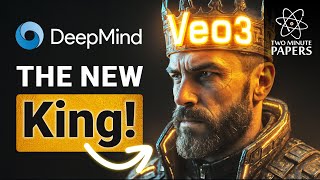
Transcript of a Two Minute Papers YouTube episode by Dr. Caro Zsolnai describing Google DeepMind’s new AI video-generation technique VO3. The speaker highlights VO3’s abilities (scene changes, reference-powered videos, style matching, character consistency, specifying start/end frames, zooming out, adding objects/people, character control, motion markup, and sound synthesis), notes some imperfections in audio, and briefly promotes Lambda GPU cloud usage.
Chapters
This was the state of the art in AI video generation two years ago. And now check this out. Look at what just arrived. But also listen. This ocean, it's a force, a wild, untamed might. And she commands your awe with every breaking light. Oh my goodness. We have a new king. Yes. Google DeepMind just announced their new AI video generation technique. VO3, where you write a small piece of text and out comes a video. And it synthesized the sounds as well. Not only that, but for speech too. Where were you on the night of the bubble bath? Wow. That is one of the hardest things to get right. Because as humans, we are wired to closely watch faces and detect even the slightest emotional cues while someone is speaking. In short, they have really been cooking. This is incredible. But it gets even better because it can do 10 more amazing things. 1. Scene changes. Did you notice that in most of the AI video generators out there, you write a little text prompt and you get one scene but no meaningful changes. Well, not here. These scenes really tell stories. Like a feather getting stuck in a spiderweb. Us meeting the mosquitoes of the future in a futuristic hive. Kidding. Or a paper boat getting lost. All of these come out from one prompt each game changer. 2. Reference powered videos. You take a photo of a character, perhaps yourself, and bam. You are immediately there doing what you specified in the text prompt. With this, you can appear in glorious places you've never been to. Perhaps places that don't even exist. Loving this one. 3. Style matching. To create a video of this amazingly creative origami world, you don't need to do much. Just fold something as a style reference, give it as an image, write a piece of text and you can create a whole feature length movie. 4. Finally, character consistency for video. This is barely solved. Well enough for still images and they did it for complete videos. And you really get the same character or can even create interesting variants of it. My head is still spinning from this. But this is nothing compared to what is coming now. Dear fellow scholars, this is two minute papers with Dr. Caro Zsolnai. 5. Specify the first and the last frame. Start a block of marble or stone. Last frame this griffin. Now little AI, you do the hard part. Everything in between. So can it do it? No way. Right? And wow, this is breathtaking. 6. If you get a scene where you wish to zoom in, that is easy. You just do it yourself. But zooming out, now that's a nearly impossible problem because you would have to synthesize all the missing information. And all this for video. Can it do that? Too. Look at that. It seems perfect to me. I can't even point out a single seam here anywhere. 7. Add an object to an already existing scene, or even a human. And here they really know how to make Karoj happy. Look, indirect illumination is there. That is the colors of the burning torch painting its surroundings. Absolutely beautiful. And eight, Character control. You record a video of yourself, add a target image of the subject and there you go. Now I am a little more excited about this variant. This equation regarding quantum entanglement in birdseed particles is proving rather elusive. Oh yes, making virtual characters come alive. What a time to be alive. Nine, you can also mark up an image with movement directions. And now try to imagine what a good result would look like now. VO3, I am out of words. This is low key. Amazing. Why? Well, it does it exactly as we specified. But the blocks don't collide and the whole scene just makes sense. You could never create a computer program without AI that can pull off anything like this. Now 10 is coming in a moment. In the meantime, I'll note that not even this technique is perfect. The the sounds of this keyboard are still a bit off. And don't forget, not all, but most of these videos have sound too that you can check out through the link in the video description. And 10 the scholars who know. You see, if you watched two minute papers all this time, you knew this was coming. Six years and 600 episodes ago we talked about a paper about an AI system that was able to guess the sound of pixels. Then 10 months ago, Google DeepMind published a follow up work on it as well that we talked about. So all you need to do is watch two minute papers and you will know the future. Bravo. Google DeepMind. And now step number two. We might get fully open solutions that will be able to do similar things. Imagine running this at home for free. I love being alive today. What a time to be alive. Here you see me running the full deep seq AI model through lambda GPU cloud. 671 billion parameters. Running super fast and super reliably. This is insane. I love it and I use it on a regular basis. Lamda provides you with powerful Nvidia GPUs to run your own chatbots and experiments. Seriously? Try it out now at Lambda AI Papers or click the link in the description.