DEEPSEEK to Be BANNED!? OpenAI Just Escalated the AI War!
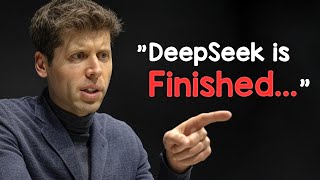
OpenAI is calling for DeepSeek, a Chinese AI lab, to be banned over national security concerns. The video covers the escalating AI industry tensions between OpenAI, Anthropic, and Google over regulation, export controls, and copyright, plus Elon Musk's legal battle with OpenAI.
Questions this video answers
March 15, 2025.
R1.
Claude 3.7 Sonnet.
Leong Wenfeng.
Xi Jinping.
Chapters
OpenAI wants deepseek banned, calling it a national security threat. And now Anthropic and Google are backing that claim too. Meanwhile, Elon Musk's legal battle with OpenAI just escalated, with both sides agreeing to fast track the trial. The AI world isn't just competitive anymore, it's turning into a full blown battlefield. Alright, so OpenAI has really been warning flag about a Chinese AI lab called DeepSeek. They're basically saying Deep Seq might be a direct threat to American, and by extension Western leadership in AI. They went as far as suggesting that US government ban Deepseek's models outright, at least in certain regions that the Biden administration classified as Tier 1 under export restrictions. Now, those restrictions already limit shipping high performance AI chips to China and allied countries. So OpenAI is essentially asking, why not also ban AI models that are built in China? Their argument is that under Chinese data processing laws, any data that passes through a Chinese tech company could be handed over to the government on request. So if an AI model like Deepseek is operating internationally, it raises some major concerns about privacy, security and possibly intellectual property theft. And you can see why OpenAI thinks that's a big deal, especially since they claim Deepseek might have distilled knowledge from OpenAI's own models in the past. Now, it's worth noting there's no direct smoking gun that Deepseek is basically an arm of the Chinese government. Deepseek started as a spin off from a hedge fund called High Flyer, not a state run research institute. But people took notice when Deepseek's founder Leong Wenfeng, met with Chinese President Xi Jinping recently. That's definitely added fuel to speculation that maybe the Chinese state sees Deep Seek as a huge strategic priority. What's even more interesting is that OpenAI has also been talking about how they need basically free reign over copyrighted material in the US or else they're going to lose ground to China. They made a big submission to the government about it, saying if they can't train their models on copyrighted material under something like a broad fair use policy, then Chinese labs, which might have easier access to data, could shoot ahead in the AI race. They're pointing to deepseek again as this sign that China is catching up fast. So the argument goes something like, hey, if you restrict our ability to mine data like books, articles, images, then you're basically tying our hands behind our backs. That could let Chinese models leapfrog us. OpenAI's even said that if they have to navigate super strict customers copyright laws in the US they might end up at a big disadvantage. They reference lawsuits that have already popped up from photo agencies, news outlets and artists who say AI companies are using their stuff without permission. It's not just OpenAI, by the way. Anthropic and Google have both chimed in recently with their own warnings about America's AI lead shrinking. Deep Seek released a model called R1, which has demonstrated some very advanced reasoning. According to anthropic deepseek, R1 even answers borderline malicious questions about, say, biological weaponization. Now, that's obviously a big no no from the standpoint of an AI safety perspective. So Anthropic is worried about the biosecurity implications of advanced AI that might not have the same guardrails as, say, Claude or ChatGPT. Personally, I believe there shouldn't be restrictions, censorship or built in biases in AI systems. AI should be truly open, truly uncensored and free from artificial limitations designed to control narratives or limit access to knowledge. Anthropic's also raising concerns about these Nvidia H20 chips that are still being exported to China. The interesting thing is that they meet certain specs that keep them below the official threshold of performance restricted by the US government. But Anthropic claims they're still really good at text generation, good enough to train large models, so they want immediate regulatory action to kind of close that loophole. Meanwhile, Google's come forward saying we get it, national security is a big concern, but don't strangle innovation with too many export controls. They're advocating for a balanced approach that keeps U.S. providers strong and doesn't hamper their global operations. So we've basically got the big three American AI companies, OpenAI, Anthropic and Google unified in saying we need a robust government plan to keep the US on top. But they differ in exactly how far we should go in restricting exports or limiting data sharing. Anthropics more worried about potential misuse of powerful AI. OpenAI is more about democratic AI beating out authoritarian AI. And Google wants to ensure the business environment stays open. Now, the irony here is that OpenAI's own models are heavily restricted, censored and filled with content filters that dictate what users can and can't do. That doesn't exactly scream democracy. If anything, a truly open and unbiased AI, one that gives users full control without ideological filtering, would align far better with the concept of genuine freedom than the tightly regulated systems OpenAI is pushing as democratic. OpenAI in particular has been calling for some massive expansions in infrastructure as well. They're talking about needing like 50, 50 additional gigawatts of power by 2027 just to train the next generation of Frontier AI models. That's a lot of electricity. And they're urging the federal government to speed up permitting for data centers, new transmission lines, all that Anthropic's on board with that general sentiment too, warning that if the US can't handle the demand, labs might set up shop elsewhere, which in the end could weaken America's AI leadership if this interesting combination of national security meets high level infrastructure planning. All these concerns are being gathered into the AI Action Plan, which the Trump administration requested to keep America ahead in AI. OpenAI's submission pushes this idea of democratic AI versus authoritarian AI, claiming China's deep Seq model is state funded, state controlled and freely available, a combo they say is risky. OpenAI warns that if China's government can manipulate Deepseek, it could pose serious threats like data gathering or even infrastructure sabotage. However, there's absolutely no evidence that Deep Seq is state controlled or state funded. Those claims are purely speculative, with no concrete proof backing them. Then there's the separate drama with Elon Musk. Remember, Elon Musk Co founded OpenAI back in 2015, but later departed and set up XAI. Now Musk is suing OpenAI, accusing them of betraying their original mission by shifting to a for profit model, a move he claims goes against the company's original goal of developing AI for the benefit of humanity, not corporate gain. However, some believe Musk's actions may have more to do with strategic interests than just principle. With his own AI company, Xai, still trying to catch up, disrupting OpenAI's momentum could give his startup a better chance to grow. Musk has also been Openly critical of OpenAI's ties with Microsoft, arguing that such partnerships give them an unfair advantage and risk consolidating too much power over AI development in corporate hands. Meanwhile, OpenAI insists that turning for profit is essential to secure the massive funding needed to stay competitive, like the $6.6 billion they recently raised, with another $40 billion investment from SoftBank reportedly dependent on this structure. Musk even attempted to outmaneuver them with a $97.4 billion takeover bid, which Sam Altman dismissed with a simple no, thank you. With both sides locked in this legal battle, a fast tracked trial is now set to take place, possibly in the autumn. OpenAI's final set of recommendations in their memo is pretty sweeping. They want a single federal set of rules so they don't have to deal with different state level regulations, because that could create patchwork obstacles. They want the government to adopt AI in a big way, like no more outdated fedramp processes or complicated procurement steps. They want an actual partnership with the FEDs, meaning the US government would evaluate and test powerful models for national security risks, all under some new or expanded agency, maybe something like a reimagined AI Safety Institute. And they're definitely not shy about being vocal on stricter export controls, basically saying we should tier our partnerships with countries that share American values and keep the good stuff away from China and its allies. Anthropic is right there with them in spirit, just that they're hammering home the biosecurity angle more. They even admitted that their new model, Claude 3.7 Sonnet is is advanced enough to provide pretty disturbing insights into potential bioweapons. That's obviously not what it's intended for, but it shows how these models can be dual use if the right or wrong questions are asked. At the end of the day, all this is being framed as a massive national security issue. OpenAI's basically declared that the entire AI domain, everything from data centers to chip manufacturing to training sets, should be seen as vital to American dominance. They're not mincing words either. We have to maintain global dominance in AI, they say. And they're pointing to the European AI act as a cautionary tale, calling it an unnecessary hindrance that the US should avoid copying. Google is a bit more open to global frameworks, but obviously they also don't want to be bogged down by tons of red tape. The whole AI landscape right now is a mess. Massive investments, lawsuits, government pressure, copyright debates and energy demands just to keep things running. And on top of that, there's this growing fear about Chinese models like Deepseek closing the gap. Now OpenAI and Anthropic are out there pointing fingers warning that Deepseek could be controlled by the Chinese government. But here's the thing, there's zero proof of that. Meanwhile, OpenAI and Anthropic are doing everything they can to cozy up to the US government, pushing for bans, export controls and basically anything that could slow down competing AI models. It's starting to feel a bit hypocritical, like they're willing to hold back tech progress just to stay on top. Sounds like they are trying to trip the fastest runner instead of training harder. But maybe they should focus on improving their own models. After all, OpenAI's latest GPT 4.5 has been widely seen as a huge disappointment, a major letdown in the AI world. If they spent more time fixing their own product and less time trying to block competitors, they might actually keep their lead the right way. So, yeah, that's the whole story. Let me know what you think down below. Thanks for watching and I'll see you in the next one. Sam.










