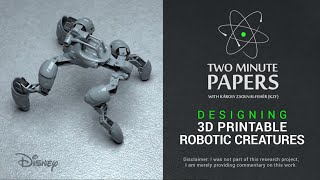
Disney Research built a system that turns simple movement commands into 3D-printable robot designs. You tell it how you want the creature to move, and it automatically figures out the body shape, joints, and leg count. Simulations matched real printed robots made from standard parts.
Chapters
Dear fellow scholars, this is two minute papers with 3D printing is a rapidly progressing research field. One can create colorful patterns that we call textures on different figures with computational hydrographic printing. Just to name one of many recent inventions, we can 3D print teeth, action figures, prosthetics, you name it. Ever thought of how cool it would be to design robots on your computer digitally and simply printing them? Scientists at Disney Research had just made this dream come true. I fondly remember my time working at Disney Research where robots like these were walking about. I remember a specific guy that, well, wasn't really kind and waved at me. It has blocked the path to one of the labs I had to enter. It might have been one of these guys in this project. Disney Research has an incredible atmosphere with so many talented people. It's an absolutely amazing place. So in order to get a robot from A to B, one has to specify scientific attributes like trajectories and angular velocities. But people don't really think in angular velocities. They think in intuitive actions like moving forward, sideways, or even the style of a desired movement. Specifying these things instead would be much more useful. That sounds great and all, but this is a quite difficult task. If one specifies a high level action like walking sideways, then the algorithm has to find out what body parts to move. How, which motors should be turned on and when, which joints to turn, where is the center of pressure, the center of mass, and many other factors have to be taken into consideration. This technique offers a really slick solution to this, where we don't just get a good result, but we can also have our say on what should the order of steps be. And even more, our stylistic suggestions are taken into consideration. One can also change the design of the robot. For instance, different shapes, motor positions and joints can be specified. The authors ran a simulation for these designs and constraints and found them to be in good agreement with reality. This means that whatever you design digitally can be 3D, printed with off the shelf parts and brought to life just as you see them on the screen. The technique supports an arbitrary number of legs and is robust to a number of different robot designs. Amazing is as good of a word.
As I can find.
The kids of the future will be absolutely spoiled with their toys, that's for sure. And I'm perfectly convinced that there will be many other applications and these guys will help us solve problems that are currently absolutely inconceivable for us. Thanks for watching and for your generous support and I'll see you next time.