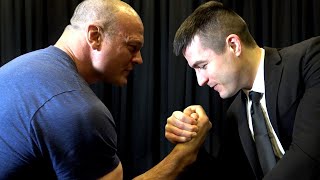
Transcript of a YouTube conversation between Lex Fridman and professional arm wrestler Devon Larratt explaining arm-wrestling fundamentals and techniques. Larratt covers posture and the opening “post,” the top roll and the hook (their mechanics and goals), the controversial “King’s move” (defensive tactic), and common injuries (notably humerus breaks). The tone is instructional, practical, and conversational.
Chapters
Devon Larratt, you son of a bitch.
That's freakin'. What's the matter? MIT got you pushing too many pencils? Alright, you got me.
If I wanted to beat you, what would I do?
Here it starts before we even arm wrestle. It's all postural, really. So if I can make you come to me, this is the first step. Always make me come to you. Exactly. It lets you use more muscles against less muscles. You target weakness. Right. You target my fingertips, you get to use more muscles. So you see this ridge? Very important. The higher up this ridge is in my hand, the better. The more the pressure is in my fingers, as opposed to your fingers, the better.
Right, what are some basics here that you should know?
Okay, maybe we'll start with a move called the post. The post by itself is not that powerful of a move, but it's a fantastic opening. Once you have a post established, the world completely opens up for you. Yeah. The post is very simply an upwards drive of the knuckles.
And it also climbs at the same time.
Yes, exactly. And it's all about generating better angles. That's it. Yeah, you're always trying. Like if you open up your hand, you're always trying to get deeper as well. So you're trying to get deeper and deeper. Climbing up and over both. Yeah, that's it. Advancing that position all the time.
Yeah, so you're always climbing, you're always coming over and.
Yeah, that's the goal. Yeah, always climbing, always improving position. Abc always be climbing. So basically, inside and outside, that'll be our first division. So when we're. When we're arm wrestling outside, basically it's all these pulling motions, pulling, pulling. And to some degree they all attack the fingers. Okay. A standard top roll will look something like this. Start to apply pressure up into the fingers. I'll start to bend my wrist and as I'm bending my wrist, you will be attempting to bend your wrist. And I will block you with something called pronation, which is this turning. And I'll carry through the fingers and I'll take you all the way to the pin pad through the fingertips. It's a fantastic move for beating people. It's one of the best techniques in arm wrestling, the top roll. Most world champions, I would say, I'd say most use top roll. Yeah.
I also seen you compliment somebody that.
You know it's not over here yet. No.
You can hold some of the strongest people in the world like this, and that's you. I think you're complimenting somebody that they were able to do that again.
Yeah. Another way to talk about arm wrestling. So we started to touch on like the top roll, the hook. So a hook is basically wrist flexor driven. Right. So it's more about attacking the person's pronation. So you establish a hook and then you can pull out of it or you make it more of a press and it's more shoulders coming right forward. You're coming right in on the person.
Okay.
So hooking and pressing, all the moves in arm wrestling are similar. Okay. Just subtle differences.
But the roll results in an asymmetric. Like, I'm losing your wing.
Right.
Feels like the hook is where you.
Get to stay in the match a little bit more. You do, yeah. But a good arm wrestler isn't gonna necessarily give you that. You don't see a lot of world class matches where the guy is just pressing. You don't see it.
The controversial Kings move. What is that?
Okay, so the King's move is actually. It's a defensive move. Okay. So the only thing I'm trying to do when I Kings move is I'm trying to attack your arm angle through dragging.
Okay.
And I'm trying to target your fingers through pronation. I'm trying to do all the other things as well, but these are my anchors. Okay. So I'll fight for all the other stuff, but I'll give them away. This is the one that I hold. So I will turn right. And a lot of times there's a dipping. Okay.
So you pulling also. Are you like basically pulling me towards you?
I'll try, but I may not be able to. So normally a king's move is used against a very strong opponent. The King's move is throwing a big wrench.
Yeah.
Into. Into the sport. But there's. This has been happening a lot as the sport evolves. The King's move is here to stay.
Where is it? Where do the injuries come?
Right here. That's the one. The bad one is the break is the break of humerus.
Oh, wow.
Right here. Yeah. So literally break your arm. Cast your frame, man. We are. We're like.
So not a bicep tear. Not.
It can happen. Bicep tears can happen. I'd say that the break is the one.
That little arm break.
Oh, yeah. And when it goes, it's like, yep.
Wow. The strongest arm I've ever felt. And he's not even trying.
I'm very specialized. I'm a super specialized athlete.