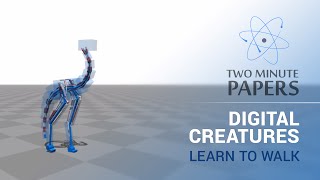
A short YouTube episode (Two Minute Papers) describing a novel algorithm for animating bipedal digital creatures by automatically routing muscles and learning their control. The work focuses on producing physically plausible, stable locomotion across varying target speeds and terrains and emphasizes the difficulty due to high degrees of freedom and sensitivity to small changes.
Chapters
Dear fellow scholars, this is Two Minute Papers with First of all, thanks so much for watching Two Minute Papers. You fellow scholars have been an amazing and supportive audience. We just started, but the series already has a steady following and I'm super excited to see that. It is also great that the helpful and respectful community has formed in the comment section. It's really cool to discuss these results and possibly come up with cool new ideas together in this episode, we're going to set foot in computer animation. Imagine that we have built bipedal creatures in a modeling program. We have the geometry down, but it is not nearly enough to animate them in a way that looks physically plausible. We have to go one step beyond and define the bones and the rooting of muscles inside their bodies if we want them to walk. We also need to specify how these muscles should be controlled during this process. This work presents a novel algorithm that takes many tries to build a new muscle, routing and progressively improving the results. It also deals with the control of all of these muscles. For instance, one quickly needs to discover that the neck muscles cannot move arbitrarily or they will fail to support the head and the whole character will collapse. In a very amusing manner. When talking about things like this, scientists often use the term degrees of freedom to define the number of independent ways a dynamic system can move. Building a system that is stable and uses a minimal amount of energy for locomotion is incredibly challenging. You can see that even the most minuscule change will collapse a system that previously worked perfectly. The fact that we can walk and move around unharmed can be attributed to the unbelievable efficiency of evolution. The difficulty of this problem is further magnified by the fact that many possible body compositions and setups exist, many of which are quite challenging to hold together while moving. And even if we solve this problem, walking at a given target speed is one thing. What about higher target speeds? In this work, the resulting muscle setups can deal with different target speeds, Uneven terrain, And other unpleasant difficulties. Thanks for watching and I'll see you next time.