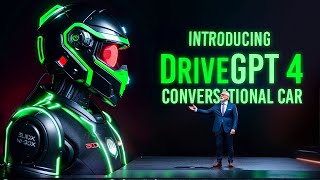
A YouTube explainer by LARRUZ (narrated by Sam) about Drive GPT4, a multimodal large language model applied end-to-end to autonomous driving. Drive GPT4 pairs a vision encoder with an LLM using bidirectional attention so the model can attend to visual features and text. It is trained via visual instruction tuning using machine-generated (GPT-4 produced) synthetic instructions and responses from driving images/videos, enabling it to output low-level driving controls from natural-language commands and to answer questions about its actions and environment. The creators evaluated it on action recognition/detection/anticipation benchmarks and in a driving simulator and real car; the video reports that Drive GPT4 outperformed prior methods and generalized robustly, following complex instructions and answering diverse scene questions.
Chapters
So there is a new AI model that can perform end to end autonomous driving by generating natural language commands for a low level controller, which essentially means that it can drive a car by talking to it. This system can understand and follow any instructions you give it, such as turn left at the next intersection, park near the blue building or avoid the pedestrians. And it can also answer any questions you have about its actions, such as why did you slow down? What is the speed limit here? Or how far are we from our destination? Sounds insane, right? Well, this system is called Drive GPT4 and it's the first of its kind to use a multimodal large language model for end to end autonomous driving. Drive GPT4 is basically a system that combines computer vision and natural language processing to create an interpretable and interactive autonomous driving agent. It uses a multimodal LLM as its brain, which means that it can also process and reason non text data such as images and videos in real time. This is crucial for self driving cars because they need to visually understand everything around them to drive safely. For instance, the car needs to identify traffic signs, lane markings, the condition of the roads and other vehicles or objects around it. Besides, it's also important for the car to have clear communication with its passengers and other drivers on the road. It should be able to explain its actions, give feedback and answer any questions in a natural, understandable way. So how does drive GPT4 achieve this multimodal capability? Well, it uses a vision encoder and an LLM as its main components, which are connected by an attention mechanism that allows them to exchange information bidirectionally. This means that the LLM can attend to the visual features of the input image or video frame. The Vision encoder can attend to the textual features of the input text. This way the system can learn to align the visual and textual modalities and perform multimodal tasks. In order to learn how to manage autonomous driving tasks, the model adopts a method known as visual instruction tuning. This method trains a multimodal LLM using machine generated data which is designed to follow certain instructions. The process involves using a pre existing LLM, for instance GPT4, to create synthetic or artificial instructions and responses using pictures or videos from driving scenes. Take a picture of a street with a traffic light as an example. GPT4 is capable of coming up with an instruction such as Stop at the red light and a response like I stopped at the red light because it's the safer choice and it's in line with traffic regulations. These sets of instructions and responses are then employed to fine tune the MLLM for tasks that involve multiple types of input. With the help of visual instruction tuning, drive GPT4 is trained to manage a variety of autonomous driving tasks from start to finish. What this implies is that it's equipped to directly determine the necessary low level control actions like steering, speeding up and slowing down based on instructions given in natural language and visual cues. Additionally, it has the ability to produce responses in natural language based on visual cues and questions phrased in natural language. To evaluate Dr. GPT4's performance, the researchers used several metrics and datasets. They compared Drive GPT4 with conventional methods and other video understanding MLLMs on tasks such as action recognition, action detection and action anticipation. They also tested drive GPT4 on a real world driving simulator and a real car. The results were impressive. Drive GPT4 outperformed all the other methods on most of the metrics and datasets. It also showed high robustness and generalization ability in different driving environments and scenarios. It was able to follow complex instructions such as take the second exit at the roundabout, merge into the left lane after passing the truck and drive along the coast until you see a lighthouse. It was also able to answer diverse questions such as what is the name of this bridge, how many cars are in front of us, and what is the weather like today? The goal here is to have a car that understands and interacts with you naturally, making self driving both accessible and Safe. And Drive GPT4 has shown the ability to drive a car on its own using only natural language for interaction. This makes the experience of autonomous driving clearer and more enjoyable. Alright, if you enjoyed this video, don't forget to hit the like button, subscribe to my channel and click the Bell icon to stay updated on all my future uploads. Thanks for tuning in and I'll catch you in the next one. Sam.