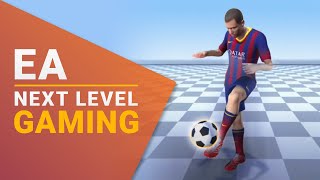
EA's AI learns realistic character animations from motion-capture data, handling fluid movements like juggling while turning, physics-consistent interactions, and adapting to new object shapes without retraining.
Chapters
Dear fellow scholars, this is Two Minute Papers with Dr. Zsolnai. Today you are going to witness how an AI learned to perform these amazing juggling skills, and not only with the ball. And I am very excited for this. Why is that? Well, because I see that this paper was co authored by our friend Sebastian Starke, which means that an amazing paper is almost guaranteed. He was behind this work too, and many other amazing papers. Now, creating a little AI that can learn these kinds of skills seamlessly is immensely difficult. Why? Well, the two hallmarks of a great animation system is that the transitions between movements are great and that no foot sliding happens. And as you see, this previous technique is unfortunately not it. Yet you see this kind of animation in a lot of computer games even today. And unfortunately it gets even worse. Look, the ball does not obey the laws of physics. So it seems that getting quality animations for gaming is absolutely hopeless. So is that it? Well, don't despair quite yet. Now previous techniques required a lot of manual labor in creating these animations and and weaving these animations together. However, today we see more and more AI based systems that can have a look at a big soup of movement data that shows how humans move. Why is that? Well, this is a learning based system, so it has a bit of an understanding of what is happening. So what does this give us? Well, hopefully exactly what we are looking for. It promises a smooth transition from any move into any other move. Well, after seeing these previous results, I don't have very high hopes, so I will believe it when I see it. This is how a previous technique was able to animate this character. Not great. And now hold on to your papers and let's see the new one. Oh wow, just look at that. These animations are indeed fluid. And no matter how we combine these movements together, the AI is able to weave them together into one smooth and believable motion. It makes up these beautiful transitions on the spot without ever having seen them. Now this captured my imagination. So what do experienced fellow scholars like us do here? Of course, we make it harder. Much harder. How? Well, for instance, let's add wind to the mixture, constantly blowing the ball away from the player. Wow, that is unbelievable. Not a problem at all for this new AI. It can adjust to new situations, which is a hallmark of an intelligent algorithm. Love it. But wait, so what is the extent of the new situations that it can generalize to? Let's see. Oh, I love that Turning motions are also possible. It had witnessed people turning around in the training data and it had seen people juggle that Is not a surprise. But what is surprising is that it was able to put the two together seamlessly so it can juggle with while turning. That is absolutely amazing. Now these results are already very impressive, but let's be a little cheeky. So can we ask for even more? Well, you know what? No one said that we are only allowed to juggle a ball. Who said that it has to be a ball? It could be a box. And does it work? My goodness looks, it still works. And it also works with an American football or even. Yes, you are seeing correctly. It even works with toilet paper. So who is better? The AI or Lionel Messi? Well, let's see. Look at that. Haha jokes on you little AI. Team Humanity versus Team Robot one zero. But unfortunately it gets even worse. I am not sure if I should be showing this to you. So are you prepared? Are you sure? I think you are not prepared at all for this. So if you continue the video, it's on you. You have been warned. Ok, go. Ouch. This reminds me of an earlier paper where they wrote up a musculoskeletal simulation system and hamstrung it in a variety of different ways. That is these poor little fox got injuries and they simulated how they would move afterwards. But worry not, after this, simulating surgery and healing them was possible. So after perhaps a similar surgery, when this new AI recovered, it was also able to do three more amazing things that I really didn't expect. One, it can juggle the ball with its chest. Two. Oh yes, this. I love this because this showcases the advantages of a physics based system for the ball movement. It can stop the ball with its foot or three, it can also kick the ball up to varying heights. And to think that it can do all this from just a soup of motion capture data I.e. recorded movement data from real humans. That is incredible. And remember, it had never seen these objects before. Wow. I cannot wait to try the video games of the future where we will be able to control these characters using this paper. What a time to be alive. So what do you think? What would you use this for? Let me know in the comments below.
Weights and Biases provides tools to track your experiments in your deep learning projects. What you see here is their artifacts feature which speeds up the most common machine learning steps like uploading raw data, splitting it into training, validation and test sets and of course the best part, starting to train a neural network. It is used by many prestigious labs including OpenAI, Toyota Research, GitHub and more. And the best part is that weights and Biases is free for all individuals, academics and open source projects. Make sure to Visit them through wnb.com papers or just click the link in the video description and you can get a free demo today. Our thanks to Weights and Biases for their long standing support and for helping us make better videos for you.
Thanks for watching and for your generous support and I'll see you next time.