Economists Just Reveal Surprising New truth about The Future Of Labour
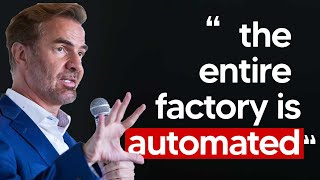
Erik Brynjolfsson discusses how fully automated factories and humanoid robots are reshaping manufacturing and logistics. The video explores what happens to employment as these technologies eliminate traditional jobs across industries.
Questions this video answers
11 production lines.
One smartphone every three seconds.
11 million flagship phones per year.
Around 750,000 robots.
Up to 3,000 pounds.
Chapters
So there was a recent talk at Stanford that has been going absolutely viral on the Internet and many people have had a variety of different takeaways from talk. But there was one statement from the talk that I saw specifically that I think people should be paying attention to when looking at the future of AI and the economy. And that is of course about automated factories. Now I'm going to show you guys this clip and then show you some data to back it up because it kind of changes my perspective on how the future of certain industries trees are going to be.
Yeah. And I think what was interesting like to me as like a labor economist is that was really like a green flag I've seen in like literature and news that okay, if we're on showing all of this chip manufacturing, isn't that going to create some sort of resurgence in blue collar jobs? And I wondered if you had any thoughts about intelligent robotic models or human labor.
I don't think it's going to be much of a. I mean where you guys have visited fab. Anybody? You guys. A few of you have. How many workers were in that fab?
Is that GSMcD?
I don't know.
Yeah, I mean, well, okay, so the answer is zero. Like the reason that they'll let you, they'll let anyone go in because we humans are too like clumsy and dirty and like, you know, we can't. So it's all robotic, it's sealed inside. So there is like work to, you know, bring stuff to them, et cetera. And if a robot like falls over or something goes wrong, they have to put on. You've probably seen these like they look like spacesuits. You know, they have to go in and then they kind of maybe adjust something and then they go back out and hope they didn't break anything. That's. So it's basically lights out. Yeah, I don't think it's. There is some like more sophisticated labor required that I don't think it's like a blue collar resurgence. In fact, one of the reasons that Apple reshored MacBook production to Texas is not because labor is so cheap in Texas or anything, it's that they don't actually require a whole lot of labor anymore. So it's a pretty labor. I think US manufacturing is surging in terms of output, but in terms of employment, it's not really growing all that much.
So what you could see from that clip here was Eric Brian Jolson is a prominent American academic, author and inventor who is known for his extensive work in the field of Information technology technology and its economic implications. Now, he currently directs the Stanford Digital Economy Lab at the Stanford Institute for Human Centered AI. So with his experience, you could say that, you know, he is a figure that can give a decent amount of information when it comes to talking about the future of AI. Now, I think this is remarkably interesting because of course, with the development of the economy and new industries, many leaders and many economic individuals have stated that, look, this is going to create new jobs and certain industries are going to expand. However, what the former might actually be true is that we're in a situation where currently it seems like things are getting more and more streamlined even in physical factories, which is a little bit of a surprise to me because I did think that whilst, yes, of course economic growth, output was going to increase, that at least there would be a lot more manual labor jobs for the time being. But it does seem to be that maybe once again we're being surprised by the capabilities in terms of automation, factory research and design, and essentially for all of that to be automated. And what he's referring to is certain chip fabs and certain factories where you have these factories that are nearly 100% automated. Now, this isn't just speculation, this, this isn't just hearsay. This is actually something that is going on right now at many different factories around the world. And what I do think is quite interesting is that this is potentially the future of factories in our economy. So what you're currently looking at is Xiaomi. And Xiaomi has indeed established an automated factory which is a significant advancement in manufacturing technology. This facility, located in the Changping district of Beijing, is often described as a dark factory or a light out factory due to its capability to operate 247 without human intervention. So essentially, this factory is fully automated with 100% of the key processes being managed by machines. It operates with 11 production lines that are capable of producing one smartphone every three seconds, aiming for an annual production capacity of 11 million flagship phones, including models like the Mix Fold and the Mix Flip. Now, the factory actually utilizes Xiaomi's self developed pengpy intelligent manufacturing platform, which serves as essentially the brain. Now, this platform allows the factory to automatically diagnose equipment issues, optimize process flows and manage operations from raw material procurement and up until product delivery. And the integration of AI enhances product efficiency by identifying and resolving issues in real time. Now, what's crazy about all of this is that the factory's AI system is designed to not only manage current production, but also evolve and optimize its processes over time. The self optimizing capability is a significant leap in manufacturing technology, actually allowing for continuous improvements and without human intervention. And this is something that is remarkable considering the fact of how factories were done before. So you can see right here that this is the factory video that is not one about phones, this video is actually about cars. And you can see that this is becoming an increasing trend for many different companies that wish to scale their efforts beyond human limitations and beyond human capabilities. So it's rather impressive that this is being done at such an impressive scale, because what we can see here is a glimpse into the future of how these factories may be fully autonomous or might just be incorporated. I did think that there was going to be an influx of maybe factories that were going to be utilizing human labor and human capital. But increasingly what we are seeing is that factories are built initially without the need for human oversight. So this is something that I think we should all be aware of, as in certain industries, certain pieces of automation are likely going to be happening a lot more than others. And one of the things that I've seen recently is that this is taking place in a lot more car factories than any other factory. For example, if you do remember the figure 2 demo, this was a robot that has recently begun testing on the BMW production line at the plant in Spartanburg. You can see here that this is the figure two robot. And this is a robot that is able to place certain sheets of metal in the correct places. And you can see that this is 100% autonomous. This is end to end. And it actually has self correcting learned behavior which allows it to fix its mistakes on the fly, just as a human would, even if it managed to make some errors. So it seems like I've said before, that this is seemingly the push the future that many industries are going to be pursuing. Now, another example of this autonomous robot being integrated into the factories is of course the very famous Tesla. You can see here that there was a recent demonstration of the Tesla bot being rather effective at doing certain activities when it comes to placing items inside this case. Now you could also see quite like the figure two robot we saw, the Tesla bot actually manage to fix its issues and diagnose the problems and then continue to move on with its task. Now, Elon Musk does say here that Tesla will have genuinely useful humanoid robots in low production for Tesla internal use next year and hopefully high production for other companies in 2026. But I do want to state that with Elon Musk predictions, we do have to take them with a grain of Salt, because Elon Musk has always advertised dates earlier than they usually happen. So whilst, yes, this might not be the immediate scenario where immediately humanoid robots are deployed into factories and replacing humans, I think this is rather fascinating with as to how manufacturing in the long term is going to change with autonomous factories, especially with the advent of AGI on the horizon within the next decade. And remember, these companies are trying to scale up their robotics efforts by, you know, increasing these numbers of robots. Like it's not just, you know, a few Tesla bots that are going to be built, they're projecting millions and billions of these robots being built. And we do have to also look at how, you know, China is actually building just literally, and no exaggeration here, China is adding robots every single day. Every single day. There is literally a new humanoid robot platform in China that it's very, very hard to keep up with all of those robotics updates. For example, what we can see here is the lineup of humanoid robots from China at the World AI Conference. And this is remarkable because you can see that there are literally 1, 2, 3, 4, 5, 6, 7, 8, 9, 10, 11, 12 humanoid robot platforms there and there are a lot more that have been recently announced. So it's not like there's just one company, there is two company. We also have to remember that with all of these robots, they're all competing for the number one spot and of course they all want contracts with these state of the art companies that are looking to integrate them into their factories. Now there is a debate that I think recently has come garnered a little bit more attention and that is of course the debate of actually, you know, is humanoid robots rather effective? Now let's take a look at another company that has had a different approach because Amazon has been trialing humanoid robots at US warehouses. And Amazon, you know, has basically spoken about freeing employees to better deliver for their customers. And of course, if you know, Amazon has been testing their new robot called Digit, which has arms and legs and, and funnily enough, a union said Amazon has been treating their workers like robots for years. But what we can also see here is some of the surprising stuff it says Amazon's automation is a head first race to job losses. And we've already seen hundreds of jobs disappear to it in fulfillment centers. And as the announcement was made, Amazon said its robotic systems had in fact helped create hundreds of thousands of new jobs within its operation. This includes 700 categories of new job types, but in skilled roles which didn't exist in the company beforehand. So the crazy thing about all of this is that Amazon actively right now has around 750,000 robots working collaboratively with its human staff, often being used to take on highly repetitive tasks. So this is something that Amazon is actively doing. They do have a video in which they showcase the differences between the their current robots and other companies robots. Now the reason I wanted to introduce Amazon's robotics area into this video is because you can gain a firsthand insight into exactly what Amazon is doing. And even if humanoid robots aren't the future for certain factories, I think what you have to understand is that there are also a bunch of huge, huge scale different robots that, that are operating in other factories that are remarkably effective. For example, right here you can see that there are all of these robots behind that are doing the majority of the heavy lifting for Amazon. Of course you can see here there are individuals that are managing the robots and working on different repairs and you know, different areas of course opens up different areas for work. But I think it's kind of fascinating to see how there are many different types of that aren't just captivating the human essence that are non humanoid. That is still remarkably effective. That we can see here. You can see here it says Hercules can lift up to 3,000 pounds and it can travel a distance of 10 football fields. So these robots are definitely going to be coming. And I think a lot of this stuff people do miss because they don't realize that these robots aren't going to be making headlines too. These robots are just going to be automating the back end of a lot of headlines. Heavy tasks that most people don't even realize are going on. For example, I wanted to show you this video by Mercedes Benz using a humanoid robot.
Every day at Mercedes Benz we are advancing towards a future where every innovation, whether it's on wheels or in manufacturing, starts with a bold idea and the pursuit of perfection. To build the most desirable cars. We continually evolve the future. Automotive production, advancements in robotics and AI open up new chances also for us. We are exploring new opportunities also for our production lines with the use of highly automated robotics in manufacturing. This is a new frontier and we want to understand the potential both for robotics and automotive manufacturing.
Now like I said before, whilst yes, there is this question of are they going to be, you know, an increasing amount of jobs in manufacturing in terms of factories? I'm starting to wonder if that is the case considering we have all of these factories being slowly moving towards automation. But there is also a question of are humanoid robots going to fail? Ultimate. Now, as someone who has been in the AI space for quite some time. You can have bias towards these things succeeding and you might not be understanding that these things might be headed down the wrong way. Now let me tell you what I mean by that. Now I saw this tweet yesterday by someone who was actually looking at this demo from Boardwalk Robotics. Essentially this shows a teleoperated robot performing a bunch of different tasks which show us that this humanoid robot, if you know the data and the training does manage to become effective, can eventually be able to do a lot of conventional tasks that are usually done by humans. But it wasn't the video that captivated. There was an argument posed by someone who's working on robotics and it was one that I couldn't really refute. It basically went like this. It says that humanoids are a race to the bottom for a non existent use case. It says hundreds of prototypes, from small startups to big techs. While yes, they are all cool, still no humanoids are doing anything commercially useful or solving any problems that benefit from the humanoid form factor. So I think this is a remarkable argument because I'm starting to wonder if there are actually any use cases that benefit from the humanoid form factor. Now what do I mean by this? I mean in the sense that whilst yes, we saw previously there are robots like Amazon's ones in the factories that move around and do stuff and there are 750,000 of them, but none of them are in this humanoid robot form factor. I mean, traditionally, right now, if we look at humanoid robots, what we do have is a system that doesn't work effectively. Now I do know that yes, in the future these humanoid robots could be used to do many different tasks. But the main question is, is that why the humanoid form factor as it makes things more expensive, it makes them difficult to move and it makes them much more difficult to build. A lot can be achieved with the traditional style robots from the ones that we saw in Amazon's factory, like these kinds of robots, the robots that are doing the pick up and the place ones. And of course the smaller robots that we saw just walking around the robot floor, like the green one that you just saw right there. So there is that question to myself, wondering is there any advantages to actually these robots? But I do think to circle back to the original point of these ghost factories, factories that are going to operate completely without human intervention. I think that in a lot of industries this might be the future, considering the fact that some factories have workplace injuries and some of them are actually quite dangerous. Now if you're wondering about some careers that aren't going to be disappearing in the future. One of them is being the AI specialist. Now, before you're thinking, okay, who on earth made this list? This list was actually made by Bill Gates. So Gates suggests that the AI specialist is one of the most obvious and suggests that professionals trained in AI will not only survive, but thrive in the new job market. Now, with regards to this, what this doesn't mean is that this doesn't mean you need to immediately drop your career and start machine learning. But if you do exist in a career that has complementary fields with AI, you can most certainly look to see how AI can complement your field and and try to become a specialist in your field, no matter what industry it is. Of course, he also talks about an energy industry worker. The energy sector, often overlooked in prevailing technology, is poised for a resurgence. According to Gates, the jobs that will thrive in this industry revolve around the production and management of sustainable, efficient power sources such as solar, wind and nuclear energies. And these sectors will need to pivot and innovate, creating new employment for a generation of workers. And lastly, the healthcare specialist. Healthcare professionals are in high demand today and will be in tomorrow. And healthcare is an inherently human centric field where automation support technologies cannot replace the crucial role of caregivers. An AI will serve as a powerful aid and not a substitute. And Gates sees a future in which technology augments the capabilities of doctors and nurses and therapists, supporting them with diagnosis and treatment to improve patient outcomes. In the end, his insights that are key to job survival in the age of AI is innovation, adaptability and serving an essential human need. So let me know what you think about this video. Do you think that there are going to be completely automated factories in the future? Do you think that this is just a minor marketing trend from these companies? And do you think that humanoid robots actually serve a real use case in these fact? Either way, I wanted to bring this to your attention because it wasn't something that I saw many people talking about, but I do think it's rather fascinating and to see as how the technology evolves with times. If you enjoyed this video, don't forget to subscribe and I'll see you all in the next one.










