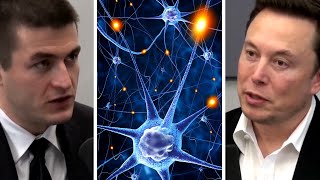
Short conversational excerpt about brain–computer interfaces that contrasts biological neuroplasticity with machine malleability. Speaker A highlights the human brain's plasticity and raises whether a communication protocol will emerge between brains and machines; Speaker B argues machines (neural networks/ML) are far more malleable and will primarily adapt to the brain, though some interface-level plasticity may emerge.
Chapters
On the human side, there's this incredible general malleability plasticity of the human brain. The human brain adapts, adjusts, and so on.
It's not that plastic, to be totally frank.
So there's a firm structure, but nevertheless, there is some plasticity. And the open question is, sort of, if I could ask a broad question, is how much that plasticity can be utilized, sort of on the human side. There's some plasticity in the human brain. And on the machine side, we have neural networks, machine learning, artificial intelligence. It's able to adjust and figure out signals. So there's a mysterious language that we don't perfectly understand that's within the human brain. And then we're trying to understand that language to communicate both directions. So the brain is adjusting a little bit. We don't know how much, and the machine is adjusting where do you see, as they try to sort of reach together, almost like with an alien species, try to find a protocol, communication protocol that works. Where do you see the biggest benefit arriving from? On the machine side or the human side? Do you see both of them working together?
I think the machine side is far more malleable than the biological side by a huge amount. So it will be the machine that adapts to the brain. That's the only thing that's possible. The brain can't adapt that well to the machine. You can't have neurons start to regard an electrode as another neuron, because neurons just. This is like the pulse, and so something else is pulsing. So there is that elasticity in the interface, which we believe is something that can happen. But the vast majority of the malleability will have to be on the machine side.
But it's interesting, when you look at that synaptic plasticity at the interface side, there might be like an emergent plasticity because it's a whole nother. It's not like in the brain. It's a whole nother extension of the brain. But, you know, we might have to redefine what it means to be malleable for the brain. So maybe the brain is able to adjust to external interfaces.
There will be some adjustments to the brain because there's going to be something reading and simulating the brain. And so it will adjust to that thing, but the vast majority of the adjustment will be on the machine side. This is just. If this is just. It has to be that, otherwise it will not work.