Elon Musk - It Will Be Universal High Income
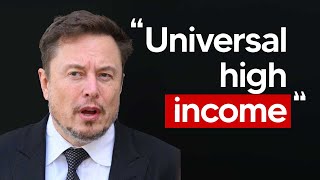
Elon Musk claims AI will deliver universal high income, not basic income. LARRUZ examines this against warnings from AI leaders and policy experts about job losses and inequality, questioning whether waiting for automation to spread before supporting workers makes sense.
Chapters
So this video is going to be discussing something that Elon Musk recently talked about on Twitter. He basically spoke on Twitter about universal basic income and introduced a rather new concept, which is quite confusing because overall it doesn't really make sense. And in this video I might make the argument with as to why Elon Musk's universal high income isn't really a thing at all. So let me know because I know this video might be a little bit controversial, but I think once you at least watch it first, you're going to understand why this does make sense from my point of view and why universal high income isn't really a thing. So Elon Musk tweeted, in the future there will be universal high income, not basic, in a positive AI future, no scarcity, except that which we define to be scarce. In that scenario, everyone can have whatever goods and services they want and it is less clear how we will find meaning in a world where work is less optional. Now, there's a lot to digest here because there is a lot that was said. Of course, one of the first, you know, controversial things is that he said income will be high and not basic in a positive AI future. An article I was reading also discussed this and basically said that just because the income is high doesn't mean that it will actually work. Because there are some fears around universal basic income because some people believe that basic income will be a trap in the sense that the government gives you a basic income because and you'll have no way to work, earn money. Now, this is something that I'm going to get into later, but of course, no scarcity. I do believe that this could potentially happen in the far, far future. But if we take a look at how society is divided up right now, we can see that food is abundant, yet many people do not have enough food to eat all the time and we waste trillions of pounds, dollars of food per year. So this is definitely a hopeful scenario. And I'm not saying that you need to be a doomerist in the sense that you need to think that the future is dystopian, but need to be a realist in how resources might actually be distributed. And of course, yes, I do believe that it is going to be less clear on how we find meaning in a world where work is optional. That is going to be very confusing for many people, including myself. Now, with regards to universal high income, Elon Musk has discussed this on a podcast with UK Prime Minister Rishi Sunak. So I'm going to show you guys this clip here, what would your kind of observation be on AI and the impact on labor markets and people's jobs and how they should feel about that, that as they, they think about this?
Well, I think we are seeing the most disruptive force in history here, you know, where we have for the first time, we will have for the first time something that is smarter than the smartest human. And that, I mean, it's hard to say exactly what that moment is, but, but there will come a point where no job is needed. You can have a job if you want to have a job for sort of personal satisfaction, but the AI will be able to do everything. So I don't know if that makes people comfortable or uncomfortable. It, it's, it's, you know, that's why I say if you wish for a magic genie that gives you any wishes you want and there's no limit, you don't have those three limits, three wish limits nonsense. You just have many, as many wishes as you want. So it's both good and bad. One of the challenges in the future will be how do we find meaning in life if you have a magic genie that can do everything you want. I do think it's hard. When there's new technology, it tends to have usually follow an S curve. In this case we're going to be on the exponential portion of the S curve for a long time. You'll be able to ask for anything. It won't be. We won't have universal basic income, we'll have universal high income. So in some sense it'll be somewhat of a leveler or an equalizer because really I think everyone will have access to this magic genie and you'll be able to ask any question. It'll be certainly be good for education. It'll be the best tutor you could and the most patient tutor said they're all there and there will be no shortage of goods and services will be an age of abundance. I think if I'd recommend people read in banks the banks culture books are probably the best envisioning. In fact not probably. They're definitely by far the best envisioning of an AI future. There's nothing even close. So I'd recommend really recommend banks.
So essentially what Elon Musk is discussing there at the last part, of course he's discussing Ian Banks the Culture series. This is a series of books that actually discusses the post AGI future where resources and things of that nature. Essentially the basis of this article here is basically stating that look believing that UBI needs to Be high fosters a poor understanding of how universal basic income works, which is what I want to try and correct here. UBI is a floor, it's a foundation, and all income is earned on top of it. For example, if your income is now $50,000 a year, then a $15,000 UBI would mean that your income before taxes is bumped up to 65,000 DOL policy year. And I think this is very true. UBI doesn't need to be high, it just needs to be a flaw that essentially just stops poverty. I think that whilst yes, there does need to be some level of inequality, and when I say some, there's a nuance in the sum, meaning that people don't need to literally be struggling to find clothing and food and basic needs. But I do believe that there needs to be an aspect of people that provide these goods and services and are rewarded for that. And this article actually speaks about how, you know, Elon Musk doesn't want people to fear the automation that he intends to solve through and how Elon Musk has expressed repeatedly that he doesn't see UBI as something to do now, but instead only as something to do after a lot of jobs have been automated. However, this article is actually really on point because it's basically stating that what is the point about doing it later when we need to be doing it right now because people are already impacted by AI and robots. This article continues to basically state that UBI is something that we should have gotten going back decades ago, in the 1970s, before computerization took off and these killed wage growth. And if you don't know what I mean by that, think about how back in the day your parents could have easily afforded a house based on one person's salary, and now you need like two people working two jobs in order to afford a simple down payment. And of course, the $50 trillion in the new economic wealth was mostly diverted into the hands of the top 1% of Americans. He continues to state that it's important to understand that between that right now and some unknown future date where technology has increased, unemployment, in a way considered finally sufficient for UBI to be implemented by those like Elon, the impact will continue being what it's always been. Inequality will rise, people like Elon will get much richer, and for those who lose their jobs, they'll find new ones. Some people will find jobs that pay more, but many, potentially most, will find jobs that pay less. And this article, I must agree, is quite aggressive for ubi. He goes on to state here and this is going to be the final point. How does high inequality need to get before it's considered too high? If unemployment never rises to a level considered too high because people are continually able to find new jobs that pay less, then when does someone like Elon say it's time for UBI high or not? Is there a functioning society society for us to exist and we're unemployment at 5% but the majority of the population has jobs that don't sufficiently cost the COVID of living or the spend needed to fuel the economy. What does that society look like? I think that Z society looks exactly like ours. It's already here. We exist in that time with low unemployment and high inequality, largely generated from decades of technological advancement, industrial offshoring and tax cuts for the rich. What I did also find interesting that Canada is supposedly introducing some sort of universal basic income. There was this clip on Twitter where they actually spoke about this to develop.
A guaranteed livable basic income. We are struggling throughout this country with homelessness, food insecurity, poverty, health, mental health issues. And this is one way that we could start to look at these issues. It's not the only way, but it's certainly a key way. And I think we've gathered a great deal of data to show the positive consequences of offering people the opportunity. Half of Canadians are pessimistic about their personal finances. A quarter of low income families cannot pay for monthly expenses.
There was Also this from DeepMind's co founder who warns governments seriously need to find solutions for people who lose their jobs to AI. There's going to be a serious number of losers, warns Mustafa Suleiman who helped found Google's AI lab. If you're unfamiliar with what that is, if you know Google Gemini, the chatbot that is from Google, DeepMind, who were essentially acquired by Google. So you had DeepMind, they got bought by Google and Google, of course now that they're DeepMind, they essentially created these chatbots. The point I'm trying to make here is that Mustafa Suleiman is not just some random AI researcher. This guy is a serious integral part to Google's team or was Google's team. He's now at Microsoft leading the head of the AI division and him ushering such a stark concern, stating that there's going to be a serious number of losers. I would definitely like to see these world leaders. I'm not sure what these guys are talking about. I know that sometimes they always have these AI safety summits. So this is actually my point. From here at these safety summits or at these discussions right here you can see. In fact, you actually can't see. Let me get you guys a bigger image. You can see here Dario Amodei, the CEO of Anthropic, the company that launched the clapbot chatbot Claude. You can see Demis Hassabis, the CEO of Google's DeepMind's lab. You can also see Sam Altman, the CEO of OpenAI. You're not going to get a room with more knowledgeable people in the space of AI. But I think they actually spoke about the wrong thing. You can see here that this is the same image and this is where they talk about potential threats. Whilst, yes, these are things that need to be considered. Why haven't they been discussing about how this is actually going to impact people's future and how there isn't really a safety net for people that lose their careers due to this advance in technology? The only thing that they did say was that the Prime Minister and CEOs are committed to work together to ensure society benefits. Getting the negative effects from this transformation in terms of job loss. Why isn't this something that they are addressing? You can also see here that the UK Prime Minister launches a new AI safety. Explain that. They're firing literally half of their companies because sector workers whose jobs are automated away thanks to the advent of AI and other technologies. So this is something that I think these governments actually need to start thinking about now, because the problem is, is that governments usually wait until the last minute to do something and by then the solution is pretty slapdash. So I would say that these governments actually need to work together with these AI companies in order to essentially make sure that they can delay the release these models. Because of course, like I said before, focusing on AI safety doesn't help the average person. But ensuring that these models are delayed so that society can have the time to actually transition is going to be something that is integral for ensuring people aren't completely screwed over by this technology.
The solution is we need to be better at distributing the fruits of this technology to everybody via something sometimes called a universal basic income, although I don't like that word basic, because it suggests that people will just have a quite a low quality of life. I prefer to think of it as a universal general generous income, not a ubi, but a ugi, because although it may not be very large in absolute terms, it will be enough for us to have a very good quality of life. Why? Because all the things that we'll need, whether it's healthcare or education, whether it's accommodation, food, consumer goods. So many of them will be available at much lower costs than ever before. How thanks to automation, thanks to the improvements in technology so overall, let me.
Know what you thought about this. Do you think universal basic income is going to be enough? Do you think there needs to be a different thing that people need to think about? And do you think universal high income even makes sense? But overall, I do know that these governments need to actually start thinking about this. And because of course governments are going to be I've taken the initiative to start my community which is post AGI preparedness. This is a community where we discuss many of the different things there. It's pretty interesting. So if you'd like to check out the school community, I recently made a 22 page guide on which of the best sectors you want to be investing in companies to actually benefit from the AGI AI revolution. And I made a pretty comprehensive guide on how to actually prepare for AGI and prepare yourself so that you aren't innovated away and you still have a long lasting career in the world of AI.










