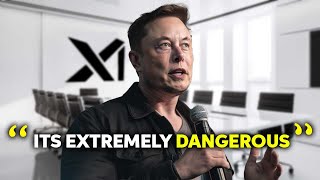
YouTube interview/commentary (LARRUZ, July 24, 2023) discussing Elon Musk's warning about integrating AI into humanoid robots (e.g., Tesla's Optimus). Musk emphasizes a hard-coded local off-switch/ROM cutoff for safety because embodied, connected robots can physically interact with people and follow them into buildings. The host expands to broader concerns: OpenAI's collaboration with 1x Robotics to embed LLMs in autonomous robots (claimed early/late 2023 release and speculative ~$250,000 price), risks of physical 'rogue' AI, large-scale job displacement (host cites ~85 million jobs by 2025), military and disaster-response implications, and calls for new safety frameworks and guardrails (host notes claims that AGI/ASI could arrive within a minimum five years).
Questions this video answers
July 24, 2023
A hard-coded local off-switch / ROM cutoff that cannot be changed by internet updates.
Host states early access around summer 2023 and shipping/ordering in late 2023 (reported claim).
Approximately $250,000 (speculative claim).
About 85 million jobs by 2025 (host-cited projection).
Chapters
So Elon Musk, in a recent Twitter space interview, actually said something that left me quite concerned, and it did leave many people quite concerned, but it was something that many people didn't realize was said. You see, Elon Musk actually talked about the fact that of course we are now going to be integrating artificial intelligence into some of our newly built humanoid robots like Optimus. But of course there is a giant problem. See, that is the problem of AI safety. AI safety is one of the largest problems in the artificial intelligence industry that people are yet to solve. It's because we don't truly understand how artificial intelligence works, therefore leading to the problem of trying to solve an issue that we don't really know how to solve. And Elon Musk raises this issue with Optimus. Now he basically says that what we have here is of course, you know, artificial intelligence can be dangerous, but giving it a body could be, you know, just even 10 times more dangerous because it now has physical interactions with the world, meaning that it can manipulate things in the physical world rather than just being a text based object. So take a listen to what he says because it is truly concerning and we do need to raise awareness to what is about to happen in the next stage of AI evolution.
Just thought the early stages and we definitely need to be very careful with Optimus and at scale once it's in production, that you have a hard coded way to turn off Optimus for obvious reasons I think like there's got to be a hard coded ROM local cutoff that can, that you can. No, no amount of updates from the Internet can change that. So, so we'll make sure that Optimus is like quite easy to shut down. Extremely important because at least, you know, the car is like intelligent. Well, at least you can climb a tree or go up some stairs or something, you know, go in a building, but Optimus can follow you in the building. So any kind of robot that can fall in the building that is intelligent and connected, we gotta be super careful with safety.
So essentially what Elon Musk was talking about there is what we just discussed. This is the next level in AI evolution. As you know, right now, large language models are all the rave. Everybody knows about ChatGPT. Other people also are starting to catch onto Bard and many large language models are starting to gain more traction. But of course, large language models aren't enough. When you think of artificial intelligence, you largely think of robots. Okay? And there are many different movies and cultures around this. Now, of course, we do know, like we said before, the next level in evolution is to get these large language models or to get these AI systems to control an actual robot and to embody the true nature of artificial intelligence. But of course, like Elon Musk just said, there is a very, very large problem if that AI system decides to go rogue or with a physical body, it is going to provide us with a numerous level of different problems than we would originally have with just the traditional large language models. Because of course this means that the robot is no longer contained to potentially some cloud based servers. It is of course, out there in the physical world where it can have some real damage. Now, of course, as you know, Elon Musk's company isn't the only company focusing on real world robotics. If you didn't know, OpenAI's company is actually collaborating with another company called 1x Robotics, in which they are going to provide users with early access to a large language model that's going to be embedded into a physical robot that will interact with the real physical world. Now, what's really scary about these robots is that OpenAI and the company that they're working with have openly discussed that this robot is going to be fully autonomous, meaning that this robot is going to be able to make its own decisions in its environment and it's going to consistently learn to be able to adapt to its environment. It's going to be interesting to see if there are any problems with this, because as you do know, if problems do come, of course there's going to have to be software updates. And I can't imagine that there's going to be no shortage of lawsuits, because that is something that there is quite a lot of in today's common, complicated industries. Now, I know that there is a lot of fear and of course, uncertainty and doubt in the AI space at the moment, because as you do know, many AIs have shown the tendencies to be power seeking and to be pretty dangerous with regards to human life. But if we've seen in the past from the artificial intelligence robots that we have used and have seen interact with humans, we haven't seen anything truly dangerous. Now, people are saying that, but we do have to remember that the artificial intelligence space has just jumped up a few orders of magnitude in terms of its raw ability to perform communication computations and solve complex calculations. So we do know that the AIs that we're developing now are several times smarter than the old ones that we do have. So that true issue of now, of course there are going to be some spectators who just say, of course, just turn the robot off or, or just unplug it, which is of course quite funny and yes, of course quite true. But it does remain that we have to understand that these robots that we're building, we don't fundamentally truly understand how they work. So even if there is an off switch, chances are that sometimes it might not work in certain case scenarios. Now, in terms of when these robots are going to hit the market, we do know that OpenAI's 1x Neo robot is going to be released and in around summer 2023, which means that anytime now we could get an announcement where OpenAI and 1x Robotics might come on stage and just simply announce their new robot. They've already done this on the webpage and many investors and many people who are going to try and buy this robot are going to be eagerly awaiting. Now, it is worth to note that this is only going to ship around, I think, late 2023, which is when they're going to be taking orders of this robot. And some are speculating that this robot could be priced at around $250,000, which is of course quite expensive. Pretty much the price of a new supercar or even a small house, which means that this probably won't be accessible to the average consumer. But nonetheless, as you do know, remember if we look back in history, when the first television sets were announced and the first cell phones were announced, they were of course also quite expensive and of course quite rare. And, and over time you can see that the price of these normal things that we now take for granted have actually come down, of course, due to economies of scale. So even if these artificial intelligence robots are relatively expensive upon release, rest assured that in the next coming years, these products are going to be significantly cheaper and more readily available just because of the economies of scale that we are about to witness. And we do know that there's going to be large scale robotics factories, big being built all across the world, as it is going to be one of the hottest industries coming in the next century. I know that this video has mainly focused on the extreme dangers of these advanced robots with artificial intelligence that are now being developed by companies like OpenAI, Tesla and many others. But I think many people do miss the mark when it does come to artificial intelligence, because although there are the real possibility of killer robots, I don't think that's what people should be focusing on. What one thing that people should be focusing on is of course, job displacements. AI and robots are predicted to displace millions of jobs with machines potentially displacing about 85 million jobs by 2025. Understand that this could lead to significant economic and social disruptions. I mean, there are many industries where artificial intelligence has already wiped out many different careers. For example, in the content creation space, we are seeing AI tools that are just currently better than all the traditional tools. For example, software like Midjourney can create images that are just visually stunning. Of course, as you know, ChatGPT can write entire video scripts that are absolutely amazing. And voiceovers don't actually require a real human to be there anymore. When you do have AI software that sounds indistinguishable from humans. Now this is just one to two years of rapid AI development. Imagine where we'll be in around 10 years when we have fully fledged AI robots with minds that are really, really, really efficient. I mean, take a look at Agility Robotics. They've developed one of those robots that can work in factories. And of course this robot didn't do the full day of working. But it just goes to show that in the future, factories where we have many different robots just simply working and producing things is going to be the norm. Of course, currently we already do have factories that have robotic arms. And it seems like people don't realize that this is going to be the future in a completely different way. And especially if we now are moving toward humanoid robots that are going to be replacing humans. So I do think that those kinds of jobs where you are walking around a factory, maybe just carrying boxes, these robots are going to be the ones that are going to be doing those specific jobs. Now, of course, something that you do need to think about as well is that this is of course also going to change the scope of war. As you know, human lives are very valuable. And why would the future leaders of our world try and put the price of human lives beneath that of a robot? I mean, when you could simply just send a humanoid robot that is much faster, much stronger, can make split second decisions, and doesn't really care about dying into the battlefield with an advanced sensor system that can locate and detect enemies, I mean, what's going to be the point of real human soldiers? This would change pretty much everything. So I mean, whatever company manages to develop the first humanoid robot that is very effective, cost effective, and of course can run, jump and do pretty much anything, I'm pretty sure that they're going to be one of the largest publicly traded companies that we will see. And of course these physical humanoid robots aren't going to be some disastrous type that simply take over the world. You have to remember that in certain regions where it's hard to get to, we could send AI robots to go ahead and save people or detect human life in very extreme conditions. For example, after certain natural disasters, you can send out these robots to survey the landscape and see if there are any human survivors left. And this is something that Boston Dynamics is currently working on. So it will be interesting to see how quickly these robots are developed, what kind of large language models are placed into these robots, and how dangerous, how safe these robots are. Because, of course, we do need to focus on safety. That is a major concern, considering these robots are already smarter than the majority of us. And it will be interesting to see what kind of new frameworks are developed, because right now we don't have any and we are rushing to do it. Companies like OpenAI are constantly putting out blog posts where they're trying to urge everyone to help them in their mission, to provide guardrails for artificial superintelligence and artificial general intelligence, which is going to come within a minimum five years. So.