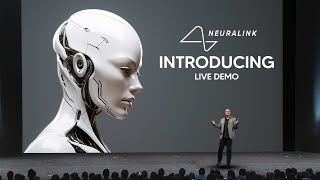
YouTube livestream (March 21, 2024 upload) by LARRUZ covering Neuralink’s public demo where engineer Bliss interviews Nolan Arbaugh, the first public Neuralink user shown controlling a computer cursor and playing games using only his thoughts. Nolan (29) describes becoming a complete quadriplegic after a diving injury (dislocated C4–C5 about eight years prior), explains how attempted/imagined movements map to cursor control, and recounts practical benefits (playing chess and Civilization VI for multi-hour sessions), limits (device charging, pressure-sore management), and medical experience (surgery with next-day hospital release). The piece blends demonstration, personal testimony, and enthusiastic commentary about broader societal implications.
Questions this video answers
29 years old.
Dislocated C4–C5 (complete quadriplegia).
About eight years ago.
About eight hours.
Released from the hospital one day after surgery.
Chapters
So this is by far one of the most impressive technological feats we've seen in the recent years. The company Neuralink has achieved a monumental achievement by allowing the first person to regain control of a device using their Neuralink capabilities. Elon Musk and the Neuralink team recently demonstrated telepathy, controlling a computer, and playing video games just by thinking in this very livestream. This is a monumental feat and is definitely a landmark event that should not be taken lightly. Take a look as they walk you through exactly how this feat was achieved and how the patient is doing.
All right, we should be streaming live here. Hello, world. How's it going out there? My name is Bliss, and I'm an engineer at Neuralink, and I'd like to introduce you to the first ever user of the Neuralink device. And I think you're my only telekinetic friend that I have.
Yeah, I hope so.
Not many more of those out there. You want to introduce yourself?
Yeah. My name is NOLAN Arbaugh. I'm 29 years old. About eight years ago, I was in kind of a freak diving accident and dislocated my C4, C5. So I'm a complete quadriplegic. So I'm paralyzed from below the shoulders. I have no sensation or movement below my level of injury. So below my shoulders. Yeah, that about covers it, right?
Do I introduce some of your dogs here? Let me flip the camera so you guys can see dogs all over the place.
Yeah, that's Montana. The one walking by is Grace.
Gracie. Gracie, come here.
Hi, Grace.
How's it going, Gracie? Yeah. All right.
This is what people doing.
Yeah, they're just here for the dogs. All right. Yeah. So while he's been introducing himself. Let me just flip the camera around so you can see what Nolan's been doing.
Yeah.
Let me come over here. Do you want to explain a little bit what's going on here?
Yeah. So I love playing chess, and so this is one of the things that y' all have enabled me to do something that I wasn't able to really do much the last few years, especially not like this. I had to use, like, a mouth stick and stuff. But now it's all. It's all being done with my brain. If y' all can see the cursor moving around the screen, that's. That's all me, y'. All. It's pretty cool, huh?
Actually, can you pause the song just for the audio coming through? And that was also done with your brain?
Yep. It's all brain power up there.
Can you Explain a little bit just to people who maybe don't have any context on this field or what's going on here. How are you able to actually move the cursor?
Yeah, so we started out with a few. Trying out a few different things. We basically went from what we call kind of differentiating, like imagine movement versus attempted movement. So a lot of what we started out with was attempting to move. So I would attempt to move, say my right hand, left, right, forward, back. And from there I think it just became intuitive for me to start imagining the cursor moving. Basically it was like using the force on the cursor and I could get it to move wherever I wanted. Just stares somewhere in the screen and it would move where I wanted it to, which was such a wild experience.
This guy wants to know if you feel like a wizard.
Yeah, right?
It's.
It's. It's crazy. It really is. It's so cool. I'm so freaking lucky to be a part of this and stuff. I mean, I just. Every day it seems like we're learning new stuff and I just can't even describe how. How cool it is to be able to do this.
Do you want to briefly talk about a little bit? I guess. What have you been using this for outside of these sort of research sessions or when you're just playing chess? What are some other things you've been getting value from this from?
Yeah, so one of the first times y' all gave me complete control over this, I actually stayed up until, geez, I don't know, like 6am Playing Civilization 6. It was. It was worth it, I guess is the best way to put it. It was awesome. I. I had basically given up on playing that game just because of how, I mean, it's a big game and the amount of time that it takes to sit in on it is. It's just a lot. And I have to worry about a lot of things, getting pressure sores and things like that. So I just wasn't really able to play it as much as I wanted to. And y' all gave me the ability to do that again. And I played it for, geez, like eight hours that day. So I do that.
I like 6pm to like 2am it was a lot. I'm giving you all my bad habits, man.
Yeah, I know, right? Yeah, it was awesome. So I did that. I read. I like learning languages. I'm learning like Japanese right now. I'm learning a bit of French maybe.
For the audience who isn't super familiar with assistive technology, why couldn't you play civ before? What was tricky about that? Or what was about the neuralink that made that possible for you?
Yeah, so one of the big things, honestly, was that, oh, I think I just got checkmated. The only way I could play it was through iPad. And that didn't allow me to play online at all. So that kind of sucked to begin with. But I.
Would you play that, like, at 2:00am before? Or what was the rest of the.
Oh, no, there was no way. There was no way for me to do that because when I'm sitting up playing on, say, like, my iPad or something, I need complete help from, say, my, like, parents or something to do it. And I just didn't have that capability to, like, keep them up all night. That's just not something I would ever want to do. So basically, I would have to go down and everyone went to bed in my house. My brother, my parents, something like that. And then on top of that, I can only play for a few hours at a time because, you know, I have to worry about pressure sores and stuff. I have to be readjusted. I have to do weight shifts, things like that. Just things that come in that. Things that come with being a quadriplegic and stuff. So it just wasn't really feasible for me to, like, say, play a full game or anything. And now I can literally just lie in bed and play to my heart's content. Honestly, the biggest restriction at this point was, like, having to wait for the, like, well, wait for the implant to charge once I used all of it. So play for eight hours, have to get off and let it charge for a while, and then hopefully be able to play some more. But it's been awesome. It's been so cool. And I'm kicking ass, too, in this chess game, too. Yeah, well, I don't know if I'm gonna win this chess game, but we'll see.
And then maybe just one final question. Your mom was showing me a bunch of pictures of you in different Halloween costumes over the years. It's something that you go nuts on. So now that you have, like, actual, you know, force control over stuff, I guess that opens up the possibility space there a bit. What are you thinking to dress up as this year?
I mean, something my friends and I have been wanting to do for a while. I think I'm going to be Professor X. I think that's pretty. Pretty fitting, not only because he's in a wheelchair, and I think that just obviously fits perfectly, but now I'm Actually, a telekinetic, basically.
Yeah.
And so it's. It's gonna be cool. It's gonna be real cool. My friends and I are really excited.
You're gonna freak people out when you play trick or treat.
I know, right?
Okay, I think that's. That's it for today. Anything else you want to add before signing off? We got more work to do. A lot to learn about the brain here.
Yeah, I mean, it's not perfect. I would say that they. We have run into some issues. I don't want people to think that it is like, this is the end of the journey. There's still a lot of work to be done, but it has already changed my life. And I think that people who are thinking about saying, applying for the human trials or are thinking about, you know, finding some way to help out with this to, you know, do your part, that's the reason I got into it, was because I just wanted the help. I wanted to be a part of something that I feel like is going to change the world. I think, like, there's nothing to be afraid of with that. The surgery was super easy. I literally was released from the hospital a day later. I have no, like, cognitive impairments. Well, I guess none that were caused by the surgery.
I beat you in chest, like, once.
So.
Yeah, yeah, yeah, I. I have. I do have a pretty good record right now as far as just like. Yeah. But, yeah, I just think that it's really awesome. And I want to thank Neuralink for doing this, for working hard every day to make this, you know, a reality. I think that they are going to change the world, be a part of it. So thanks, guys. And I'm looking forward to releasing some of this.
Yeah. So I guess we're going to end here, but, yeah, we're going to plan to release more in the coming days. So if you want to stay in touch with what's going on here and hear more from Nolan and his work, just. Yeah. Follow along here on Twitter. Thank you, everyone.
See y' all later.
So what do you all think about Neuralink? Do you think this is going to be the start of a technologically abundant age where certain health issues and certain disabilities are no more than a simple common cold? As in, they're going to be as easily treatable as a common cold. And that would usher in a new golden age for health, life and longevity, leaving many people just to focus on creating and, of course, working in their futures. Now, I think this is one of the most important things to be working on because I think certain things that have previously been roadblocks for the medical field now being opened up, especially with new innovative technology and different techniques, show us that the future really is very unpredictable and we really don't know what we're going to be in the 10 to 15 year range. So I want to see what you guys think about this. I think this is a monumental achievement. I also said, like I said before, I think this is truly a landmark achievement that shouldn't be underestimated at all. Because if we've seen anything in the last year that last two to three years, especially with AI, with biotech, with the research that's going on into longevity research, I do think that the next 10 to 20 years are going to be extraordinarily fascinating, especially considering all of the predictions around the year 2030, 2029. So with that being said, let me know what you thought about this video. I thought that this was just absolutely incredible. Elon Musk's team has done something amazing here and I can't wait for widespread rollout of this. And of course, I'm hoping that there are no issues with this at all because those who actually do need this kind of technology, I'm sure they're going to appreciate it a lot.