Elon Musk’s SHOCKING Move to BUY OpenAI for 100 Billion!
Elon Musk offered $97.4 billion to buy the nonprofit controlling OpenAI, escalating a public feud with Sam Altman. The dispute centers on OpenAI's unusual nonprofit-for-profit structure, Musk's legal attacks, and competing AI ventures like his Xai company and the $500B Stargate infrastructure plan.
Chapters
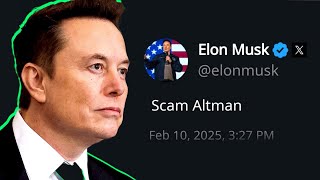
Elon Musk just dropped a $97.4 billion bombshell on OpenAI, trying to take full control of the company behind ChatGPT. But Sam Altman laughed it off and hit back with a sarcastic counteroffer to buy Twitter for a fraction of what Musk paid for it. Then Musk fired back, calling Altman a swindler and scam Altman blasting him all over X. This isn't just a corporate deal. It's a full blown war. Lawsuits, social media jabs, secret boardroom moves, and a $500 billion AI project that could change everything. Musk says OpenAI betrayed its mission and wants to drag it back to open source ideals. Altman, on the other hand, is pushing forward at full speed, turning OpenAI into one of the most valuable companies on the planet. So what's really going on here? Is this about AI ethics, insane power struggles, or just another Musk takeover attempt? Let's break down everything you need to know because this is one of the biggest battles in tech history. So let's set the stage. OpenAI was originally co founded by Elon Musk and Sam Altman all the way back in 2015. At the time it was a non profit dedicated to advancing AI for the benefit of humanity. Meaning they wanted to keep things transparent, share research openly and avoid letting corporate profits drive the development of artificial intelligence. Fast forward a few years and Musk leaves the organization officially around 2018 or 2019 depending on the source. And Sam Altman becomes the face of OpenAI. Then came the launch of ChatGPT in late 2022, which really put OpenAI on the global map. Now let's talk money. Big money. Recently, a consortium of investors led by Elon Musk put Forward a massive offer. US$97.4 billion. Some outlets have rounded it up to a full 100 billion. To buy out OpenAI or more specifically the nonprofit entity that controls OpenAI's for arm spin arm. Musk's lawyer Mark Tobaroff confirmed they sent that offer over to the OpenAI board and they even said they'd be willing to match or exceed any higher bid. That's a jaw dropping amount of cash, especially when you consider that just last year OpenAI was valued at around $157 billion and more recent estimates say it might balloon to 300 billion if a major new fundraising deal with SoftBank goes through. SoftBank, by the way, is rumored to be interested in investing up to $40 billion in OpenAI, along with a few other investors piling on which would almost double or triple its valuation from just a few months ago. But get this, Sam Altman isn't having it. He responded on X, formerly known as Twitter, saying no thank you, but we will buy Twitter for $9,740,000,000 if you want. If you're doing the math, that's just about 1/10 the amount Elon paid for Twitter back in 2022 when he dropped a cool $44 billion on it. Elon responded, calling Altman a swindler, which, you know, definitely isn't subtle. He even posted or shared an old video of Altman in front of Congress, captioning it scam Altman. So yeah, these guys are basically going at each other in front of the entire Internet and the memes are flying everywhere. But let's dig deeper into the reasons behind all this drama. When OpenAI first started, it was strictly a non profit. But Sam Altman and others soon realized it would take a colossal amount of funding to train the best AI models like GPT and keep up with other AI powerhouses. So OpenAI formed this unusual structure where a nonprofit still exists, but it has ultimate control over a for profit subsidiary. This for per arm can accept giant investments, which is how they secured billions from Microsoft and others. But the nonprofit board is in charge of the overall mission. It can, in theory, even fire the CEO, as we saw happen in late 2023 when the board let Altman go, only for him to return five days later amid public outcry and intense negotiations. Elon Musk, meanwhile, is claiming that OpenAI has strayed from its original mission. He argues they went from open source and safety first to becoming more like a conventional profit driven startup. He even filed a lawsuit last August accusing Altman, Greg Brockman and OpenAI of ditching the nonprofit ideals in favor of making money. Musk's legal team said it was a textbook tale of altruism versus greed. Guess what? Musk also formed his own AI company called Xai in 2023, which he basically wants to use to compete head on with ChatGPT and other generative AI systems. So if Musk acquires OpenAI now, it'll be more like he's eliminating the biggest rival in one giant swoop. Or as some folks are speculating, maybe he'd merge OpenAI with XAI and and create the single biggest AI company on earth. According to some legal experts, what's super complicated here is that the nonprofit board that controls OpenAI has a legal obligation to ensure that if it sells or transfers any of its assets, it's got to be for a fair market value. If Musk is offering nearly 100 billion, that may set the bar extremely high. So even if OpenAI wants to break free from the non profit arrangement, the board might have to justify why they'd sell for less, say, if some internal deal valued the controlling nonprofit stake at less than 97.4 billion. Lawyers say regulators in states like Delaware and California, where OpenAI is incorporated and headquartered, are probably going to watch this very closely. Meanwhile, OpenAI is also tied into something called the Stargate project, which aims to pour $500 billion into AI infrastructure in the U.S. this was announced alongside big names like SoftBank, Oracle, and even references to an Emirati sovereign wealth fund in a Japanese investment firm. Former President Donald Trump endorsed the project, calling it the biggest AI infrastructure plan in history. Elon Musk publicly doubted whether they actually had the funds to pull it off. Then Sam Altman fired back, saying that Musk should come check out the site if he's so skeptical, and basically implied that Musk's own business interests might not align with what's best for the country. Speaking of Trump, there is also a weird subplot about TikTok. A while back, some people speculated Musk might want to buy TikTok, especially when the government was making noises about banning or forcing a sale of ByteDance's short video platform in the U.S. musk shot that down, saying he's not interested, that he doesn't personally use TikTok, and and that he really doesn't just buy companies unless it's a pretty unusual exception, as he claimed with Twitter. Now, what about the lawsuits? We've got to keep track of a couple. Musk did sue OpenAI last year, but apparently he dropped it once some internal emails revealed that Musk had originally been okay with the for permission model up until it became clear he wouldn't control OpenAI outright. Separately, the New York Times sued OpenAI and and Microsoft over alleged copyright infringement in building AI models with news articles that's still ongoing. And on top of that, Musk's legal team is also emphasizing that if OpenAI wants to fully pivot into being a standard for profit company, it needs to compensate the nonprofit charity fairly, because otherwise it'd basically be taking public assets and turning them into private assets without paying the real price. It's truly a tangled web. The new $40 billion funding rumored from SoftBank would value OpenAI at $300 billion, making it one of the most valuable private companies in the world, right up there with SpaceX and ByteDance Musk's 97.4 billion offer might be a tactic to either scuttle that valuation, slow down the process or or jack up the cost so high that OpenAI can't conveniently buy out the nonprofit board. Some observers think Musk just wants to hold up the deal so Sam Altman and co are forced to spend more money or time sorting out the nonprofit structure. Altman has tried to reassure everyone that a single individual can't take over OpenAI because of its corporate structure. He's also suggested that Musk's moves are simply a tactic to weaken us because of our success. He says they're not going to bow to pressure from Musk, especially now that ChatGPT has grown so popular and the company is forging major partnerships like the one with Microsoft. We also know that Musk is extremely outspoken about the need for AI safety and open sourcing, whereas Altman is leaning toward building advanced AI quickly while still having some safety guardrails in place. At one point, the nonprofit board literally fired Altman Cyber, citing a loss of confidence in his ability to keep development in line with the whole benefit of humanity promise. That caused a massive internal uproar at OpenAI, with employees threatening to leave en masse. Altman was eventually reinstated, showing he has huge support among staff, major investors and the broader public. This revolving door drama laid bare how unusual the structure is where a non profit board holds ultimate control but the majority of employees are part of a for pernicious entity. What happens next? Well, we'll have to see if OpenAI's board takes Musk's $97,400,000,000 offer seriously or just ignores it. Maybe it'll spark a bidding war if someone else steps in to try and buy OpenAI, though that sounds insane at these valuations. Meanwhile, Altman's snappy response about buying Twitter for $9,740,000,000 suggests he and Musk won't be hashing this out quietly anytime soon. The big question is whether this conflict will disrupt OpenAI's day to day progress or if it'll just be an entertaining sideshow while developers keep rolling out new features for ChatGPT and other AI products. Personally, I can't wait to see how this plays out. Will Musk push through and restore OpenAI to a more open source and non profit approach? Will Sam Altman's team maintain control and complete their rumored $40 billion fundraising with SoftBank with or even aim for that $300 billion valuation? And what about the $500 billion Stargate project that's supposed to revolutionize AI infrastructure in America. It's definitely a lot to take in, but one thing's for sure, we're witnessing a pivotal moment in tech history. The outcome could shape not just OpenAI, but the broader AI landscape worldwide. Let me know in the comments how you think this will all pan out. Are you Team Musk, Team Altman? Or are you just here for the popcorn? Thanks for tuning in, folks. If you enjoyed this deep dive, don't forget to smash that like button and subscribe for more updates on this ongoing showdown. I'll catch you in the next one.










