Elon Musks Teslabot Just Had A Massive UPDATE (Teslabot Gen-2 Update)
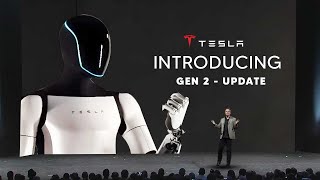
This YouTube commentary (by LARRUZ, Jan 16, 2024) reviews a recent Tesla Optimus Gen-2 demo — notably Elon Musk's tweeted clip "Optimus folds a shirt" — and clarifies that the demo was teleoperated (Musk: "Optimus cannot yet do this autonomously") while framing it as useful data collection to train future autonomous behaviors. The video places the demo in context with Optimus development milestones (Bumblebee Sep 2022; Gen-1 Mar 2023; Gen-2 Dec 2023) and compares Tesla’s approach to other robotics work (Figure’s coffee demo, Google/Stanford's Mobile Aloha, and Shanghai’s Kepler). It emphasizes dexterity, bipedal balance, and the role of teleoperation in gathering diverse training data toward generalization and autonomy.
Questions this video answers
"Optimus folds a shirt."
"Important note. Optimus cannot yet do this autonomously."
Bumblebee: September 2022; Optimus Generation 1: March 2023; Optimus Generation 2: December 2023.
Chapters
So teslaleon Musk have just given us a real sneak peek at their new Tesla bot update. And this actually does come as a surprise, as recently we were introduced to Generation 2 of the Tesla bot, which did show remarkably good skills, remarkably good dexterity, and a huge set of upgrades compared to generation one. So let's get straight into what this means for the company and why this is fascinating from a robotics standpoint. So recently Elon Musk's on his Twitter account, he tweeted that Optimus folds a shirt. And this tweet definitely didn't break Twitter because that would be a bit crazy, but it did spark a very interesting discussion with, as to what robotics is going to be doing in 2024. So essentially you can see here that this is the Tesla Bot Generation 2, and a Tesla's factory seemingly folding a a shirt. And of course, there are some things and some nuances that need to be discussed because there is a lot going on behind the scenes here that many people don't understand. So of course, while this is very, very impressive, and it does show us just how good the Tesla bot is if it is able to do certain things with its hands, one of the things that you do need to know and one of the things that Elon Musk actually did state was the fact that that this is actually tele operated. So Elon Musk added a tweet stating that important note. Optimus cannot yet do this autonomously, but certainly will be able to do this fully autonomously and in an arbitrary environment, which essentially mean that it won't require a fixed table with a box that only has one shirt. And this tweet definitely did stir some of the people who are speculating and spectating on this space, because some people do see the tweet of the robot folding the shirt and of course they immediately would assume that it is completely autonomous and able to do this at scale. But upon further inspection, some people do feel that they've been deceived, when in reality this isn't the case. This is actually pretty normal if you actually look at the robotic space. And the thing with teleoperation is that it's always usually disclosed. Now, the reason that it's so fascinating for the Tesla bot is because what we do get to see here is we actually get to see how, how effective the Tesla bot is at moving its arms and performing delicate tasks that would largely require hands to do. And we do get to see how fast this thing can move, if it's able to be done. Now, what's also fascinating that you shouldn't ignore is the fact that he did say it can't do it autonomously, but certainly will be able to do it autonomously and in an arbitrary environment. Now I think that is something that many people did miss because whilst many robot demonstrations are rather impressive, the. The only thing that isn't impressive about some of them is the fact that there's usually a very standard setup. So for example, there's usually certain markers on the table, there might be a mug, there might be something big where the robot knows exactly where to move its arms and essentially perform in the demo. Well, which essentially can raise more interest in whatever it is that is going on. Now, what's important to note here is that one thing that I did see that was not fascinating, but is expected is that some people are missing the mark on what this actually means. So a frequent tweet that I did see that was posted was a machine can already do that at 50 times the speed and 90x or 95% less than the cost. And essentially this was accompanied by many different robots that are folding clothes. And people are saying that this is like replacing horses with mechanical steeds instead of cars. And I think that people are missing the entire point of this, the entire point of the Tesla bot, the entire point of Optimus is not to just do singular tasks. It's to be able to do pretty much anything that an actual person can do essentially more effectively and to be cheaper and more efficient than an actual person having to do those mundane tasks. And this exploration, even if it is teleoperated, which essentially just means that some someone else is controlling it. And those of you that might not see it during the video, you can actually see that there are points where you can see that there's a human operator's hand on the right hand side come over to show you that. But like I said, people are missing the point here. It's not the fact that yes, there are other individual narrow robotic systems that can perform folding laundry very, very more efficiently, but the point here is that we're able to see the development of this robot. And I mean, hopefully in the future we're going to be able to see this robot do a lot more than folding laundry. And we've definitely already seen that because I saw way too many tweets saying that this is, you know, not good, yada yada yada, it's not that great of a development. But like I said, it does show us what is capable with this actual robot. And of course There has been some competition heating up. So essentially there was a tweet from the Optimus Tesla bot engineering at Tesla, someone called Milan Kovac, and essentially he said increasingly complex tasks, tasks through teleoperation, to essentially verify that our current hardware has the dexterity to do those tasks, collect the data needed to train end to end neural nets to do it autonomously, just like with the colored blocks sorting and unsorting that we've shown last year, and of course accumulate enough data diversity to generalize faster. And who wouldn't help, and who wouldn't welcome help with folding clothes? So essentially right there he's stating the point like, you know, a lot of people just got confused, like what is the point of this? Yada, yada, yada, but essentially it makes sense because what we have here is a system that we now know can do certain things. And of course this is all just data collection and is going to be able to get data diversity to generalize faster. So I think this is very, very good research. And like I said, people are missing the mark here because if we did look at what Tesla was doing last year, we can see this right here, which was very, very impressive because this was completely autonomous. And remember, this was just from not even Generation one. This was pretty much like the Bumblebee version, if you don't know what the different versions are. I will show you a quick thing right here. So this is the different screenshots of all the different versions. So we got Bumblebee, which is September 2022, Optimus Generation 1 in March 2023, and Optimus Generation 2 in December 2023. Definitely moving very, very quick. But back to this point, the point is that being able to do this with adversarial disturbance, with this and sorting these blocks autonomously. And I think it was on board with vision, so it says its neural net runs entirely on board. Using only vision is definitely a large step in the right direction with what we want to see from Tesla. And like it says, it does so with dealing with the dynamic reality of our world. So certain things aren't autonomous, but we know that eventually we will get there. And it's important to understand that, that the systems that we do have can actually do the tasks that we do want them to do in the future. And today with the folding laundry, although it might not seem like a big step, every small step does equate to more and more gains across the entire balance. And of course we can see here that these Tesla bots, the balancing is definitely something that is rather Impressive, because even though this balancing right here might not seem that impressive, it might seem like a pre coded thing. Something about these robots and walking bipedally is very, very difficult. Robotics trying to get these robots to, you know, run around and move, you know, in a way that is actually not only human, but actually does work is very, very difficult. So previously, Tesla didn't actually, you know, they weren't actually able to do this very effectively. You could see. And one thing that was pointed out in one of the videos that I was watching was that even in this earlier demo, the Tesla bots, you know, walking, they were actually just previously hooked up to the railings there. And which is why we saw these swingings of the rope right there, whatever it was, the harness. And it goes to show that robotics is definitely really, really hard, especially with what Tesla is trying to do. But they've made some really, really impressive progress. Now that's not to say that there are other companies out there that aren't also working on this stuff too. So, for example, this person tweeted, the robot wars are here and the score is 1:1. We have the robot making coffee, which is the figure robot from figure. And of course we have folding a shirt via Tesla Optimus. And how long till one of these things can read Ikea instructions and assemble furniture? And we'll get back to that statement right there because trust me, there's a robot that is rather fascinating at that point. So essentially right here, what we have is the bigger robot. And this was something, if you aren't familiar with it, I'm not sure if I discussed this before, but this was a robot that recently gave its demo on how it was able to learn how to make coffee simply by just watching humans do it. And essentially right here you can, you can see that it was able to grab this and this was all fully autonomous. Place this into the area right here, the designated area, close this and then of course, press on the button. Once again, this demo was also under some criticism for its ability to, you know, do a very simple task. But like I said, that's not the point of these demos. I think one of the main things that many people did even miss from this demo, which was rather fascinating too, was was the fact that this one was able to learn to self correct its mistakes. And like I said, this is something that is really big because any robot can really do, you know, a preset routine, but being able to identify the fact that you've made a mistake and then self correcting, I think that was one of the major, major things. And even this tweet did actually point it out. So he said that the split screen, where it is struggling to get the pod into the slot in two unique ways, but overcoming was the impressive part. And well said. It did strike me that it clearly not only understood the objective, but devised seemingly natural ways to resolve it. And of course, we do have the CEO of this robotics company stating some things here. And he said, why is this so important? The reason why this is so groundbreaking is that if you can get human data for an application, for example, making coffee, folding laundry, warehouse work, example, you can then train an AI system end to end on figure one. And there is a path to scale every use case. And when the fleet expands further, data is collected from the robot fleet retrained and the robot achieves even better performance. So overall, whether it be competition from figure, whether it be Tesla bots and Optimus, that is going to be moving forward on vast use cases, I think we are definitely in a very good area because these robots are showing us that they're moving very, very quickly. And this year is likely to be one of the biggest years. Now, if you haven't been paying attention, then you may have actually also missed Mobile Aloha. So even though teleoperation is something that is rather big, you have to understand that autonomous, you know, abilities are still very much pretty good. So this was an autonomous demo for Mobile Aloha. There was a full video on this. It was some impressive stuff conducted out of Google Research and Stanford University, and they were able to get a robot, some through teleoperation, but some that were completely autonomous, to cook shrimp, to fold laundry, and to do a whole host of different tasks. And this was a real, real leap up from what we've seen before. But like I said before, this does show us that when we truly understand the capabilities and the limitations of these robots, we can then understand where the autonomous capabilities are, are going to be in the future. And of course, within the next 12 months, what are things going to look like? Because, boy, oh boy, it shows us that not every single robot is going down the same road. We might get some robots that work around the house that look like this, and of course, we might get some other ones that look more like the Tesla bot, that look like this. So it's rather fascinating to see where this is going to go now in the next 12 months. There was also one company that flew under the radar that might be be competition to the Tesla bot. So this is Kepler, and this is a robot that is coming out of Shanghai. So this seems like China's poster boy for what the competition to the Tesla bot could potentially be. And so far, based on this entire demo, it looks to be rather, rather effective at doing certain things. There will be a full video on this robot because it is remarkably impressive and it shows us that the competition around the globe is, is rather this, especially since we've seen multiple companies popping up in terms of what they're able to do with their robots. So overall, what do you think about the Tesla bot? Do you think that this was a really small demo? Do you think that it was not that impressive? I personally am excited for the future of this demonstration. I think it was really cool. I think it shows us what is capable in the future. And although it was teleoperated stated by Elon Musk, I do think that in the future, along with the competition that is going to be coming, we will have some other scenarios where we're going to be seeing robots making ridiculous breakthroughs.










