Emilio Frazzoli, CTO, nuTonomy - MIT Self-Driving Cars
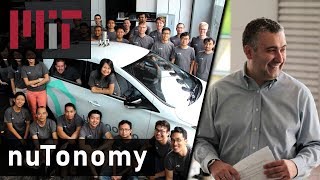
Emilio Frazzoli, CTO of nuTonomy and MIT roboticist, argues that self-driving cars only deliver real value through vehicle sharing, not just driverless commutes. He dismisses partial automation as dangerous because humans fail at supervision, and says full autonomy without human takeover is the only way to realize the technology's benefits.
Questions this video answers
15 years (first as a graduate student, then as faculty).
2009.
About $9 million.
About $300 billion per year.
About $600 billion per year.
Chapters
Today we have Emilia Frazzoli. He's the CTO of Nutonomy, one of the most successful autonomous vehicle companies in the world. He's the inventor of the RRT Star algorithm, formerly a professor at mit, directing research group that put the first autonomous vehicles on road in Singapore. And now he returns to MIT to talk with us. Give him a warm welcome.
Thank you, Lex. It's a great opportunity. It's a great pleasure to be back here. I spent 15 years of my life here at MIT. First as a graduate student and then as a faculty, as a faculty member. And this is where Newtonomy, the company essentially was born. And we did a lot of the research that led us to, to start this company and eventually develop all this technology. What I will talk about today is a little bit about our vision on autonomous vehicles, why we want to have autonomous vehicles, some of the guidelines on the technology development, why we are doing things in a certain way. Let's get started. I really would like to tell you a number of stories about why I started doing this and why I think this is an important technology, why we ended up starting this company. So I've been a faculty member here for 10 years and I was happily working with my UAVs and I was in Aeroastro. At some point around 2005, there was these dark background challenges that sounded cool, so I started working on cards as well. But that work that I was doing was mostly I was working on airplanes and cars to make them fly or drive by themselves because it was cool. Just look, no hands. It drives as a controls guys, roboticist. That's all I needed. But then in 2009, there was this new project that was starting the team that was getting together to write a proposal for a project on future urban mobility in Singapore. Okay. Not telling you the whole story, but essentially I got interested in that project just because I wanted to go to Singapore. Okay. And then I, you know, then I called the person who was putting together the team and okay, thank you for your interest. But you know, what do you think that you bring to the table? And you know, we had just done the Dar Horban Challenge, so. Well, you know, I know how to make autonomous cars. So what? This is a project on future urban mobility. So what do cars have to do with urban mobility? Autonomous cars? What would they have to do with urban mobility? There was the phone call, the five minute phone call that changed my life because she asked me this question. That actually was Cindy Barnard, who is now the Chancellor. And then I had to come up with an excuse. So why? Well, imagine they have a smartphone and then a smartphone app, and then you use this app to call a car. The car comes to you, you get on the car, drive wherever you go, want to go step off the car and the car goes to pick up somebody else and goes to park or something. So this was 2009, Uber was Travis Karanick and a couple of guys, black cars in San Francisco. And essentially she bought it. So I joined the team and, and we started this activity. But the important thing is that I started thinking about there was something, an excuse that I made up in those five minutes. But then I said, you know what? Kind of sounds like a good idea. I started thinking more about this and I started thinking more about why do we want to have self driving vehicles? So the number one reason that you typically hear is we want to have self driving vehicles so that we make roads safer. Okay? A very large number of people die on the road, road accidents every year. What people do not realize is that most of those people are actually fairly young, like in their 20s and 30s. Okay? And clearly what people usually say is that Sebastian Troon back in the day, he gave all these TED talks talking about his best friend from when he was young who died in a road accident. And then he made a mission for his life to reduce road accidents. Anyway, the idea is that most of the road accidents are due to human errors. You remove the human, you remove the errors and then you save lives. This is typically the number one reason that people mention when they talk about why you want to have self driving vehicles. Second reason is convenience. Essentially, if the car is driving by itself, you can do other things. You can sleep, you can read, you can text legally to your heart's content, you can check your email, so on and so forth. This is also great. Third thing is improved access to mobility. People who are cannot drive, maybe because they have some physical impairment, or maybe they are too young, they are too old or maybe too intoxicated to drive, so then the computer can take them home. Another thing is increased efficiency throughput in a city as cars can communicate beyond visual range, for example. Another one is reduced environmental impact. Now these are all fantastic reasons why we may want to have self driving vehicles. The problem with me is that if you think about this, these are all good reasons, but these are all ways that you take the status quo, how cars are used today and you make it a little bit better, maybe a lot better, but you do not make it different. Really. That is what I was mostly interested in can we, you know, use this technology, leverage this technology to change the way that we think of mobility? Okay, so how do you compare all these different things? Okay, so this is, you know, quick back of the envelope kind of calculation that you can do. You know, on your own. You can question the numbers, but I think that the orders of magnitude are right. Okay. The first thing is, okay, so fine. We heard that a big reason for self driving cars is to increase safety, save lives. Great. Now how much is your life worth? Well, to yourself, to your loved ones, your friends, your family is probably priceless. To the government it's worth about $9 million. So this is what is called the cost of a statistical life. There was a report that was released a few years ago, probably there is an update now, but I haven't seen it. The economic cost of road accidents in the United States is evaluated to be about $300 billion a year. The societal harm of road accidents is another. All the pain and suffering is evaluated to be another $600 billion a year. So what we are getting to is about almost $1 trillion. Okay, it's a big number, but let's look at where the other effects are. What is the cost of congestion is an estimate $100 billion a year. The health cost of congestion, of the extra pollution, so another $50 billion a year. So you see that these are just a small change. The next effect is actually important. So what is the value of the as everybody in society will get back from not having to drive? Simple calculation. What I did is I multiplied one half the median wage of workers in the United States, which is an embarrassingly low number, multiplied by the number of hours that Americans spend behind the wheel. What you get is about, what was it, $1.2 trillion a year. Something that you may notice is that the value to society of getting the time back from having to drive is actually more than the value to society of increased safety. Of course it's a little bit cynical, so take it with a grain of salt and a grain of salt, but you start seeing how these things compare. What you may notice from this pie chart is that there is still half of that is missing. What is the other half? The other half is actually the value that you provide to society, to all individuals by essentially making car sharing finally something that is convenient to use, affordable, reliable. So for me, car sharing or vehicle sharing in general is a concept that everybody loves, but nobody uses or not as many people as we would like to use this kind of services. Examples, when I was here at mit, I really like using hubway, the bicycle shedding. But you had to be very careful. If you wait too long in the afternoon, sorry, there are no more bikes on campus. Or maybe very often you cannot find a bike, or maybe you cannot find a parking spot for your bike. So then you had to buy somewhere else and then walk. So that defeats the purpose of using that bike. Same thing with cars. So typically with car sharing systems, what you have is either you have a two way, which is essentially hourly rental, or you have a one way but in one way system, then the distribution of cars tend to get skewed. And unless the company repositions cars in some clever way, then you're not guaranteed that you will get a car where you need it. And you're not guaranteed that you will get a parking spot when you don't need the car anymore. If you think of that, these are both like friction points for using vehicle sharing. And these are both friction points that are actually addressed by if the car can drive itself. So if you bring in all the economic benefits of a car sharing system that actually works, that's something that we estimated to be is about $2 trillion a year. So you see that this actually has a big chunk in this pie chart and that is using an estimate of what we call the sharing factor of four, meaning that one of these shared vehicles can essentially substitute for four. In privately owned vehicles, there are some studies that get to this sharing factor up to 10. And of course the benefits are even more. Now every time I see a round number like that, I get suspicious. Ten is a little bit too convenient to be true. But anyway, so that's something that you can find in the literature. So this is really where I think that the major impact of autonomous driving or self driving cars will come from. Now I think that also there is a lot of confusion in the community, in the world about what a self driving car means. Now what I'm doing here, I just listed these five levels, actually six levels of automation. These are the Society of Automotive Engineers levels. So level zero is not automation. That's your great grandfather's car driver assistance Level one. There is for example cruise control or some simple single channel automation, partial automation. You have something like for example lane keeping and cruise control, but you still require the driver to pay attention and intervene. Conditional automation, Level 3 driver is a necessity. It's not required to pay attention all the time, but needs to be able to intervene, given some notice. Okay. And that some losses I think is ill defined concept. Then you have level four, level five that are like a high automation, essentially no driver needed in some condition that is level four, and in all conditions that level five. Now, my first reaction when I started seeing these levels, and there is also a similar version by Nitsan, is that this seemed to me a horrible idea. And the horrible idea in the sense, because they are given numeric levels. So you have level 0, 1, 2, 3, 5. Whenever you have a sequence of numbers, you're led to believe that these are actually sequential, that you do level 0, then you do level 1, then you do level 2, 3, 4, 5. I think this is an enormously bad idea because I think that level two and level three, that is anything where you require the human to pay attention and supervise the automation and be ready to intervene with no notice or with some ambiguously defined sufficiently long notice that just go against human nature. This is especially painful for me as a former aeronautics and astronautics professor, where we saw in the airline industry that as soon as autopilots were being introduced and everybody thought that accidents would go down. Actually there were more accidents because now you have new failure modes induced by autopilots. You have mode confusion. Pilots lose situational awareness. Pilots lose the ability to react in case of an emergency. Okay? So the headline industry had to essentially educate itself on how to deal with automation in a good way. And think of pilots are highly trained professionals, which is not the same that you can say about your everyday driver. So how do you train people who probably the last time they sat with an instructor in a car was when they were 16. How do you train people to use the automation technology and do it safely? So I think that this is something that I find very scary. On the other hand, I think that the full automation, when the car is essentially able to drive itself, does not rely on a human to take over. Is something that in a sense is easier. This is what we are doing. But the point is that not only it is easier, but I think that is essential to capture the value of the technology. Now, if you think of it, so how do we realize the value of these self driving vehicles? Okay, so the first thing that people say is safety. I think it is true that event.










