Expert Panel: Optimizing BizOps with AI
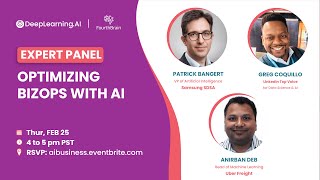
Patrick Bangert, Anirban Deb, and Greg Cucilo discuss how Samsung, Uber Freight, and Amazon use AI for recommendations, inventory planning, and logistics. They advise startups to start small, get data quality right, and build data literacy before jumping to complex models.
Chapters
Sam.
Hi everyone and welcome. My name is Sandhya Simhan. I'm the Director of Marketing and Communications here at deeplearning AI. Welcome to our expert panel Optimizing Biz Ops with AI. This event is presented to you by deeplearning AI and fourthbrain. Fourthbrain is a company that creates accessible and flexible pathways to AI careers by training candidates with valuable, practical and interesting interpersonal skills. You can learn more about their programs on their website, FourthBrain AI. Now, we all know that AI has significantly improved business efficiency and productivity. So whether you're an AI practitioner or a business leader, you really always have to be considering what are the feasible use cases of AI in your business? How can AI improve the efficiency of your business? And how can you leverage the power of AI to scale your business? So to answer these questions, we've assembled a panel of AI leaders today to share their visions and thoughts. You can find the list of topics we'll be covering if you scroll down to check out the event description. Afterwards, we'll be taking events from the community via Slido. If you've signed up for the Slido ticket, please check your email for the access link to post and upvote questions there. And now, without further ado, let's welcome our panelists today. They are Patrick Bangert, VP of AI of Samsung SDS Greg Cucilo, LinkedIn top voice for data science and AI, and Anirban Deb, Head of Data science and Machine Learning for Uber Freight. So for the next 40 minutes or so, I'll be asking some questions to our panelists and while I'll probably direct questions to a specific person, I'd like to also encourage any of you on our panel to jump in and offer your input in the conversation. So let's go ahead and get started. So I think one of the first topics that came up when we started to even think about this panel was really understanding how AI fits into organizational structures these days, because that often impacts how AI teams and machine learning engineers and data scientists are really interacting with the rest of their community. Oh, I'm so sorry. But before we begin to that, I'll ask everyone to introduce themselves really briefly. Patrick, do you want to go ahead and get us started?
Yeah. Hi everyone, my name is Patrick and I'm the VP for AI at Samsung SDS where I head up a department to produce software to make AI, as well as a consulting department to create the model. So we support the full workflow and we do that for Samsung Group as well as third parties Cool.
Anirba.
Hello everyone, my name is Anirbandev and I head up the data science and machine learning at Uber Freight. Been almost like five years with Uber. Almost all of you are familiar with Uber. We are in the, my group is supporting the logistics division which is trucking and you know, responsible for all pricing, recommendation, matching, prediction and all sort of algorithms. And we're using AI to disrupt the logistics marketplace.
Awesome. And then Greg.
Thank you. Hi guys, thank you for having me. My name is Greg Kokio and I currently work for Amazon and in the past two years I've been on this journey to learn AI self taught person here and with that I've been very active on LinkedIn and fortunately I had this award to be named as one of the LinkedIn top words for AI and data science. Was able to grow a nice community and I'm happy to be here. My goal is to continue to learn and share with the community and showcase the power of AI and how can integrate just about any industry. So I'm happy to be here. Thank you.
Awesome. And Greg, we're big fans of self directed learners here at Deep Learning. So excited to see someone in that type of a path. Like I was saying before, one of the biggest ways that impacts how AI teams and machine learning engineers and data scientists and data analysts really work with their, the rest of their organizations is really how the organizational structure works. So I was wondering if you guys could chat about how your organization or others that you've seen how they interact, how the AI teams are structured. Patrick, do you want to take that one?
Yeah. Thank you. Within Samsung Group we have multiple AI teams that focus on different use cases. Of course, if you're familiar with our range of products that includes a large number of consumer electronics that have models on them. So you might have a facial recognition to give you access to your phone if you want to talk to your phone and have it do things as a Bixby system to do that. So there are multiple AI systems at work to do image processing, natural language processing, time series, forecasting, that's user facing. But internally to the organization we of course have multiple models at work that have to do with the retail and wholesale aspect of the products. To for example forecast when will certain units be sold at certain stores at certain times in the future. Then there is the supply chain to make sure that sufficient number of units arrive at those stores just in time in order to be to able sold. So you find uses for AI basically throughout the business, both internal and the external leasing product so AI is an absolutely integral part of Samsung Group, but it is, I think, also an integral part of virtually any sophisticated corporation these days. Under the heading of future of work, you will find on the Internet many, many use cases of how the daily life of anybody who is doing a job will change or will be impacted by some AI system somewhere. And of course, we know our personal life has been affected by Netflix telling us what to watch at night. So you find yourself surrounded by AI systems and the biggest job is of the AI system is to become invisible. Right. It's just supposed to be useful, but not supposed to tell you, hey, I'm the AI system and I'm doing this great thing for you. It's just supposed to do it. And so all of us encounter AI maybe 10 or 20 times a day without even knowing it. So it's integral to the structure.
No, definitely makes sense. I was wondering. So today's topic is mostly focused around business operations and that optimization that's available or enabled by AI. Greg, could you give us a few cases that you've seen that are particularly interesting across the industry?
I think what we've seen in the industry lately, whether it's a retail company selling online or a manufacturing company, they're able to leverage that tool to have better accuracy in their inventory planning, their delivery planning, optimizing event trucking in terms of space, as long as they have the computational power to manipulate data and extract insights. If you are a company like Netflix, you have the state of the art recommendation systems. We're all, to Patrick's point, we all live in a world where AI is everywhere. And that's really the point of it. AI is not there to tell you, hey, I'm here to recommend a new movie or a new show to you, but it's all around. Whether we shop online or watch a TV show online, or receive a package at home from an online business, it's there to make our lives better. But in the meantime, in the process, you have the company also being effective in saving money in that space. Leveraging AI.
Yeah, no, it's really interesting you say that. DeepLearning AI is part of an ecosystem of companies. And one of our sister companies, if you will, is AI Fund. So it's a venture capital firm and one of the portfolio companies for that fund focuses on maritime logistics. So Behring AI does a ton of work to bring an industry that's kind of been outdated for some time and is kind of operating on logistics and tools and software for the last few decades. And is bringing this ton of innovation to help people kind of, you know, how can we not just, how can we not just like, you know, make things go faster but like how can we reduce fuel usage and you know, all sorts of really interesting applications that didn't even occur when they first started out. So. No, no, I definitely agree. Like there's lots of these cases that just kind of pop up as you're doing the work and that's always a really interesting aspect working with machine learning. So that's, you know obviously there's big corporations doing big fancy work, right? Like Netflixes of the world and you all work for pretty large organizations that are AI driven and have access to large amounts of data but for our audience who are working in startups or other small businesses, where do you think that they can get an insight using AI but you know, using relatively small data set? You know, is there a practical approach in implementing AI with limited resources that still helps you create operational efficiency? Anirban, I'd love to hear your thoughts on this.
Yeah my experience and advice would be basically three things I would say first of all, start with a very simplistic approach, narrow down your scope as much as you can. AI has to be like a lot of times when you are starting with AI, especially in a very small organization or in a startup, you really don't know the value of it, right? But you would learn in the process not only you might be convinced but you need to convince others, you need to convince your customers. So I would say from your use case, start small, start small narrowing down what use case you want to apply AI for whether it's delivery, whether it's NNP solution, creating a chatbot, how there is an OCR kind of computer vision, document scanning but narrow down the scope. The second thing is as you are looking into AI, let's not jump into the wagon saying that everybody is doing AI so let me do AI. AI actually is a very wide range. It ranges from sophisticated air traffic control, NASA landing into Mars. It goes all the way and goes very basic like you probably have just a prediction, right? So it's a huge range subject. So when you start with AI, make sure that you have enough data. You have enough data because if you don't have enough data a human probably can do better job. Honestly a human can do better job if you don't have too much data than a machine can, right? Because finally machine actually can only be work when you have a lot of data. So the second thing would be to make sure you start with the data. Third thing is when you are a data scientist or a machine learning engineers, start with very naive methods. Don't start with complex, don't start with deep learning. That is not the starting point. You should generally go for, you know, go for. Of course there are some solutions like computer vision or NLP that you have to go for. But even then you probably can start with basic, you know, algorithms that are, you know, well there and then create a baseline saying that whether it's, you know, making any difference in your accuracy metric. And then once you have that, then you start. So create a baseline with a snave method and then from there start to improve.
As a non technical person, I'd love if you could help explain to the beginners in our audience what are some examples of some of these basic algorithmic techniques.
Yeah, so for example, like if you're working with general classical AI cases, maybe you can start with logistic regression, for example, if it's a classification problem or start with decision tree regression like XGBoost, things like that. If it is like, you know, simple NLP based techniques, then, you know, start with very simple neural nets. If it's a time series problem, maybe starts with something like Arima before we go into more new RNN kind of structure. So basically what I'm saying is that see where your opportunities are to use classical machine learning, which I categorize as supervised non supervised learning kind of methods. You know, within that those are classical methods. Then you go to more black boxy methods which are deep learning based and stuff like that. So don't start with deep learning because you are passionate about that. You know, start about something that are simple, can be solved using classical methods. Then slowly push yourself into deep learning as you see gain in one after another.
Got it? No, that makes complete sense. Start with the foundations. Patrick or Greg, is there anything that you guys would like to share about, you know, the practical approaching to implementing AI when you have limited resources?
Yeah, so just real quick, I think a number of really major innovations have been made by a single person with a laptop. So you don't need to have a large team or large computing resources to leverage AI to do something good and useful. And the second thing is that of course years ago the word big data was coined and everybody uses that to some extent as a synonym for artificial intelligence. And there's a kind of a trend to collect bigger and bigger data sets. If you read the literature, there's, there's kind of a competition that is along the lines of, hey, My data set is bigger than your data set. Right. So the, the upshot of it is that currently there's a fairly significant research topic in artificial intelligence which is called small data. Coming from the realization that there are quite a few use cases where it's either very expensive or just plain not possible to generate a larger data set.
It is what it is or unethical at times. If you're dealing with healthcare data.
Oh, if it's unethical, then you may not even have data. Then it may not be a problem for AI. It may be a problem for something else.
Society.
Yeah, right. But learning, you know, in learning what you can from a very small data set is a, is a challenging task and there are many methods available nowadays and they're being researched actively. Oftentimes you can get away with a much smaller data set than you think and get the same accuracy. Yeah, yeah, really good point to channel.
Anir Bhavan and Patrick, I want to say definitely start small. One thing that I don't hear people talk enough is about culture. How do we make sure as a startup you have a culture where your employees have some data literacy? Starting small simply means do you have a workforce that is capable of performing the basic analytics to understand the power of your data, to understand how to extract? A small project for me could be a simple dashboard. Building a dashboard with key metrics that really matter to you and your customers. Do that and automate this. Another thing too is as a startup, can you start making an assessment in terms of what infrastructure you have today and what you will need five, ten years from now? So with that, this assessment will give you a guidance for how you can scale from starting with small data to a company that will grow to be a big one, that will have the infrastructure to support its needs.
That's a really interesting perspective, the idea that you sort of figure out what are the questions I want to be able to answer in five years. So what's the data I need to collect now so that I can answer those questions in five years? Now that's really, that's a really interesting thought. Andrew talks a lot, usually informal chats about the importance of not just big data, but, you know, good data. So we probably need to get him to do like a talk on that sometimes. But I really appreciate what you said about data literacy. It's something that we see a lot obviously in the education space of just helping people understand what is AI, what is machine learning, but then also just simple things like what's regression models and things like that. Too. So there's definitely a place for data literacy that we really need to step up as an industry. So very cool. And that brings me to the next question which is when you're building that talent, when you're building that competency and data literacy in your organization, what are some challenges that you faced? Anirban, you'd mentioned earlier that you'd had one, a great example of this, you.
Know, and I think it's a nice, you know, probably reference to the previous question. You know one thing I think Patrick talked about small data, big data, whatever you use, big, small, medium. I think one important thing is data quality, right? I think a lot of people don't take it very seriously, right? Like a lot of companies I have worked with don't invest that much, you know, resources on data engineering, right? But a model is as bad as a bad data is, right? You put a most sophisticated model against the bad data, it will give you the bad data, right? That's why it's not human. It's not going to make decision. If the data is telling it's a bad decision, it's not going to change that decision. So I think, you know, one of the challenges that we feel that culturally to Greg's point, not a lot of people understand the value of data. They think like okay, oh, data quality means oh, there is five null values, okay, that's fine, I can fix five null values. But just investing into upstream like when especially early companies or bigger companies when they really need to invest data infrastructure, data engineering, making sure high quality data is captured big or small before you do oi I think it's the biggest, one of the big challenges in the companies, that's one thing, they jump into the solution. But we need to understand that AI is a solution to the future. But you need basic foundations to have that solution work. That is one of the challenge I want to call out good data quality and investing in that capacity. Second thing is I think also a lot of times I have seen the problems of where AI can be applied is not very clear. Especially true when you talk about non technical leadership, right. I think it's our job as a data science leader or a data scientist to understand what problem are you trying to solve? Not really. Forget about what technique you will use to solve it. But is this a problem? Like for example, are we trying to in our case, you know, we want to optimize delivery, right? Like you know, Uber is all about optimizing and matching delivery. So what is the problem? The problem there is that you Know if you do sequential delivery, it is going to take you full day to order five orders. But if you optimize to machine learning, we want to do 50 delivery. So that's the problem you want to go after and then build AI solution once you define the problem. So not a lot, a lot of times I've seen people jump into the solution first before actually formulating the problem properly, which is a challenging task.
Really, really important. You have to scope out the problem that you're trying to solve before you try to jump into solutions. Excellent advice, Patrick or Greg, anything you guys would like to add to that?
Yes, I would add to that. AI as such in and of itself has no value. Value is obtained by people using AI to do something. And so you're facing two big communication challenges. The first communication challenge is the data scientists have to be able to communicate to non data scientists. What is this AI, what's it good for? How does it work and need to learn from the world, what is the problem that I'm solving? The second, we often call it change management. That is persuading the potential user base that this thing is going to be good for you. Designing the user interface, which may be as simple minded as a few graphics and a few boxes to click on in such a way that the users actually look at the graphics and click on the buttons. And I've seen that out of 10 AI projects, nine will fail. And they won't fail because the math is bad, but they will fail because the packaging and the communication is bad. So if you're talking about talent acquisition, I kind of take it for granted that people can do the math and the algorithms and if they can't, we can train them up. It's not a big deal. Everybody can learn to do math. But learning to communicate well in verbal speech, in writing and in the all important language of PowerPoint slides, that's a lot harder.
Yes, no, that's a really good point, Greg, you seem to want to add something to that.
Yeah, yeah, absolutely. Communication is definitely key. And to summarize it all to me, what I'm learning is that we can find pain points quite easily. Right? We can say that whether you're on the tech side or non tech side, you can find pain points. What's missing from what I'm seeing is that we kind of jump from you identified the pain point to the technical solution to that pain point and in between is what I call the program. How does that mechanism works? If you have the group aligning on what that program looks like to Patrick's point, this change management should be reflected in that new program. Then you come up with that technical solution and figure out how does that technical solution, how can that technical solution integrate that program to make it work? Without this program where you have alignment between technical and non technical, everything else fails. This is where the communication will be ruptured.
Yeah, no, that's a really good point. Sometimes we talk about translating some of our courses into translating from engineer to English, but can't forget the language of PowerPoint. That's a really valuable skill set in and of itself too. So maybe engineering to English to PowerPoint. So one of the big things that we're seeing is 2020 obviously accelerated a lot of AI adoption and just digital transformation in lot of companies and industries. I'd love to hear you guys talk a little bit about, you know, are you about what you see forward in 21? Are you seeing a big increase in the number of AI professionals? Like what are, what are the type of skills that you're looking for besides fantastic communication skills that, you know, you're like, hey, it would be great if more people had X capacity or X skill set. Patrick, do you want to take this slide?
Sure. So I think there's a lot of emphasis in terms of job descriptions on various programming languages like Python and various environments like PyTorch or TensorFlow or something like that. And that's kind of table stakes, if you will. And even if an individual doesn't have those skills or doesn't have great skills at those things, it's pretty easy to acquire. What I find a lot more interesting is experience in handling data and data sets. So in AI, it's the focus on the data that's a lot more important than the focus on the AI algorithms. Everybody likes to do algorithms, but there are these tool sets that will basically do it for you, right? You spend five minutes on PyTorch and you have a model. If your data is okay, the model will be okay. If your data is bad, the model will be bad. So if you learn more about the domain of where the data came from, how to tease out the right features, how to choose the features that are informative about the situation and the general thought processes that go into selecting the right model, selecting the right hyper parameters to train it, and so on, then you will be a lot better. So the skill set I'm looking for is not so much I know these 20 languages and so on, but more like I've been around the block and I've solved these Sort of five data challenges and I've come up with a reasonable model that I find to be valuable.
Really good, really, really good points. Gregor Anirban.
For me, what I'm seeing here is or is needed is a little bit more effort on the non tech side to take on what Patrick just said, which is being able to manipulate data and even navigate through data sets. I'm super interested in the trend where you'll see a lot more product managers now will have the minimum requirements in terms of knowledge of machine learning and how they can leverage that to deliver new features in their products or transform their products into machine learning based products that can increase the user experience or tackle new pain points for their customers. With that, I think this basic understanding of these knowledge or these skills will also increase communication between business teams and technical teams. So this is the space that I'm really interested in. I definitely want to be a product manager at some point, if not become an entrepreneur later on. But this is where I see that I can collaborate with technical teams who are interested in coming up with the state of the art algorithms that can take data and extract insights from.
Fantastic points. So for our next question, there's obviously a lot of enthusiasm about AI, but sometimes there's also folks who are pretty skeptical. So for aspiring machine learning practitioners who are working with a boss that might be skeptical about AI, it could be lack of impact assessment, a variety of reasons. What's the best strategy to get buy in? How do you show a proof of concept to execs when oftentimes, you know, you need investment and infrastructure ahead of time. Anirban, do you want to take that one?
Sure. I would first say that skepticism is really important, you know, and especially important for anyone in a data world. You should be always skeptical and curious and that's how you become a good, you know, AI practitioner or data practitioner. If your boss, you know, is already skeptical, he's probably halfway there. He just, you know, get to the technical skills and other part of it. So it's not bad. And I think in terms of convincing people see the thing is action speaks, right? It's the investment, right? You know, companies investing, it's a culture change, you know, it's a mindset change, you know, it's there is sometimes even in fear, right? We always hear, oh my God, are robots coming to take our work? You know, robots going to replace humans, right? So people are afraid and people are skeptical and things like that. I think the main point that we need to focus on is what's the you know, there are two things I have learned that, you know, generally helpful. One is showing, like a impact. Like what? What are you actually improving by doing this? You know, is it a business impact or is it an automation impact? You know, are you trying to make certain, you know, work process efficient? That means if a human does it, it will take five hours. If you do an AI, you know, it's probably more efficient and they can do more job done in this less amount of time. Is that that impact, or is it like, you know, a financial impact, like, it is going to drive profit for you, your company? So I think that part we need to be clear and how to get there. And the second thing is a vote of confidence about.










