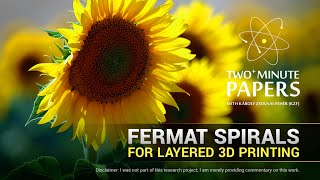
Fermat spirals, the same pattern found in sunflower seeds, can improve 3D printing. Using them to layer infill makes prints faster, stronger, and smoother than standard methods.
Chapters
Dear fellow scholars, this is two minute papers with what are Hilbert curves? Hilbert curves are repeating lines that are used to fill a square. Such curves so far have enjoyed applications like drawing zigzag patterns to prevent biting in our tail in a snake game. Or jokes aside, it is also useful in for instance, choosing the right pixels to start tracing rays of light in light simulations, or to create good strategies in assigning numbers to different computers in a network. These numbers, by the way we call IP addresses. These are just a few examples and they show quite well how a seemingly innocuous mathematical structure can see applications in the most mind bending ways imaginable. So here's one more. Actually two more. Fermit's spiral is essentially a long line as a collection of low curvature spirals. These are generated by a remarkably simple mathematical expression. And we can also observe such shapes in Mother Nature, for instance in a sunflower. And the most natural question emerges in the head of every seasoned fellow. Why is that? Why would nature be following mathematics or anything to do with what Fermat wrote on a piece of paper once? It has only been relatively recently shown that as the seeds are growing in the sunflower, they exert forces on each other, therefore they cannot be arranged in an arbitrary way. We can write up the mathematical equations to look for a way to maximize the concentration of growth hormones within the plant to make it as resilient as possible. In the meantime, this forced exertion constraint has to be taken into consideration. If we solve this equation with blood, sweat and tears, we may experience some moments of great peril. But it will be all washed away by the beautiful sight of this arrangement. This is exactly what we see in nature, and which happens to be almost exactly the same as a mind bendingly simple ferment spiral pattern. Words fail me to describe how amazing it is that Mother Nature is essentially able to find these solutions by herself. Really cool, isn't it? If our mind wasn't blown enough yet, Fermit spirals can also be used to approximate a number of different shapes with the added constraint that we start from a given point, take an enormously long journey of low curvature shapes and get back to almost exactly where we started. This again sounds like an innocuous little game evoking ill concealed laughter in the audience as it is presented by as excited as underpaid mathematicians. However, as always, this is not the case at all. Researchers have found that if we get a 3D printing machine and create a layered material exactly like this, the surface will have a higher degree of fairness be quicker to print and will be generally of higher quality than other possible shapes. If we think about it, if we wish to print a prescribed object like this cat we there is a stupendously large number of ways to fill this space with curves that eventually form a cat and if we do it with ferment spirals it will yield the highest quality print one can do at this point in time. In the paper this is demonstrated for a number of shapes of varying complexities and this is what research is all about, finding interesting connections between different fields that are not only beautiful but also enrich our everyday lives with useful inventions. In the meantime, we have reached our first milestone on Patreon and I am really grateful to you fellow scholars who are really passionate about supporting the show. We are growing at an extremely rapid pace and I am really excited to make even more episodes about these amazing research works. Thanks for watching and for your generous support and I'll see you next time.