Fire Physics Was Broken. Not Anymore
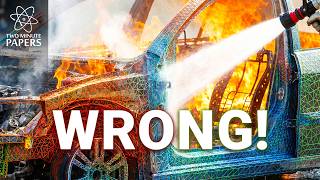
A new fire simulation method couples fire grids with water particles, finally letting them interact realistically. It models steam generation, fire extinction, and soot deposits using the Arrhenius equation for combustion. Applications include VR firefighting training and safety labs for testing sprinkler systems and other fire scenarios.
Chapters
Previous works have shown us that fire simulation is possible. You can set a virtual tree on fire and see what happens. Or on a bigger scale, simulating wildfires. But what about extinguishing the fire? Not like this. With water. Well, I found an amazing research work on that too. Yoo hoo. Now, there are different types of flames depending on what kind of chemical created them. This incredible work models that too. That is already stunning, but it's nothing compared to what it can do. So the main problem is that fire simulations are like the ones in video games. It's like a plastic display burger in a restaurant ad. It looks fine until you touch it. Or if you throw a bucket of water on it, nothing happens. The water just clips right through it. This problem goes way beyond games, so such a thing could be amazing for fire safety training too. You could actually try to train firefighters by putting out realistic fires in VR. But you can't do that if the fire is ignoring the water holes. So how do we fix this? Well, this new research work, just give it the geometry of the scene. A fuel source and a water source, and it promises a chemically rigorous simulation where the fire actually dies. If you starve it of oxygen or cool it down. Here's the crazy thing. You can even mix different fuel types and fuel oxygen ratios, and they create completely different kinds of flames. How on earth did they do that? Wow. And when we hit the fire with water, we finally get some vapor. So cool. It's really tough to put out though. Look, even if you aim at the base, it didn't do a great deal. Why? Because a laminar flow is essentially a solid beam of water with minimal surface area, which limits its ability to absorb heat from the flames. Now let's try a proper spray instead. Does this work better? Oh my. You bet it does. Why exactly? This works beautifully because breaking the water into thousands of tiny droplets increases the surface area for heat absorption. This cools the area down instantly. While look, the huge expanding steam suffocates the fire. Now this is a virtual world, so we can try funny things. You often hear the term adding fuel to the fire, so why not do that? Oh wow. Look at that. Now note that the visuals are not state of the art. I need to mention that simulation and visualization are different disciplines. The true treasure here is the accurate chemistry simulated under the hood and not the pretty pixels. Now, it advects the fire and also starts scorching this wall next to it. Look closely at how the wall darkens over time. This is not just some pre Computed color being slapped on it. The simulation actually tracks the formation of soot during incomplete combustion and even deposits them onto the object's surface. It simulates the environment having a memory of being burned. Wow. Now real life firefighting gets so much more intricate than these toy examples. So let's put it to the real test. Can it simulate this? Okay, wait, what is happening here? This is a brilliant application of the Venturi effect. They are spraying water. Not into the window. No, no. But out of the window. That is the key. Why? Well, if you do that at a high speed, you lower the air pressure there, which essentially vacuums the smoke and heat out of the room. It is like a massive truck speeding down a highway. This creates a gust of wind that pours dry leaves behind it. This simulator cannot possibly be so smart to understand this. Right, let's see. I can't believe my eyes. This is incredible. Now, one other detail that completely blew me away is the annealing simulation. Here they heat up a metal rod and when the flame is removed, the rod stays glowing and slowly cools down. It even creates its own light source. This wasn't even the main point of the paper, but it adds so much realism. I absolutely love this. Ok, now the two final boss scenes and then I'll tell you how it works. Three cars burning with massive flames. Yes. Finally, this puts it all together. This is a multi phase experiment. This is a fancy way of saying that the holy trinity of physics states are all fighting each other. Solids, liquids and gases, all at the same time. And you now see that it is not just deleting the fire. The liquid water heats the hot gas, absorbs the heat and transforms into white steam that mixes with the black smoke. It is a chaotic, beautiful mess of thermodynamics. The water fights the fire, the fire fights the air, and the steam fights for space. The simulation is calculating the chemistry of extinction. And now hold on to your papers, fellow scholars, because all this happens in real time. Yup, I am out of words. Now let's demonstrate how this kind of knowledge can save lives. Here we have a kitchen fire. Starting on a stove, we activate the sprinkler. But with just a tiny bit of delay. A tiny bit. And look. Oh goodness. The fire grows, climbs the walls and eats the ceiling and fills the whole room with thick black smoke. It is a total disaster. Now, a simulation technique like this can help us imagine a what if scenario. What if we activated the sprinkler just a bit earlier? Probably doesn't matter. Right, well, hold on to your papers. Fellow scholars. Yes, again. And look at the difference. In the second timeline, the water spray caused the reaction instantly. You see the fire turn into a puff of white vapor. And try out. Hmm. This proves why this isn't just a toy for making video games look cool. No, this is a virtual safety lab. Don't forget this is accurate and fast. With this, we can test millions of what if scenarios. Different sprinkler positions, different delays and fuels. All this without ever having to burn down a single house. Whew. Okay, so how is all this magic possible? How did they do that? Dear fellow scholars, this is two minute papers with Dr. Zsolnai. Well, first of all, this doesn't use any AI whatsoever. Only human brilliance. Okay. The reason previous techniques failed is that fire and water in a computer speak two completely different languages. The fire lives on a grid. Imagine a giant 3D spreadsheet of boxes that calculates airflow and temperature. But the water. The water lives as particles, like millions of tiny sand grains floating freely. In older simulations, these two worlds couldn't talk each other fast enough, so the water particles would just fly through the fire grid like ghosts. To fix this, these amazing scientists built a high speed translator that sits between the two worlds and forces them to interact. This is brilliant. Ok, so why is that important? Well, here comes the magic. Because of this new translator, the water and fire can finally speak to each other. When a droplet hits a hot spot, it demands some heat from the fire. And because they are connected, the fire has to give it up. The water uses that stolen heat to turn into steam. This creates a chain reaction where the fire cools down and the no steam crowds the room, pushing the oxygen away to suffocate the flames. And now all of these speak the same language. The water can finally extinguish the fire instead of just passing through it. But that's not all. Not even close. Under the hood, the simulation uses a famous mathematical formula called the Arrhenius equation to control the fire. Think of this as the fire's gas pedal. It calculates exactly how fast the fuel should burn the based on the current heat and the available oxygen. Because this equation is super sensitive to temperature, even a small splash of water that lowers the heat causes the math to slam on the brakes, instantly stopping the chemical reaction. So the fire physically stops burning simply because the math says it is too cold. Glorious. Now, surprisingly, there is so much more to learn here. Not just about simulation techniques, but about life itself. You see, the simulation proves that a solid beam of water fails, but a spray succeeds because it maximizes contact area. That is great life advice. Sometimes you don't need to solve a crisis with one huge heroic effort. Break the solution down into many tiny droplets, tiny little tasks. You might find that they absorb the heat of the problem much better. So good. Also, remember the paper simulates the kitchen disaster before it happens. You can do that too. Imagine yourself in the future and imagine that your friendships, marriage or career has already failed. Now the question is, if it failed, why did it fail? Work backwards to find the cause. Then, like the sprinkler, you can fix the problem before it even happens. Okay, now with all that said, let's not overstate things. Yep, not even this technique is perfect. The authors note that the solids in the simulation are static. The geometry has to be fixed. So that's why you are seeing simulations with lots of metal and not elastic trees burning. I think that is an acceptable trade off for now. But of course here we invoke the first law of papers which says that research is a process. Do not look at where we are, look at where we will be. Two more papers down the line and in two more papers, baby. I am sure this is going to simulate an entire city. Now that would be incredible and super useful too. Subscribe Hit the bell and leave a kind comment if you enjoyed this. Thank you. We need new tools for the era of LLMs and weights and biases. Now has Weave a lightweight toolkit to confidently iterate on LLM applications, use traces to debug how data flows through each step of your app, and use evaluations to measure your progress. It is the best. Try it out now at WNB Me Papers or click the link in the description below.










