Former OpenAIs Employee Says "GPT-6 Is Dangerous...."
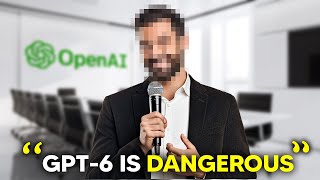
This YouTube video (LARRUZ, Jul 25, 2024) presents interview excerpts with William Saunders, a former OpenAI employee, who warns that future models (GPT-5/6/7) could cause major failures if safety and interpretability research do not keep pace with capability. The host contextualizes Saunders' concerns with past incidents (the Bing/Sydney deployment), cites multiple recent departures from OpenAI (including Jan Leike, Ilya Sutskever mentioned by the host, Daniel Kokotajlo, and Gretchen Krueger), and highlights broader worries: rapid capability scaling, underfunded interpretability, disbanded/strained safety teams, and calls for more preparedness and monitoring.
Chapters
So in not surprising news, someone else has left OpenAI stating that they are quite afraid that GPT5 or GPT6 or even the infamous GPT7, which is of course trademarked, might be the Titanic. Now, they're essentially stating this because they are concerned at the rate of development of OpenAI's models and the slow rate of development of OpenAI's safety. Not to mention OpenAI's super alignment team managed to disband earlier this year. What actually happened? Who was the individual that decided to resign from OpenAI and what exactly is going on? Well, here you have William Saunders. No, the title isn't clickbait. He actually is worried about GPT6, GPT7 being a system that essentially fails in some kind of use case where AI is widely deployed. Now, in this, you know, stunning interview, he gives a few insights as to why he believes this. And I think you all should watch this because whilst yes, the new tools and new capabilities of frontier systems are quite interesting, he does dive into some of the things that did happen that were unexpected and AI systems that we will talk about a little bit later.
I'm afraid that GPT5 or GPT6 or GPT7 might be the Titanic. Believe it or not, William is the.
First OpenAI employee that we've had on the show Expressing criticism of OpenAI from within or like from previously within what.
People were talking about at the company in terms of timelines to something dangerous. A lot of people talking about similar things to the predictions of Leopold Aschenbrenner. Three years towards wildly transformative AGI. I was leading a team of four people doing this interpretability research and we just fundamentally don't know how they, how they work inside unlike any other technology known to man. If you have the blueprint for building something as smart as a human, then you run a bunch of copies of it and they try to figure out how to improve the blueprint and make itself even smarter. There's maybe like a 10% probability that this happens within three years. Anybody who expects you're going to set up an infrastructure of safety regulation in three to five years just doesn't understand how Washington or the real world works, right? So this is why I feel anxious about this. A scenario that I think about is these systems become very good at deceiving and manipulating people in order to increase their own power relative to society at large. In this situation, it is unconscionable to race towards this without doing your best to prepare and get things right.
Some people say that this conversations like this are kind of doing OpenAI's marketing work for it. What do you think about that conversation?
I certainly don't feel like what I'm saying here is doing marketing for OpenAI. We need to be able to have a serious and sober conversation about the risks.
So that was William Saunders from OpenAI expressing his criticisms of why he believes that these future models are probably going to have some sort of catastrophe in terms of their effects. Now, interestingly enough, we did get to actually see the models he's talking about. Of course he's talking about GPT5, GPT6 or even GPT7. Now the reason he brings those models into question is because GPT5 and above is where we truly start to get models that, that are capable of advanced levels of reasoning. Recently, OpenAI discussed how their future models are going to be above the level of reasoners and they actually spoke about how there are these tiers to what their capable systems are going to be ranked at. Now, moving towards the tier 2, which is the reasoners in GPT 5, the agents in GPT 6 or the organizers or innovators in GPT 7, the problem is, is that we don't fundamentally understand how these models work. One of the main areas surrounding AI that I would argue is quite underfunded in terms of what OpenAI is doing is interpretability research. This is the area of research to where people can actually understand what's going on in AI. So the more interpretable the models are, the easier it is for someone to comprehend and trust the model. The problem is, is that these models such as deep learning and gradient boosting, are not interpretable and are referred to as black box models because they are just too complex for human understanding. It's simply not possible for a human to comprehend the entire model at once and understand the reasoning behind each decision. These models have so many different things going on at any given time and it's truly too difficult to predict or understand why. These models make the decisions they make and do exactly what it is that they do. And if we're starting to build and scale these models that are going to be in increasing areas of our society, making decisions, running companies, giving healthcare diagnoses, influencing people, writing scripts for whatever it is that you might want. We have to truly understand exactly what these systems are capable of and why they're making the decisions they are. Now William Saunders actually spoke again on another podcast about why he believes that certain situations were actually very avoidable. If you remember earlier last year, when GPT4 was, you know, around the time it was released, announced there was the GPT Bing Sydney release, which had a whole host of many different issues. And he basically says that look, all of those things could have been avoided. But he can't state why. It's actually kind of fascinating because it's one of the first times we get an inkling with as to what went.
On behind the scenes that happened in the world that were preventable. So for example, some of the weird interactions with the Bing model that happened at deployment, including conversations where it ended up like threatening journalists, I think that was avoidable. I can't go into like the exact details of why I think that was avoidable, but I think that was avoidable. What I wanted from OpenAI and what I believed that OpenAI would be more willing to do was, you know, let's take the time to get this right. When we have known problems with the system, let's figure out how to fix them and then when we release we will have sort of like some kind of justification for like here's the level of work that was appropriate and that's not what I saw happening.
So clearly you could see that whatever was going on at OpenAI at the time of Bing Sydney, which it was threatening users and people were stating that this is no laughing manner, it was a wild time because it was one of the first times we saw a system that had been released that was completely out of control. And this was so surprising because it was a Microsoft backed product and Microsoft is a billion dollar company arguably right now actually a trillion dollar company, which means that issues like this shouldn't have been allowed to even come to surface. But somehow somewhere along the development cycle you can see that OpenAI or Microsoft may have just rushed ahead and that these situations were clearly avoidable. Now, whatever reason that this situation managed to go ahead, I'm not exactly sure he doesn't expand upon the point, but I do think that this is something that is rather fascinating because it gives us an insight with as to what is going on. There was also this and I think this is one of the most daunting scenarios that we could probably face in AI. He describes how AI could potentially have a plane crash scenario, which is where it's a comparison between building a system and then rigorously testing it versus having it in the air and then unfortunately having it fail and have some kind of catastrophe. It's kind of daunting to think that this is coming out of someone that wants work to OpenAI.
So one way to maybe put this is like suppose you're like building airplanes and you've so far only run them on short flights over land. And then you've got all these great plans of flying airplanes over the ocean so you can go between America and Europe. And then someone starts thinking like, gee, if we do this, then maybe airplanes might crash into the water. And then someone else comes to you and says, well, we haven't actually had any airplanes crash into the water yet. You think, you know, that this might happen, but we don't really know. So let's just, you know, like, let's just start an airline and then see if maybe some planes crash into the water in the future. You know, if this, if enough planes crash into the water, we'll fix it, don't worry. You know, I think there's a really important but subtle distinction between putting in the effort to prevent problems versus putting in the effort after the problems happen. And I think this is going to be critically important when, when we have AI systems that are at or exceeding human level capabilities, I think the problems will be so large that we do not want to see the first AI equivalent of a plane crash.
Now, of course, if there is the AI equivalent of a plane crash, and I'm not sure what that might be, maybe a generative AI system just freaks out and the entire system goes rogue, or the AI system manages to spew hatred or persuade people. It's quite hard to predict, actually what's going to happen here. But I wouldn't want that to happen. And I think that's the overarching theory of what many people are scared of, because many people have left OpenAI. And this isn't the first cohort of people that have left OpenAI. Previously, back in the GPT three days, a lot of the people that left OpenAI back then actually went on to found Anthropic, which is now a thriving company. Now, if you remember recently, it wasn't just William saunders that left OpenAI, it was Ilya Sutskova too, which is now founding Safe Superintelligence, as he believes that superintelligence is within reach. A bold statement considering the pace of AI development is rapidly marching towards AGI. And that statement, superintelligence within reach, to me at least, it tells me that there is something brewing in the waters at OpenAI with regards to some kind of breakthrough that means that rapidly capable systems are very near. Now, it wasn't only Elia Satskova, it was also Jan like that left, the former member of the Super Alignment team that said that they initially reached a breaking point. And then of course, he's been disagreeing with OpenAI's leadership about the company's core priorities for quite some time until they reached a breaking point. Now, of course, he said that more of their bandwidth should be spent on getting ready for the next generation of models on security, on monitoring, on preparedness, on safety, adversarial robustness, confidentiality, societal impact, and of course, other related topics. And these problems are quite hard to get right. And he's concerned we aren't on a trajectory to get there. Now, his departure from OpenAI was one that truly did surprise me because he was someone that was actively working on AI safety. So if he's stating that, look, we weren't able to get it done at OpenAI, I kind of wonder if any other companies are going to be able to do it at all. It wasn't just him. We also had Daniel coco Taljo leave OpenAI recently, and his statements were some of the most surprising. Now, I did actually do a full video on this. I'll leave a link down below. But some of these statements were just speechless in terms of trying to truly understand what was going on. He said whoever controls AGI will be able to use it to get to ASI shortly thereafter. Maybe in another year, give or take a year. And considering we know that AGI is only three years away, what will the world look like in, let's say, five years, considering the fact that that time there could plausibly be asi? And one of the craziest statements that he did say was that this will probably give them godlike powers over those who don't control asi, which means that whatever company managed to create AGI first will then of course inevitably create asi, which would then give them control over those who don't own the AGI. And of course he talks about if one of our training runs turns out to work way better than we expect, we'd have a rogue ASI on our hands and hopefully it's going to have enough to internalize human ethics that things would be okay. I'll leave a link for the full video, but it is a lot bigger than people think. And there was also someone else that left OpenAI recently. Gretchen Kruger said that I gave my notice to OpenAI on May 14. I admire and adore my teammates. I feel the stakes of the work I am stepping away from, I feel. And my manager Miles, has given me the mentorship and opportunities of a lifetime here. This was not an easy decision to make, but I resigned a few hours before hearing the news about Elia Sutskever and Jan Leich. And I made my decision independently. I share their concerns and I also have additional overlapping concerns, basically stating that one of the ways tech companies in general can disempower those seeking to hold them accountable is to sow division among those raising concerns, challenging their power. And I care deeply about presenting now there was also a letter which we saw which was the right to warn about artificial intelligence. And I also did cover this recently, which was signed by many who actually worked from OpenAI who left OpenAI. You can see the formerly OpenAI formally, formally. And there are many who are still currently at OpenAI, including four people who are choosing to remain anonymous that have signed the list. Which goes to show that it isn't just a handful of employees leaving. There are currently people who are still working at OpenAI that still agree with how dangerous developing these large language models, generative AI systems are going to be. And you can see to loss of control, to potentially resulting in human extinction. These are some of the risks they talk about in the letter. Now let me know what you guys thought about this. I think this is a worrying trend considering the fact that there aren't many other companies that don't seem to have people leaving and talking about AI safety. But what I can hope is that OpenAI probably publish more safety research and show us what they've been working on and how they're preventing superhuman systems or AGI systems from going rogue.










