Founding an AI Startup: Dos & Don'ts of Building a Company
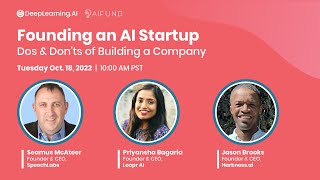
Three AI founders share lessons on building startups. Priyansha Bagaria cut deployment time from one year to under a month and costs from $500k to under $50k for manufacturing AI. The panel covers product strategy, rapid prototyping, and why model governance matters in real-world use.
Questions this video answers
Oct 18, 2022
Over 140 countries
From roughly 1 year to less than a month
From about $500,000 to less than $50,000
October 2021
Chapters
Foreign.
Hi everyone, and welcome to Founding an AI Startup, Do's and Don'ts of Building a Company. My name is Katherine Baird. I'm an Associate Builder for AI Fund and I will be your host and moderator. We appreciate you taking the time to join us for the event. We're so glad to see you tuning in from all over the world. We have attendees from over 140 countries today. If it's late for you. Thank you for staying up for us. Our event today covers the do's and don'ts and the highs and lows and the lessons learned of building an AI startup. And we're just going to jump right in today. If you hear anything during our discussion that prompts a question you'd like to ask one of our panelists, please follow the slido link in the description box on the YouTube page. And if you're just listening, you can click the link to see the questions that have been asked and upvote your favorites. Our speakers will do their best to answer most of your upvoted questions during the Q and A portion of this event. So without further ado, let's welcome our speakers. Seamus McAteer is the CEO of SpeechLab, Priyansha Bagaria is the founder and CEO of Looper AI and Jason Brooks is the founder of Harkness AI. Welcome everybody. I'm so happy to have you all here today.
Thanks for having us.
Thanks for having us.
I'd love to just kick off with you. You're the founder and CEO of SpeechLab and you're an experienced entrepreneur and operator. Tell us a little bit about your background about speech SpeechLab and about your experience.
Yeah, so I've been an entrepreneur for I've founded three companies of my own prior to SpeechLab, successfully exited those companies through TradeTell, primarily in the data space. My first company, the first company I founded was the currency data set for the mobile Internet called M Metrics. It was acquired by comscore after they went public. I subsequently started a company that built on my experience there and my experience at working with a company that was bringing data to hedge funds. And we built a ad platform in the mobile space ostensibly to mine the resultant data exhaust to use for targeting. We sold that pretty quickly actually. It was acquired by Millennial Media after they went public. They wanted the team and our tech. I headed up data analytics there and left with one of their top engineers to build a company. We focused on micro location analytics. Probably the wrong bet, but we built some cool tech, we had a great team and we found A home for the team successfully. So everyone did quite well at Newstar where we were the foundation of their IoT business. I subsequently worked with the founders of Otter, AI, Sam Liang and Yoon Fu to help them launch Otter. I joined when there was a handful of engineers and PhDs and that really got me enmeshed in the whole area of bringing an AI product to market. So worked there for three and a half years, had a great run there and I founded SpeechLab. It was incubated at AI Fund. It was built on some ideas that the folks folks at AI Fund had in the speech area. And our focus at Speech Lab is to make the world universally accessible for people who speak different languages by building a platform for speech to speech translation. That's what we're doing at Speech Lab.
Excellent. Well, I get the sense you've got some war stories and some good advice for new founders out there. So thank you so much for joining us. Priyansha, you are the founder and CEO of Looper AI and a fourth generation entrepreneur in family business in manufacturing. I would love to hear about your background, what you were doing before you started Looper and what Looper is up to.
Great, thank you so much, Katherine. So I am the fourth generation entrepreneur in my family business of manufacturing electrical insulation, which is completely, completely different from what AI is all about. And I did computer science, engineering, did my masters from Netherlands, worked with like, you know, a lot of big multinational companies over there. But the bug, the entrepreneurship in my blood was always there and I was like, how do I, you know, get started starting my own company? And after doing my mba, I did a data science fellowship from Cornell and that was my first exposure to AI. And after that I joined as a CRO Chief Revenue officer for an AI startup, AI consulting startup, which was focusing a lot on retail use cases. So some of the challenges which I saw, which I love, which I noticed while I was trying to sell the consulting, AI consulting projects, the biggest challenges were like when you go to a consulting company to build any solution, it takes at least a quarter to at least a half a million dollar to build any solution. And the time it takes to build that solution is roughly a year long time now for a lot of companies out there, you know, they don't understand technology, especially on the manufacturing, agriculture, aerospace side. Technology is something they have no idea about. And when you go and talk to them about that, it's like, how, why would I give you away half a million dollar if I don't even know what to expect at the end of the day. Right. Like it's, it's like it's a lot of money. And, and, and that's when like I was like, hey, why don't we productize a lot of things that you know, we can do which can be easily implemented for the company. And so what we've done is we've reduced the time that it takes to build a product build AI solution from a year to less than a month. And the cost it takes is from half a million to less than $50,000. And that's what Looper is all about. And you're really focusing a lot on because manufacturing is very close to my heart. That's what I've come from. Like my background is all around that and I'm here really trying my best to help manufacturers with solutions like defect detection, predictive maintenance, document digitization. These are the use cases which is very prominent across all manufacturing companies and trying to really get them a solution which is very quick to adopt and which doesn't take a lot of time and money. So this is all Looper is all about.
That's fantastic. It's an AI startup that's really propelling people, non AI industries into their AI future. That's so great. Jason, the founder of Harkness AI, you, you have a very interesting background and I'd love to hear about your background and Harkness and what everything has been like.
Absolutely. So part of my background sort of ties in what Seamus and Priyansha sort of said, but I'm originally from LA, South Central LA, born and raised in the late 80s, early 90s. And just to give you a sense of sort of the environment that I grew up in, I was at my seventh birthday party, I saw my first person get shot and killed and from there I won the Parent Olympics. And they had the foresight to figure out that like, wow, our family unit was really tight. Go. Eastman really worked well. The environment wasn't one that was conducive to keeping me physically safe. So they sent me to an all boys boarding school out in Claremont, California. So it's kind of going from the hood to Hogwarts. And there I was exposed to really high octane classmates and incredible teachers.
Right.
And we all learn around the Harkness table. So it's a hundred year teaching technique where you get really great students and really good faculty around the table reading the classics and then my professors by hand would sort of track our interaction. That led me to an 18 year career in teaching where I taught Mandarin, Spanish and mathematics. And then Covid hit. And I imagine we will all have these stories where the pandemic changed the course of our lives. But I was met with muted mics and blank video feeds trying to figure out how the heck do I connect with my faculty and my students. And then I realized I'd gone to a pretty good high school and I think there might be a solution here. So by hand I tracked interaction of all of my classes and the faculty meetings and all the things. And I just saw a profound transformation in the way that we interacted because that awareness of how and with whom we interacted, you can't unsee it right? Once you see that, oh my gosh, I only talked to two people in a class meeting. 18 people, and I'm ignoring all of the other 60 people at the table. You have to do something about that. It's really hard to sit without making that change. So then it's, it's totally surreal and I'm a little bit of a fanboy here, but my first entree into AI was through the NLP deep learning specialization through deeplearning AI. So and that was about a year and a half ago. So went from there to Fourth Brain, which is another AI fund company, and got trained up in my capstone project. The final project was the core technology that powers Harkness now and then reached out to a former two former students of mine, Evan Ellison and Keenan Hale. And we found the company in October of 21. So we've, we've been developing the technology for six months now. Just came out of a six month incubator and are out in the market. So it's a little bit about me. So thanks for having me.
Fantastic. Thank you so much for sharing. So let's go ahead and dive into our discussion. So for the next half hour I'm going to be asking questions directed to specific members of our panel and I encourage panelists to jump in with their input. Anything to enhance the conversation. Similarly, all of you out there in the audience all across the world, please provide any feedback on the discussion or questions you have so far directly in the YouTube live chat or questions to the slides. So we're going to be covering a lot of ground today, from company formation to product market fit to team building and to fundraising. But I'd love to kick off our discussion the same way that AI companies start, which is the decision to take the enormous risk to change your career and change your trajectory. So Jason, we just touched on this a little bit, but after 18 years of teaching, that's A massive change both in your work and your day to day. Can you talk about the challenges and opportunities of that transition and what it was about the Harkness idea that made you take that leap? Yeah.
Right. So I've heard once before that necessity is the mother of invention. And when you're really trying to just make it through an experience that nobody on the planet had experienced before, you just got to survive.
Right.
And at the point in my career, I was running a school, running, running a school there and sort of had to figure out how to do it. So I knew early on that my time in education was coming to an end. Right. I'd been there for 18 years, so I sort of raised a bunch of different children, but over an 18 year period. Right. So I felt like I'd done my work. I raised a kid now go off to college, but was looking for the next thing and really trying to figure out where, where that was. Knew I wanted to be in the AI ML space solving a bunch of problems around edtech. Just knowing that, you know, we're, we're in a profound moment as a species. Right. The planet's on fire. There's a lot of problems that can be solved. And education, you know, to the extent that we can educate folks, well, we want to, I want to be a part of that movement. And then really I came to the idea when, when Covid forced it, it was like, oh my gosh, this thing works. And AI the promise and the allure of AI is that we get to automate incredibly tedious processes. And that was what I was doing on a daily basis. And it kind of. There was a eureka moment when I'll never forget that the young lady in my class said, Mr. Brooks, all the baseball boys only talk to each other and if you don't do something about it, I will. And I was like, oh, okay. That is a very clear direction. One, thank you for having the boldness. And then two, I'll follow that, that path. And that path led me to Harkness.
AI, that's great. What about your, your day to day? Obviously going out and being a founder is, you know, being in a classroom with lots of different humans around you to suddenly being on a super small team. What has that been like?
Yeah, yeah. So it's been a really significant transition.
Right.
So at the beginning I thought we'd be an edtech solution, but one of the things that happens every day is that you talk to a ton of people and it felt like I was telling somebody the other day, it Felt like we had invented a trap like most AI companies are trying to build a better mousetrap. We had built a trap and trying to figure out, oh my gosh, what, what can we catch in this thing. So we had to talk to a lot of different people to figure out a solution that we're still in that process every day iterating, talking to, to our folks. But most of my day to day is just talking to folks from literally all over the planet and figuring out their problems and seeing how our solution can really make their day better.
That's great. So you're still keeping that community around you even though it's not physically in your classroom.
Yeah, because the tech has been normed. Right. Like we can all talk to each other. Right. Like we're all in really different parts of the world. So let's keep going.
That's great. Priyansha, you had been working in the AI industry as a consultant before founding Looper. So how have those two modalities been different? Working with clients and running your own show? And is there anything that you could tell your former self? What would you want to know?
Yeah, so in an AI consulting the approach is very different. The time it takes to really get the deal done is much, much, much longer. And what I personal experience is like, you know, when you go to a customer and you just show them a PowerPoint, like okay, this is, you know, what is the possibility, what you can expect towards the end. But now the difference is when I go to a customer, I can show them a demo on their own data in less than a week. It's a huge game changer. Now they can see really how it's going to impact them. And that's what the difference I've really seen between a product and a consulting company, like the third, the time it takes to really close a deal is much faster. Of course it has taken some time to build these. I mean, so what we've done is we've created a platform which takes care of the end to end AI life cycle. So it starts from data pre processing to data annotation, to model training, to model real time inferencing, to model governance. So everything can be done through one platform. And what we've really been focusing on is a lot around transfer learning because there's so many great models that exist out there. And when you go to a customer and you'd be like, hey, I can start show you something but give me like thousand data set, that can be a big challenge for a lot of companies over There. So what we've seen has really worked is really starting with small data set, get things going and make it better and better over time rather than trying to start with 100% accuracy, because that's not possible. That's not something which even like, you know, companies with millions and millions of data set have been able to reach. So it's all about how do you get them going? Start with like, you know, let's say an acceptable accuracy and then really make it better and better over time. So this has been an approach that we've taken and how it's, I mean this has really helped us to really show value to the customers like you know, early on and because right now if you really see most of the things that they're doing is 100% manual, it's not even that they have any automation. So for them to even start with seeing some automation is very, very helpful. So this has been our approach and this is how we are really differentiating in terms of getting the solution out there and very quickly and showing them the value very quickly and closing the team.
You mentioned that acceptable accuracy concept, which I think is something that's so, you know, unique to AI and other software, doesn't face that, those same kind of questions. So how do you communicate that to customers and clients? And how do you talk about acceptable accuracy and how they manage their expectations of what the AI will do?
Yeah, so let's say I'll just take an example of defect detection. So like right now they have somebody manually deployed on the factory floor looking at every piece that's coming out of the process. If we get the AI going, it's going to automate. But you can't replace the person that say if the AI is deployed today, you can't just get the person out of the factory floor. So what we suggest is start going and see if he was spending 10, I mean, five minutes to look at one product every time, if I can bring that time, one minute. So you're really reducing the time that he's taking to do those processes. And over time when you cut, collect more and more data and you know, you start with, and again, like this is something which is dependent on company to company for some like 90 is a good number to start with, some 95%, it just depends on that. And then you can slowly automate those processes, I mean, or to keep getting more and more data. And another thing that we've seen is even though you get started with 95%, whatever, there's a big chance of Modern threat, which is something like, you know, it's not always about really like, you know, getting an AI out there. AI model out there. The biggest challenge that, you know, I've seen now what companies are talking about is that they have implemented AI and after six months, the accuracy from 95% has come down to 60%. So what we really see a big opportunity out there is around model governance. It's not just about implementing AI from scratch, but like also making sure that you're keeping a check because the environment of the factory floor can change, like, you know, how the lighting conditions might change. And all of these things also impact the way the AI models are working. So it's what, and this is something that, you know, we incorporate to our product is also we, we really look monitor how well the AI is doing and keep checking on the accuracy. And then we focus a lot around retraining of the models to make sure that we avoid the water dry.
That's really, yes, some of those unique challenges that come with AI and really not with other types of software businesses. So, Seamus, Speech Lab is far from your first venture, but when we're thinking about the business side, so product market fit and value propositions, what do you think differentiates the process of building an AI company from say a data analytics company?
Yeah, I think, well, with data analytics there are different forms of data analytics companies, right? There are people who build tools to analyze your data. There are people who build models to be deployed in your environment. I tended to focus on syndicated data and I did build a platform for analytics of location data. You're generally after a pretty precise answer, right?
And.
You know, your seeking to generate ground truth, right. With AI, you're seeking to come close to ground truth, right? You're, you're, you're starting some way off and over time, you know, you're iterating your model to get closer to that sort of golden reference, right? The ground truth are better than a human would do or equal to or better than a human would do. In the case of transcription, in the case of live interpretation of, you know, in translated conversations, it's much more iterative process, it's much more creative. The skill sets are very different. You know, I've worked in speech AI. You know, it helps actually to have and understanding the sort of talent you're bringing in. It helps if they have an understanding of linguistics. You don't need that as a data scientist. If you're, you know, building pure data models, you know, you're, there's, there's a lot going on that's more iterative, more creative. I've also noticed actually, you know, a tendency to sort of move faster in. In AI and iterate faster. It's like you're not looking for a perfect kind of statistical reference that, oh, is this better? You sort of move on anecdote, particularly in the early going. It's like, yeah, just this is better. You're looking at the data, you've got a few anecdotes. It's like, let's deploy, let's test. You can always go back, right? So it's, it's a much more creative, it's much more fun process, I think, overall, building an AI application company. You know, there's a lot of companies now that, you know, the buzzword is generative AI. We're kind of fit that and, you know, we're generating new content based on input and, you know, it is, it is a. It's a much more fun area to work in. I have to say, in terms of product market fit. You know, like, I'm just what I learned from Sam, who founded Otter AI. He's a brand.










