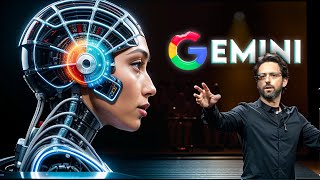
Sergey Brin returned to hands-on work at Google to lead development of Gemini, a multimodal AI model designed to compete with ChatGPT. The project faces massive challenges in training scale and compute costs, but Brin's involvement signals how seriously Google is taking the race against OpenAI and Meta.
Questions this video answers
July 27, 2023.
570 gigabytes of text data.
About $12 million.
70 billion parameters.
175 billion parameters.
Chapters
Sergey Brin, one of the guys who started Google, has been visiting Google's office a lot lately to help with their AI projects. Even though he stepped back from his big roles in the company a few years ago, the main thing he's excited about now is an AI project named Gemini, which is Google's answer to other big AI projects out there. In this video, I'll talk about why Sergey Brin is returning and why it matters to Google. We'll also dive into his plans for AI. Keep watching until the end to understand everything. Oh, and don't forget to subscribe to our channel so you stay informed about AI updates. Alright, so Sergey Brin is one of the co founders of Google. Along with Larry Page, he is also one of the co founders of Alphabet, Google's parent company that oversees various businesses such as YouTube, Waymo, Verily, Calico and more. Bryn and Page are widely regarded as visionaries and pioneers in the tech industry, have shaped the Internet as we know it today with their innovations in search, advertising, cloud computing, mobile devices and more. However, in 2019, Brin and Page announced that they were stepping down from their executive roles at Alphabet and Google. They said they would remain as board members and shareholders, but would focus on their personal interests and philanthropy. Many people thought that this was the end of their involvement in Google's affairs, but they were wrong. According to recent reports from the Wall Street Journal, Brin has been frequently visiting Google's Mountain View headquarters in recent months to help with its AI efforts. He is reportedly deeply involved in planning an AI strategy for Google and working with researchers on technical matters such as measuring the performance of AI models. But his primary interest is Gemini, the highly anticipated AI model from Google DeepMind, which is expected to outshine ChatGPT. The co founder, who is now an Alphabet board member, is spending a lot of time with researchers working on Gemini. Gemini is still in training and is expected to be available later this year. So why is Brin's involvement in Google's AI endeavors so crucial? Well, there are several reasons. He's always loved AI, having a strong background in computer science and math. He even once mentioned that AI was his main reason for starting Google. Brin has made impactful decisions for Google, like buying YouTube in 2006 and forming Alphabet in 2015. He also supported Google X, which focuses on big ideas like self driving cars and smart lenses. He's hands on at Google, guiding AI research, hiring decisions and leading weekly AI talks. Sources like the Wall Street Journal say he's played key roles in recruiting top AI experts to the company. Having Brin involved shows Google's commitment to AI, especially when facing challenges in retaining AI talent or addressing AI ethical concerns. Google is emphasizing the importance of AI to its future and its dedication to the AI community now. Gemini is an AI model developed by Google DeepMind, a part of Alphabet that focuses on artificial intelligence research. They're famous for AI projects like AlphaGo, which beat a human expert in the game of go alphafold, which predicts protein shapes accurately and alphazero, which can learn games without prior knowledge. It aims to match ChatGPT in producing diverse, high quality text. But unlike ChatGPT, Gemini is built from the ground up and is multimodal, meaning it can process different data types like text, images and audio. It also easily integrates with various software tools and APIs. Plus, it's designed for future growth, with abilities like recalling past info and envisioning future situations. Gemini holds big promise for Google. It could enhance Google's search engine and voice assistant, making them smarter. It might also upgrade Google's Chatbot Bard, which was introduced to compete with ChatGPT. Bard can chat with people, answer queries, write code, make music, and more. Beyond that, Gemini offers new creative outlets for users, from writing stories and songs to teaching subjects and languages. It might even introduce fresh entertainment options like games and jokes. But creating Gemini is not an easy task. In fact, Google faces many challenges and competition in the field of AI and large language models. One challenge is the sheer scale and complexity of training Gemini, because, as you can imagine, training a large language model requires massive amounts of data, computing power, time and money. For example, according to some sources, ChatGPT was trained on 570 gigabytes of text data from the Internet, which is equivalent to about 570,000 copies of War and Peace. And it cost about $12 million to train, which is more than the budget of some Hollywood movies. But ChatGPT is not the only competitor that Google has to worry about. Recently, Meta, which was once called Facebook, launched a new language model called llama2, and they did this with Microsoft. Llama2 helps people and businesses create tools using AI. The good news is that llama2 is open source, so mostly anyone can use it without paying. But there's a catch. Really big companies have to get special permission from Meta to use it. Now, Llama 2 isn't just competing with Gemini, it's also up against ChatGPT. It has some cool things that make it stand out, like it's multimodal, which means it can work with text, pictures, sound and videos. Plus it can do its job using fewer resources. For example, a version of llama2 called llama270b uses 70 billion parameters and can produce text as good as GPT4, which uses 175 billion parameters. But what about Gemini compared to llama2? We're not totally sure yet because Gemini is still learning and hasn't been shared with everyone. However, Google says Gemini will be even better than Llama 2 in some ways. For example, it'll be super smart like AlphaZero, learning new things on its own. Also, Gemini will have more tricks up its sleeve, doing more than just writing text. It can create code, make music and even draw pictures. So Google's AI strategy is to leverage its strengths and assets in AI research, engineering and infrastructure to create products and services that can benefit billions of people around the world. They have been investing heavily in AI for years and built a reputation as one of the leading AI companies in the world. Google has some of the best AI talent, resources and capabilities in the industry, and it has been producing groundbreaking AI research and innovations that have shaped the field of AI and beyond. Their AI strategy is led by Sundar Pichai, who is the CEO of both Google and Alphabet. Pichai is a strong advocate and supporter of AI and he has a vision of making Google an AI first company, meaning that AI is at the core of everything that Google does. Pichai is also a believer in the potential of large language models and generative AI and he has been instrumental in driving Google's efforts in this area. He was the one who issued a code Red after the launch of ChatGPT, which prompted Google to accelerate its development of Gemini and other large language models. Google's AI strategy is also influenced by Demis Hassabis, who is the co founder and CEO of Google DeepMind. Hasabis is a genius and a visionary in the field of AI and he has been leading DeepMind to create some of the most advanced and impactful AI systems in the world, such as AlphaGo, AlphaFold and AlphaZero and also the leader of Gemini. To sum it all up, Sergey Brin is diving back into Google's AI efforts, especially with the exciting new Gemini model. Google faces stiff competition, but with their history and talent, they're pushing the boundaries of what AI can do. If you found this information valuable, please give the video a thumbs up and don't forget to subscribe to our channel for more updates. Thanks for watching and see you in the next one.