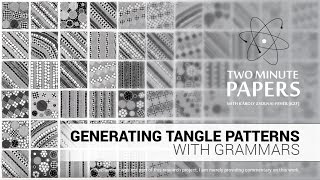
Grammars, rule-based systems normally used for language, can generate tangle patterns in computer graphics. Start with a shape, subdivide it, group the pieces, and assign patterns to create complex decorative designs automatically.
Chapters
Dear fellow scholars, this is two minute papers with a tangle pattern is a beautiful interwoven tapestry of basic stroke patterns like dots, straight lines, and simple curves. If we look at some of these works, we see that many of these are highly structured, and maybe we could automatically create such beautiful structures with a computer. And now hold on to your papers, because this piece of work is about generating tangle patterns with grammars. Okay, now stop right there. How on earth do grammars have anything to do with computer graphics or tangle patterns? The idea of this sounds as outlandish as it gets. Grammars are a set of rules that tell us how to build up a structure such as a sentence properly from small elements like nouns, adjectives, pronouns, and so on. Math nerds also study grammars extensively and set up rules that enforce that every mathematical expression satisfies a number of desirable constraints. It's not a surprise that when mathematicians talk about grammars, they will use these mathematical hieroglyphs like the ones you see on the screen. It is a beautiful subfield of mathematics that I have studied myself before and am still hooked, especially given the fact that from grammars we can build not only sentences, but buildings. For instance, a shape grammar for buildings can describe rules like a wall can contain several windows. Below a window goes a window sill. One wall may have at most two doors attached, and so on. My friend Martin Ilcik is working on defining such shape grammars for buildings, and using these grammars, he can generate a huge amount of different skyscrapers, facades, and all kinds of cool buildings. In this piece of work, we start out with an input shape, subdivide it into multiple other shapes, assign these smaller shapes into groups, and the final tangle is obtained by choosing patterns and assigning them to all of these groups. This yields a very expressive, powerful tool that anyone can use to create beautiful tangle patterns, And all this through the power of grammars. Thanks for watching and for your generous support. Thank you, and I'll see you next time.