Georges St-Pierre, John Danaher & Gordon Ryan: The Greatest of All Time | Lex Fridman Podcast #260
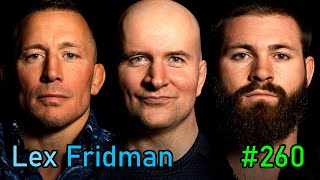
Long-form podcast conversation (Lex Fridman with Georges St-Pierre, John Danaher, Gordon Ryan) exploring the psychology, tactics, training, and careers of elite combat athletes. Key themes in this chunk include: identifying undervalued techniques (John Danaher on leg locks), personal turning points and confidence (Gordon and Georges), coach-athlete dynamics, the role of emotion and persona in sport, diet and health anecdotes, training volume versus specificity, and technical comparisons between grappling and MMA (time-to-apply techniques, takedowns, submissions).
Chapters
Humans are fascinated by violence, and you've got to ask yourself, why?
Is it the rash guard?
Yes.
And I talk so much shit that I'm like, man, if I lose, this is going to be rough.
You're learning this. Shut the fuck up.
I got you, man.
You were powered by McDonald's and Coca Cola.
I want more.
And then I smacked him and he didn't want to fight anymore.
I'm not impressed by you, Jeff.
If George St. Pierre and Khabib Nurmagomedov face each other in their prime, who wins? I'm here with three individuals, each of whom are considered by many to be the greatest of all time in each of their respective disciplines. The greatest MMA fighter of all time, George St. Pierre. The greatest martial arts coach of all time, John Donaghar. And the greatest submission grappler of all time, Gordon Ryan. So let me ask the first question. You guys didn't see the question? No preparation here. What is the key to your success? Each of you, one thing or multiple things that come to mind. John, go first. Is it the rash guard?
Yes.
I like that you choose.
John, right off the bat, you seem the most nervous.
Please inspire us to give the right answer.
For. For me, it's about finding a way to work in a world where most of the answers are already known. Okay? In any developed sport, by the time you enter that sport, most of the basic precepts, the major techniques, the major mechanical understandings of the sport are long since worked out. And so in a highly developed world, the key to success is to be able to identify some area of the industry that you're in which is currently.
Undervalued to do what the other people are not doing.
Deeper than that, everyone has a view of, okay, these are the main skills of the industry I work in. At any given time, some set of skills attributes will always be somewhat undervalued. They're underappreciated by the people in the game. You see that in any given industry, there are always trends which change the nature of the industry over time. So fashion trends in the clothing industry, you'll see at any given time, there's a change, general wave of fashion which pushes most of the people in the industry in a given direction at a given time. What makes people stand out is the ability to look at the various possibilities out there and say, here is something which is genuinely useful, but which is currently being underused, underutilized, and I want to bring that back in and develop it. And because it's an inherently useful product, it will be very, very successful in its initial applications against people who aren't currently using it. If you can do this in whatever industry you're in, I believe you'll be highly successful.
So this applies both for actual specific like techniques and the also tactics as.
Well in the case of jiu jitsu. So for example, in my sport, leg locks have always been around, okay, there's, there's no shortage of people you can look back in history who are applying leg locks. Nonetheless, as in, across the industry, leg locks were undervalued and underappreciated. There was a general sense in which most of the leading figures of the sport, for most of the history of the sport of jiu jitsu, tended to de emphasize leg locks. And when I looked at them, I said there was immense potential, but it wasn't being realized and needed to be changed. Since then, that has more or less occurred. Now most people coming into the sport understand that leg locks are an important aspect and they're no longer undervalued. If anything, it's gone too far the other way and now perhaps they're a little overvalued. And this kind of fashion trend exists in every industry. And the job of anyone who wants to excel in a given industry is to be able to identify, okay, what are the things that are currently out of fashion and undervalued and then look at what is their actual objective value and then work to bring them back to the forefront.
So John brought up fashion. George is wearing a really sexy shirt. So assuming that's not the reason, is there, is there something that comes to mind as the key to the success of your incredible career?
Well, of course, everybody knows the famous answer that every athletes are saying. Oh, it could be genetic. I was maybe gifted at certain predisposition. I worked really hard. But I think something that people don't talk enough is when everybody sometime go right. I was never afraid to try to go left. And I fell many times trying to do things that were not known to be things that would brought me success. But I tried it, you know, very often. I was the first of trying new things and I felt many times, but certain times it gave me a certain advantage. And for example, I was sometime fighting guys that had much better wrestling background than, than me on paper. And nobody before that fought those guys. Never, nobody had dared to try to take them down because their wrestling pedigree were so good. And I didn't have on paper the wrestling pedigree to take these guys down in a fight. But when everybody try to Go right. I was going left. I, I fought them in a different way. And that was the blueprint to beat certain some of these guys. You know what I mean? You know what I mean?
Yeah. So we'll actually talk about a few fights where you did just that. This is fascinating, but let's say at the high level. So Gordon, again sticking on fashion, may I compliment your incredible badass hat trying to fit in here. We should say we're in Texas now. So he's become a Texan overnight. So what, is there something you can speak to that you would attribute to as the key to your success?
Yeah.
So first of all, there has to be a rule where you don't ask us all the same questions because how am I supposed to compete with the answer John just gave? There's nothing I can do that's going to top that. Yeah, but I think it's, there's many things, but I think the number one thing is just is John. When I came in I was a blue belt and I was beating brown and black belts in competition already. But he really changed my way of thinking about the sport. I would just come in and if something wasn't working, I would just do it harder and faster and more aggressively. And that just degenerated me into, degenerated into me spastically. Knee sliding into cross Hashi Gourami against Eddie Cummings for six months and then just getting heel hooked repeatedly. And I'm like, this is not working. And Eddie like when I met him was like a chubby librarian looking guy. And I'm like, there's, I'm like 6, 2, like a jacked like 170. And I'm like there's no way I'm losing the, to a guy who looks like this. But he just kept heel hooking me so I would just go harder and harder and it wouldn't work. And then John's like, well if you learned leg locks you might, you might have some more success. And then I was like, yeah, that probably makes sense. And from then on I kind of just changed the way I thought about the sport. Instead of doing, doing things harder, I would actually try to get better at jiu jitsu.
Do you remember like a turning point where you became as opposed to being mediocre, not just in technique but in approach to, to great.
I think it was somewhere around brown belt level when I was training consistently started training full time with John when I was purple belt, mid level purple belt. And towards the end of my brown belt days I was beating up like Legitimate, like ADCC champions in the gym. So I think like brown to black belt was a big thing for me. And then when I won my first EBI and I was, I submitted Yuri, who won abcc and I beat Roostom. So I think that was like my turning point as a competitor. But I think I started to, to reach world level a little bit before that. I think somewhere around brown belt, mid level to late level brown belt.
So is some of that mental, like, was there a moment when you, like after a training session you realized I could actually do this, like I could be at the top of the world, like world class.
The critical moment for me was when I think it was right, right when I got my black belt or maybe a few months before I got my black belt, uh, we had a former ADCC champion come into the gym and we did a hard round together. And I think I submitted him like four or five times and no one knew who I was. I never won anything up until that point. And I was like, okay, like, if this is like one of the best guys in the world and I could submit him multiple times around, I think that this is like something that I actually could do professionally and make a, make a career out of this.
Okay, so the actual performance was the, like, you don't need to believe before you could perform. Like a lot of Olympic gold medalists, they, they have to believe before they can perform because like they're getting their ass kicked for a long, long, long time.
Yeah, I think but the best way for me to believe in something is to have repeated success doing it against high level guys. Like, I'm not going to just believe I can do a double leg if I can't hit a double leg on anybody. So for me, the, the belief came from the repeated success in the gym. Yeah.
But to get to the point where you're submitting somebody like Yuri Samoa is like one of the, the greatest grapplers ever. It's like a long journey.
Yeah. But I had the confidence, I had the belief in myself because of the success that I had in the gym prior to that, got it to that event even.
And it's one step at a time. First it's the brown belts, then it's the black belts and it's world class. Okay. George, was there a turning point for you when you thought, like, I can actually do this?
Yes, I always dreamed to become champion, but I think the turning point, there was two turning point and there were my two losses. First, my losses to Matt Hughes. I went into that Fight just to not lose. I was not fighting to win. And it's. After the fight, when I watched the replay of the fight, I realized I was like, I was doing pretty well, but during the fight, in my own mind, I was not seeing it that way. I, I thought I was getting dominated by use like a hundred percent, but when I watched the replay, I was like, man, I can, I can beat this guy. I was beating him until I made that stupid mistake. So I was very frustrating. But, but that's what gave me the mentally, the, the championship level mentality. And then I became a little bit overconfident because I started beating everybody after that and I start to believe the hype of people when they look at me. They were like, oh, he's the new up and coming superstar and he's going to be unstoppable. And, and then when I became champion, I, I lost to, to, to Matt, to Matt Serra. So before I, I believe my first failure was because I had a lack of, of confidence. And, and my second failure was I was. Because I was overconfidence. So I think it's, there's a perfect center of confidence. I mean, I mean, it's good to be confident because, like, John taught me, like, confidence, it's, it's like money in your bank account. If you, you can have all the skills in the world, right? And, and if you're, if you don't have the confidence, it's like you, it's like you can be a millionaire, but you don't have access to your bank account. So that's a little bit the analogy that John told me. So that's how I feel. Confidence plays for an athlete, but to be overconfident, I think it's always good to be aware, to be afraid of what can happen. So to have a perfect balance of confidence and fear, to me, that's what mentally gave me the edge to become, I believe, successful in my sport.
Playing off that, John gave me a speech one time and he was like, you have to be able to flip a switch and turn it off. Where, like a guy like Mayweather or someone who goes out who's super confident and he plays the character of someone, he's like, no one can beat me. I'm the best that there ever was, and that's it. But if you look at him, he actually trains very hard. You can't play the Persona of no one can beat me and then have it translate into your life and just think that you're so good that you don't have to do anything and no one could ever beat you. You have to be able to play that public Persona of no one can beat me. But, but then you have to actually do the training to make that happen. You can't just, you can't believe your own hype and say, say that you know, I can just do whatever I want. No one's ever going to beat me. You have to be able to switch between the Persona and the actual athlete. And that made a big difference for me.
It's tough because like you're you, you dominate such a large fraction of the world in, in grappling and George too. Just the perfect dominance after those two. It's hard for the confidence not to.
Just.
Like, how do you avoid the confidence not becoming a thing that weighs you down where you completely delude your mind?
For me it's just, well, number one, the guys in the gym are so tough. So the guys in the guys in the gym that I train with are always like nipping at my butt and always giving me new, new problems to solve. And for me it's really just about trying to learn new stuff over time so that, that keeps it interesting for me. And it's not really about, um, you know, no one can beat me. I don't have to train, I don't have to do it. I can do whatever I want. Uh, it's more, what keeps me in the gym is more about the fact that I'm learning new stuff all the time and working on something new and progressing to new levels at all times. Um, it's not, I don't just come in and do the same thing over and over again and that gets boring. You just come in and you don't learn anything new and you just do the same stuff for years at a time and like, okay, this is boring. But when you have new stuff to work on and new goals, short term and long term goals reach, then it makes it interesting.
It's, for me, it's a little bit like Gordon says, is, is the fair because sometime in the gym, even before when I was competing, I was, I was getting my butt kicked. But I don't care what happened in the gym. I mean it, it hit my ego, of course, because I'm a proud person, I'm a competitor even in the gym. But it's not a malicious competition. Competition in between each other. When you fight, you have to be malicious. You go there to hurt the guy. But it hit, it hit me in terms of my pride when I get beat in a gym. Of course. But that fear that I don't want it to happen in public, especially not during a fight, that what keeps. Help me. Keeps the balance between confidence and fear. You know what I mean? It's kind of weird. It's a mixture of both that I believe I, to me helped me succeed, to have the right mindset to fight.
And I talk so much shit that I'm like, man, if I lose, this is going to be rough.
So, yeah, you put a lot of. I mean, that's, that's the hard thing to do when you talk shit. When you, when you play, the heel is.
So has to perform.
The pressure is. I mean, you have to be good under pressure. It's the Conor McGregor thing.
You know, the reason I actually started talking was actually like, indirectly because of George. Because.
Because I, I would become the opposite of George.
I won. I won my first ebi and I, I didn't talk. And everyone was like being like, oh, you know, he only beat Yuri because. Because he was tired or, you know, this or that. And if they have a rematch under any of the rules, that he would have lost. And I'm like trying to figure out what I'm going to do. So I'm scrolling through George's feed one day and he posted a clip of him beating someone. And I look at the comments and I'm with this in mind, I'm like, george is the nicest person of all time. And if you look at the comments, it's like 10,000 comments. And like 9,000 and 900 are just people calling him. Like, all you do is lay and pray you. You suck. You can't finish anybody. And I'm just, I'm looking at this and I'm like, people are gonna say what they're gonna say regardless. They're gonna talk shit regardless. So you may as well just say whatever you want and then just be yourself.
Is there some aspect. As I mentioned, Conor McGregor, he. He crossed the line with Khabib. At least in the eyes of Khabib. Is there something you ever regret about crossing a line? Or does that. You ever feel like there is a line or do you just keep pushing the line?
I, I basically play it per. Per person. I just, I. I basically fire back with like one step above what, what they do.
It's always plus one.
Yeah. Yeah.
Okay.
So I go. I usually go hard, like they fire a bullet and then I drop a duke and then, and then after that initial shot, then we go back and forth and I'll just keep one upping Them.
So, you know, there's a lot of people that love you, but there's also a lot of people that love to hate you.
Yeah.
So, like, what, do those people, like, energize you? Or do you just. Or is it funny to you? Like, what is an athlete? As a performer, you should not think about them. It's like a fun thing outside of.
It's like. It's just like a fun thing that keeps me occupied. Like. Because. Because most of them that, like, talk shit, they like, just say stuff that's factually incorrect. So then I just argue with, like, actual statistics. Yeah, it's just like, you suck or you're not going to beat this person. I'm like, I've already submitted that guy. So it just, it riles them up and it's just. It's just a fun thing for me to do. My. My downtime.
Yeah. Your responses are usually very factual. It's very scientific. I appreciate, like, you actually, you start by talking trash, but then you respond with science. Yeah, it's great. Okay.
It's a good mix.
It's a good mix.
I mean, on the topic of haters, or more specifically, sort of doubts within yourself or doubts around you as you're coming up, maybe George, you can comment. And we're just going to ignore John completely in this conversation. I. I was going to ask you another question, but let me just ask you on this, on this topic, are there times in your life you have to. You were surrounded by people that, that.
Doubted you all the time?
And so what's. Is there something you could say, as in, by way of advice, how you overcome the doubt, either yourself or others.
Around you all the time? The first time I manifest my desire to become a professional mixed martial art athlete, everybody doubt me. Just not even. I'm not talking about the ufc, just to become a professional fighter, everybody doubt me. Then I became a. I became a professional fighter. I had few amateur fight, I won them all. Then I fought my first fight in. In Montreal. I won and I became a professional. Then I. I told people that I wanted to fight in ufc, everybody doubt me again. So it's a normal thing. So I worked my way up, beat a few guys. Then I, at the time, Pete Spratt was just knocked out Robbie Lawler with leg kick. And the person who was my agent at the time did a great move for me, so he brought Pete Spratt in Montreal to fight me. Pete Spratt came to Montreal and I believe he didn't know who I was. So he thought that he was coming to collect an easy paycheck, and I, and I end up beating him. So that gave me the opportunity to fight in ufc. Then after I was in ufc, I wanted to become champion of the world, you know, but Matthews was there, and he seems invincible at the time, so everybody doubt me again, and I became world champion. And after, when you, when I was world champion, I wanted to be, I was competing against other world champion of other weight class for the title, you know, for the legacy and everything. So I was not no longer competing against my opponent. I was, you know, as a competitor, you always, you, you never wanted to be, you never want to be satisfied, because when satisfaction is the death, you know, when you're satisfied, you better retire because it's over. So always have to find motivation. What you can have more. I want more. Don't be satisfied in life. So I want it to be like the best, you know, So I was competing, you know, like to become the best. And, and, you know, of course, people doubt, doubt you all the time. Every time you say something that it's outside of the norm of the normality. When I say there's nothing normal. But I'm talking about when you, you manifest your desire to do something that takes special attribute to, to, to succeed or that is something that is hard to, to do, it's for sure you're gonna always have people that doubt you.
It's so strange that people don't, they don't lean into supporting like people that love you too.
Yeah, even people that love me used to doubt me. And I believe I, I, you need to use that as a positive, positive thing, as a motivation to prove them wrong.
Yeah.
So for me, that, that was the thing. When someone doubt me, nothing gave me more, there's more energy because I want to prove him wrong. I want to look at him in the face and say, hey, you see, I got you, man. I did it.
So, John, do you ever use this in one way or the other by saying, I don't think you can do this to motivate them to prove you wrong, or more general question of the mental toughness required to achieve or confidence required to achieve greatness? What's your role as a coach when you have these two athletes with regards.
To your first question, Would I ever say to someone, you can't do this as a kind of reverse psychology? No, My job is to prepare people first and foremost with their skills. And as Gordon pointed out earlier, if you're in any way a rational human being and you're noticing that you're getting tremendous success with a given move in the gym against high level opponents who give a good read on what your actual opponent in a competition is like. You would have to be a to not recognize that kind of success and say, this is something I should be building into my game. And you will carry the confidence that you earned in the gym into the arena. So I never try to use reverse psychology. I build up. Everything I do in terms of confidence is to give people physical skills. I know people say, oh, there's physicality on the one hand, there's mentality on the other, and confidence is squarely in the mental aspect of the game. But all the underpinnings and beginnings of confidence are physical. A rational human being will see where they're having success and where they're having failure, and confidence will surround those areas where they're having success and will degenerate in cases where they're having failure. So my job as a coach is to set them up for success in the gym with a given set of skills, and I don't have to do anything psychologically after that. If I can set you up to be highly successful with a given move or a set of tactics to 10 times in a row against quality opposition in the gym, I don't have to do a damn thing when it comes to instilling confidence. I will tell people, hey, you're doing a really good job with that move. It's working well for you. But when they nod in agreement, I'm not trying to force anything on them. They already recognized that long before the words came out of my mouth. But on the other hand, intelligent, rational people will recognize when they're failing with given moves, and no amount of talk on my part can ever change that. If I teach Gordon a given arm lock and 15 times in a row he tries it over a month, and all 15 are failures. There's nothing I can say verbally to come up to Gordon and say, hey, you're really good at that move. He's going to look at me and say, bullshit, I'm terrible at it. And that will create a crisis of confidence where Gordon no longer believes the words coming out of my mouth. So I will never compromise that.
But isn't there a lot you just said 15? Have to believe that doing this arm lock 15 times over a period of a month is worth it because eventually you might get it.
Yeah, that's a separate issue. That. That's a separate issue. There are times where I've more or less pushed athletes to go in a certain direction. For example, when I first met Gary Tonin, he never had a guillotine strangle. And I. I would say to him, gary, you know, you're a scrambler. Like, one of the greatest weapons that scrambler can ever develop as a guillotine. Like, it should be in your arsenal. And he was like, no, I just scrambled for the back. And I said, well, there's going to be a day you can't take someone's back. And it's always good to be able to strangle from front and back. Okay. Of course, we all prefer strangles from the back. That makes sense. But there's going to come a day where it's going to be useful for you. And so that was one of the few times where I put my foot down and said, you're learning this. Shut the up.
And he, like, literally wouldn't teach him any. Anything else until he got a guillotine. Gary, like, asked him a question. He's like, let's say you're guillotine.
And for the first three months, as gifted as garrytonen is in learning most moves, most moves, Gary gets it, like, in minutes. There was something going on with Gary. Just couldn't get a guillotine on people. And finally, after around three months, he started having some success until ultimately it became one of his best weapons. We had to go through, like, 15 different variations of guillotine until he found one which actually worked reliably for him. And that was one of the few times where I put my foot down and said, no, you have to learn this.
So the long search had to do more with the physical characteristics.
Like, you couldn't figure out the right kind of sense. It made sense in the case of Gary Toner because there were more opportunities per minute of his grappling four guillotines. That the investment in time was worth it for another athlete. I might have said, well, he hardly ever gets in the situation, but front headlongs or guillotine, so it's not even worth investing the training time.
Let me ask you a question. On the. On the competition side, we mentioned haters. And do you think about this aspect of the competition with athletes?
It's a great question, and the answer is no. You can see that you couldn't find two more polar opposites psychologically than George St. Pierre and this monstrosity on my left. And I've never said to my athletes, hey, I think this is the sort of demeanor you should carry yourself with. I'm myself. A very flawed character. And I'm the last person on earth who should be delving out moral advice to other people. The only thing is that of course I believe some things are off limits. But as long as it's done in the context of sport where no one's physically attacking people or doing anything crazy, where it just goes completely over the top, then I give almost zero moral advice to my athletes. I'm a jiu jitsu coach, not a preacher.
Alex, if I may. We are entertainers, you know, we're athletes, we're professional athletes, but we make a living because of people want to see us perform. Same thing an actor, same thing a singer. And a lot of the time, especially in the fight game, an event is promoted, it needs to be with emotion. Love me, hate me, but do not ignore me. And you know, when it's authentic and it's done well, I think me, my personally, my favorite fighters to watch are the one that are, that have some sort of a bad Persona. I really enjoyed watching those guys because they bring an emotion element into a fight, which is great. You know, I feel, to me, it's more interesting to watch when there is an emotion involved. And I believe that's why some fighters make more money than others, you know? You know what I mean? That's the reason why we can make a living out of this.
Yeah, they're better entertainers. But you're right, the authenticity seems to be really important there.
There's actually something very interesting there. It's time to break out some secrets. Do you know who, like you think of George St. Peter, you think of the highly technical, polished martial artist.
That's just gonna be great.
Do you know who his favorite fighters to watch were? You'd probably be thinking, oh, probably someone who's really technically advanced. Actually, it was Mark Coleman, Kevin Randleman and Phil Barone. He used to love watching. That was a Hammerhouse. That was his favorite. He would love those guys. And whenever their fights were on, George, we watching the Hammerhouse crew, and it's funny what you said about how those guys bought an intensity to MMA that was off the charts. Have you ever met those guys in their prime? Let me tell you, it was something to behold. And they had this crazy larger than life personality. Most of the things they did made no sense whatsoever. I mean, technically, but that was their appeal. And these guys and George loved to watch them more than anyone else.
You never knew what could happen with these guys. I remember when Mark Coleman won the Pride Grand Prix. I was in my living room. I was jumping. I was so happy. I was like, yeah, he beat Igor Vorchevchin. I was like, to me, it was amazing. You know what I mean? Because of the emotion that they brought into the fight.
George, I was actually very interested by something you said, that normally when I ask, what is the appeal of a given fighter and what makes people watch a fight? You talked about the idea that fighters are entertainers, and that's absolutely correct. They are. It's this weird, weird industry where you're both an athlete and an entertainer, and you need to be successful in both regards to become financially successful, insofar as your favorite athletes to watch, at least, were people who are almost like the polar opposite of who you are. I've always said that most people, if you look at, say, a million people, watch a pay per view event, what percentage of those million people have a genuine technical understanding of what's happening as they watch a fight? It's tiny. It's absolutely tiny. The vast majority of people who watch a professional fight have almost no technical understanding of what's going on in front of them. So how do they relate to the fight? What's the only way they can? It's through emotion. And so when they get a sense that these two don't like each other, then they can relate to the fight. But only a tiny percentage of people watching a given professional fight can relate to it. On a technical level, the overwhelming majority will always form an emotional attachment to the fight. That's why when you see shows like UFC primetime, they never focus on the tactics and the techniques of the fight. They focus on the emotional elements, the preparation, the view of their own family members. As athletes get ready, it's always an emotional pull, because that's how 99% of the viewers relate to the fight. Think about chess, okay? If I have minimal knowledge of two world champions coming to fight each other or match up against each other in a game of chess, I know so little about chess tactics, and I can't really form any kind of technical appreciation of what's going on on the board. But if you tell me that these two chess players hate each other's guts and they've got a rivalry which goes back five years, and they've said this and that about each other in public, then suddenly my ears prick up and I'm like, oh, okay, this sounds interesting, because I just don't have the knowledge to appreciate what's going on on the board in a chess game, to be able to appreciate the technical nuances of what they're doing. So any interest that I have in the chess match is going to have to come from some kind of emotional level because I'm just not qualified to make technical ass. And that's exactly how it is in the case of both grappling and mixed martial arts. That's why the ones who evoke the most attention are always the ones who can form some kind of emotional appeal. Conor McGregor was the all time master of this.
I believe also emotion can be used as a weapon. For example, I've learned this from my favorite boxer is Sugar Ray Leonard. Sugar Ray Leonard. I remember I was very young so I, I watched his fight later when I was older. But I know that Sugar Leonard was the best boxer of his era to me personally. And I don't think nobody could beat him. I think it was skill, skill wise it was the best. However, when he fought in Montreal, Roberto Duran. Roberto Duran made it in a way that Leonard became very emotional. He wanted to stand in front of Duran and fight a different fight that that he normally does because he wanted to show that he's a man. And he lost that fight, which was a mistake. So by, by then later on he beat Roberto's Iran in quite easy. You know the, if the, everybody remember the no mass thing. But my point is emotion can be used in a way that it can make your derail your opponent out of his game plan. And I felt a lot of my opponent trying to do that with me. So that's why I never got involved. That was my way to defend myself against some kind of bullying to put like a, like a shield in front. But some other guy like Gordon, he expressed himself differently. Of course there's like language barrier but for him, he's better at giving, giving, giving back. That's his, he's a better counter attacker. You know, that's the way you respond to the aggression of an emotional attack. I think everybody is different in that regard.
What's interesting that John said that he doesn't study the tactics of this game or maybe you're not interested in the tactics of this game because it seems like this is more than just being an entertainer. It seems like it could be an effective part of the match.
Yeah, I just feel like whatever investment you make in that is it's going to get negligible rewards. First of all, it's probably only going to pertain to one match in front of you rather than the totality of your career. And whatever gains you get out of psychological trickery in play typically don't last Long, you raise an excellent example with Sugar Ray Leonard. He did fight outside of his usual manner in that regard. But rather than me try to tell someone, hey, behave like this before a fight. I would have been probably more forceful between rounds with an athlete and say, no, no, no, you're fighting this fight the wrong way. And that would have a much more beneficial impact on my athlete than psychological trickery before a fight.
I believe another example of emotion that leads to failure is Jose aldo against Conor McGregor. I think it was, it was on purpose that Conor McGregor did this, tried to bait Aldo to become over aggressive, to open himself because he's an excellent counter puncher. Puncher. That's what I believe. He made a mistake.
There's another great one, my match against Cyborg 2018 Nogi Worlds where he didn't even try to win. He just like wanted to smack me in the face the whole time because he was so angry. I was talking to him before the match and it was like the finals of the Absolute. It was like the biggest match of the weekend. And he just didn't even try to pass my guard or do anything. He just wanted to hit me in the face and I was like, sick. I just won.
It was incredibly frustrating. It's fascinating to watch like a grown man sort of lose composure.
Gordon, one thing, I've always been very impressed with you and that's no matter how heated talk gets before a match with you, when you go out to grapple, you're absolutely cold. Like you've never gone into a match carrying anything other than just cold blooded calculation. And you've always been able to separate very well the idea of words and deeds. And I think that's always been one of your, one of your strongest assets. A way I often measure this is when a match is over, I will ask the athlete questions about the match and if they can't answer the question, what were you doing in the fourth minute? Okay, what was that setup you used in the third minute that got you into the Kimura lock? If they can't answer that, that tells me they were just fighting on instincts and emotion. But with Gordon, it's like a logbook. It's like, okay, in the seventh minute you went for that Juji Gatami set up on the left side. What were you thinking? He can always give an answer. He's absolutely stone cold.
Speaking of emotion, Gordon, you will potentially, if you're healthy, face Andre Galvao and the adcc. Coming up. Super fight. Who is Andre Galval? For people who don't know, can you tell the story of your beef with the. The emotional interaction with a man?
Yeah. So Andre is. He's considered the greatest ADCC competitor of all time. Multiple time black belt world champion, winningest ADCC champion ever. He has six, six gold medals. And I've been trying to compete against him pretty much forever. Like, since I got my black belt in 2016, I've been trying to get matches with him. He was in the first DBI that I did and he ended up pulling out. And then I've been trying to get matches with him and he would always say no and give one reason or another. And then after the last adcc, I was like, hey, Andre said he was retiring after this, after this, this competition. So if he wants to retire, you know, he's. He's the greatest ADCC competitor of all time and I think it's great. But if he wants to compete, then that's great too. I was like, super nice. And then he started, like, posting like passive aggressive Instagram captions. And then we started going back and forth in the Internet. And there was like one point where I saw him in person when he acknowledged, he's like, I understand, like, what you're doing. Like, we're going to pump this fight up. And he was like, totally on board. But then there must have been something that happened where, like, it changed from, like, him, like going along with it to being like, actually pissed. And then there was that one night at Flow where I went to go shake his hand and he. He flipped me off. And then he followed me backstage and started to try to fight me and then I smacked him and then he didn't want to fight anymore. And then we've been going back. He's actually blocked me on Instagram now, so he, he just won't engage. No one from atos will engage now. But it's going to be interesting how he, how he shows up, if he can keep it under control or not.
Do you think. How do you explain that level of emotion? Is this fear of losing your throne? Is it. Is it just a human being? Like with Cyborg just, just becoming emotionally unstable?
It might just be me. I just have a way to get, get under people's skin. It's just. I don't know. He's. He's. He was, he was cool for a while, and then I just. I don't know. It just that everyone gets like this. They're all so emotional by the time they actually step up to compete that it's pretty easy to read them they're either so emotional that they want to actually come forward and. And beat me. Like. Like, Tim Spriggs is a perfect example at ADCC. I posted, like, on my story on Instagram, like, 10 minutes before a match, I said, like, what I'm gonna do to Tim Spriggs is going to be criminal. And he's, like, a very stally guy. And he came. He saw that, and then he came out and actually tried to fight me. Like, he came and actually engaged my guard, and I ended up submitting him. So it either has that effect or. Or it has the effect where they know I've talked so much shit leading up to the match that they're so afraid to lose that they just get super stally and they move away. So it either has one effect where they come forward and they want to. They want to beat me, beat me, or they want to just. They're so afraid of getting submitted that they know if they engage, they're super cagey and they just back away and don't really do anything.
Do you think this match happens?
There's a lot of variables. One, I have to see how my stomach is, and two, if I'm actually gonna show up and compete, my stomach's healthy. I doubt that Andre will actually show up to compete. I've been trying to compete against him for six years, and he hasn't done it, so there's no reason to think he would.
Now, is it possible for you to speak to where, like, your estimates are about your stomach, or is it too unclear for now?
Still too early to tell. I have this round of treatment that I'm doing until late February, and I'm pretty sure that I need to do the same test they did initially to retest all my levels and then go from there. So I've been feeling a little bit better. Like, it's not nearly as bad as it used to be. Um, I was explaining to someone the other day, like, for the last four years, I would be so nauseous that every time I would walk into a new room, I'd have to actively locate a garbage can in case I have to throw up. So I'm, like, one step above that right now. I'm, like, doing a little bit better than that. Um, so it's definitely getting a little bit better, but it's not. It's not where it needs to be.
Can we.
Can we talk about diet for just a sec? Because both of you, George and. And Gordon, like, suffered from stomach issues. Different kind. And have arrived for now. For different places. So can you maybe George, speak to the general question of what is the best diet for performance, for training? Like what have you learned through your career about this?
Well, I, I think everybody is different to me personally I implement fasting, time restricted eating and, and prolonged fasting.
What's the longest you've done so far?
The longest I've done is five days. I do it quite often. I do, I do four times a year. I do three to five days water fast and I, I liked it. It helps me with inflammation. I think it boosts the immune system and that, that's about the, I read papers about, about this and I, it helps me also feel, feel good. It's kind of very therapeutic.
Physical and mental, just mental, mental and physical.
Because when I eat my, when I break my fast and I sit at the table with, with other people, it doesn't matter what I eat. If we all eat the same thing. I always tell them, I said my, my food right now tastes better than all of yours. You know, because you know, I have this thing that I, I believe sometimes you need to put yourself into suffering to realize how pleasurable something is. And I tend personally like diet wise I eat whatever I want, whenever I want. I don't, I no longer have any problem with this. But if I would have a competition coming up like knowing that I, what I know now about my body, I would orient myself more towards an animal based diet. That's because I've tried different things and that's the kind of diet that I believe helped me having less inflammation and feel better in terms of performance for, for, for doing something physical.
So high protein, high fat, low carbs.
Well this is different between animal based diet and keto. I mean there is carbs, there is a lot of fruit. I get a lot of the carbs from the fruit. A lot of organs. Organs. I know a little bit about paleontology and the past about prehistoric human and I know that and not only about that. I know because I've traveled a certain place in the world. I went to visit the Maasai in Africa, the Yantargetter tribe. And I know that when they kill an animal they go for the organs first. And I know most predatory animals, they do the same thing. So organs I believe is something that normally in our culture in the western part of the world we don't really eat, but it's something that is very nutritious.
Have you been able to convince Gordon to try fasting?
We always talk about diets.
It's a different situation I think for Gordon, because he's an heavyweight, he doesn't want to lose weight. He don't want to heavy weight. The range of like, my. My range was like, I was a welterweight and middleweight, but heavyweight, it's like some of the guys that you compete can compete against, there might be £300. So if you lose weight, it's a. It's a big problem. You know what I mean?
So.
And there is things that will work for me that. That works for Gordon, you know, so you have to make his own experience. And I told Gordon, sometime when everybody goes left, you try to go right, see how you feel with certain things.
Experiment. Not. Not a topic that's part of your optimization, optimal performance formula.
Well, what I used to do before my stomach issues, and for those of you listening who don't know, I had recurring staph infections in 2018, and I took a bunch of oral antibiotics and it just completely wiped out my stomach. So I just was diagnosed, I was misdiagnosed as gastroparesis. So for those of you messaging me on Instagram who are just watching Rogan asking me about my gastroparesis, that's not what I have. They misdiagnosed it. And I did some other tests, and for four years, I didn't even know what it was. And then I got this. I went to this doctor in California who diagnosed me with, I have H. Pylori and then a fungal and a bacterial overgrowth in my small intestines. So the issues in the small intestines. So what I used to do was I used to do, like seasons where I'd have a very clean season where I was competing and I would have a lower body weight and I would do like an off season, kind of like a bodybuilder where I would eat a lot more food and a little bit dirtier food, and I would have cheeseburgers and pizza at night time to have the extra calories. But now I can't eat those foods because they upset my stomach. So now I pretty much just try to eat whatever I can and maintain the weight the best I can based around how my stomach feels. So right now it's like rice, chicken, eggs, fish, vegetables, fruits, and pretty much nothing else. Like, anything hard to digest. Anything spicy, red meat, fast food, all that's all that's hard for me, which sucks, because in Texas, things. Yeah, barbecue.
And I mean, this diet is really important for you, John. I can tell. Like, is it. Is that something you think about for athletes at all? Again, no part of the.
No, I've. To be honest with you, I've never seen any measurable improvement in sports performance in jiu jitsu by change of diet. I do believe that diet is important for longevity in human beings, and I do think it makes a difference, especially once you get past the age of 40. With regards to longevity for older athletes, I do believe it makes some difference. But my observation is, in athletes in their youth and working up into their prime, I've seen athletes have the worst diets. God bless Travis Stevens, but that guy won Olympic silver medal, basically, on McDonald's. And candy. Yeah. George St. Pierre, for 80% of your career, you were powered by McDonald's and Coca Cola Alfredo.
That was my. Yeah, my meal of choice before a championship fight.
Gordon, in his youth was just five guys. Hamburgers. Gary Tonin, same thing. I've worked with Japanese judo players who smoked a pack of cigarettes a day and won Olympic gold medals. I've worked with Russian wrestlers who just ate whatever was put in front of them, and their athletic performance was outstanding. I've worked with other guys who did have what would be considered a very clean diet, and their performance was no better than anyone else on the mat. So I've never seen someone say, okay, I changed my diet, and because of that, there was a measurable improvement in sports performance.
Another way to phrase it, though, is I have noticed with a lot of lead athletes, what they eat, they begin to believe that that either is not a hindrance or it's actually good. Like, Travis Stevenson is an example of somebody who eats shitty because he believes it's like. It's like a power. Because whenever he's traveling across the world, he can't rely on healthy, good food to be there. So I'm going to eat shitty so that. That's. That, like, my body knows how to perform under whatever. Skittles or whatever.
Everywhere's got McDonald's.
Everywhere's got McDonald's. So that makes like. And they've convinced themselves. And you talk about Russian athletes, a lot of them have very strong beliefs about, like, this, a particular food being good for them.
But there's no agreement among them. Exactly.
There's no agreement.
Yeah. Yeah.
So belief is more important than the actual diet.
Yeah.
If I can. After, you know, after a night out, when you hang over, I think the best thing. And. And I'm saying this in all sincerity, I think the best thing to eat to me was like. Like a cheeseburgers with. We call that a Putin back home because it's very fat. It's greasy. So it. So the next day when you wake up, I think you feel better because it absorbed the alcohol. You can train my mom.
My mom told me the same story once. And then I try. I was like, I was hungover for some party and I woke up, I was like, probably, I don't know, 19 or 20. I woke up and my mom's like, yeah, just have it, have a cheeseburger. Go, go, go eat something greasy. And I did. And I was like, oh, I feel kind of better now.
I do not know the science, the exact science behind it, but I always notice, and I don't know if it's possible, but I always notice that if I, if I'm. If I'm. If I party hard and I've been drinking a lot, if I don't eat before I go into bed, if I don't eat shitty food the next day I will wake up and feel worse than if I eat shitty food, I feel better. I know it sounds crazy, I don't know why, but it works for me.
Yeah, but it's also hard to do science on extreme performers. So the discussions we're having is amongst the very elite. You know, this might not apply to a general, like recreational athlete, but for.
The elite, I've just seen champions in every kind of combat sport and I've never seen a correlation between dietary habit and performance in people under the age of 30. I do believe that diet is important for longevity, however, and for that alone, it may well be worth investing time in it. But with regards to sports performance, at least in jiu jitsu, I've never seen any significant difference.
Well, we had a little bit of a difference of opinion on this, I think. What about strength training and muscle building? Or at least we had a discussion about this. So what do you believe is the value of training outside of the sport? So fitness, lifting, heavy lifting, explosive, all kinds of lifting.
Personally, for me, I believe, and I've learned that from, from John. I used to, to do like to train like a bodybuilder before because I thought in my early days of competition that was the most efficient way to do things to. Because it was like I was watching Jean Claude Van Damme, Arnold Schwarzenegger. We thought back, back in the day, that was the thing that that's how we should do it, you know, for. To get ready for a fight. But I realized later on that it's all about efficiency. And some guys, they don't lift at all and they're doing pretty well. So I do cross training Mostly for longevity.
More.
It's mostly for therapeutic therapy. Like a therapy. It's more therapeutic than for performance. It's to keep my body healthy, to do a certain movement that are different than what I do every day in the gym, in combat sport, to keep me healthy and, and athletic.
So all the interesting movement stuff that you've done outside the sport, that was for therapeutic.
Mostly therapeutic. I think it does. It could transcend to performance, but it's mostly therapeutic. I do not believe that squatting five plates or bench, bench pressing three plate will make me a better fighter. I do not. I believe actually it could hurt me more. It could damage me more than benefit me.
So Gordon, somebody who on Instagram posts a lot of pictures of you being shredded in huge. What's the value of, of strength?
So I do like a combination of John got us big into like gymnastics type movements like toes to bar and muscle ups and things like that when we were young, like toast bar, because that's like the exact motion you have to do when you're retaining guard is knees to chest. So I do a lot of that stuff in combination with. I do a lot of opposite of George. I do a lot of bodybuilding workouts where I do like a basic split like a chest and triceps back and biceps day. And my idea is that weightlifting should always be a supplement to jiu jitsu, so you shouldn't be missing a jiu jitsu session to lift weights. So I don't do. I do probably I train jiu jitsu every day and I lift three to four times a week. I feel like lifting seven days a week for me is, is too much and the lifting takes a lot of energy when you do like hard lifts like that. But my idea is if you want to get good at jiu jitsu, do jiu jitsu and if you want to be bigger and stronger, lift weights and, and eat food. And I, I generally don't go super heavy when I lift because you start putting crazy weights, then start tearing muscles and stuff. So I usually do moderate weights with a, with a very high REP range, like four sets of 20 with a drop set at the end to fatigue the muscles, break the fibers and grow.
Okay, so forces at 20. That's interesting. So that, that's more for endurance and raw strength.
Yeah. And also I think closer to competition I'll pick the intensity up. And while there's no real way to get significant gains in VO2 max, I think that lifting and just getting used to mentally redlining gets me kind of in competition shape. Because a lot of times in jiu jitsu, the guys I'm training with, they're not on a technical level where they can physically exhaust me to the point where I feel like I'm gonna die. But I get most of that, like when I'm wrestling because I'm not as efficient in wrestling. So I get a lot more tired and lifting when you do like, if you do like four sets of 20 leg press to squat and you go back and forth like you're like about to die at the end. And I think I feel it gets me in the mental habit of redlining before competition.
But does muscle help you? Like the actual mass of muscle like that?
So I think being stronger will always help in a combat. Will always help, yeah, to some degree. It's not going to be to a degree where it overrides efficiency, but I think that it can't help being or can't hurt being stronger.
Well, there's a bunch of people who believe, depending on the sport, that strength can quickly become, that have detrimental effects to efficiency. Like certain kind. I mean, if strength is pure, is like very cleanly purely applied to the exact movements of the sport. So in judo, the explosiveness you need is very difficult to replicate in any kind of way except by doing judo.
Yeah, I mean, for us you always have to understand there's only so much technique that can overcome a certain amount of strength. Like if we all try to fight, a silverback gorilla is going to kill us. But that, that being said, I do think that like, for example, heavyweights are usually the least technical because they rely on their size and strength to beat smaller people. But I think that if you stay with this, with the discipline of doing everything very precise, and I train with a lot smaller people most of the time, so I get out of the habit of using, using my strength. And I think if you're very precise with the way that you train, I think that the, the extra size and strength can help you.
Quick question. How would you fight a silverback gorilla? I mean, is there, which animal do you think you can actually defeat that would be impressive that most people would say you can't.
You know, I actually, I don't have an answer to this. I thought you were gonna say I want, I want, I want to say that me and John had like a four hour discussion on this one time. I'm like, what would win, bear or gorilla? And he went into this whole dissertation about how jaguars spin underneath and bear and bolo silverbacks and kill them. And rip their artery and their legs out. It was amazing.
Okay, so before we talk about strength, John, let me ask you, what do you think people would be surprised by if two animals faced? 1 of them would win and people wouldn't predict that. So they would be surprised by the effectiveness of certain animal at fighting in the. Whether it's in the forest, in the jungle.
So let's slow down here.
So there's two animals of different species fighting and most people would pick. So for example, the lion gets a lot of credit for some reason. I'm not exactly sure why the king of the jungle. Well, a lot of people told me that the lion, for example, the tiger can be the lion.
Yeah. This is one of those age old debates.
Well, in grappling, in fighting, it feels like some animals use teeth and some use other parts of their body also like bear. Actually, I don't even know how they.
They have extraordinarily powerful and long claws. And in addition, they're powerful biters as well.
So I wonder. And the same with the silverback. I don't know how much they're. I love that we're having this discussion.
We need Joe Rogan for this discussion. I think so. Yeah, I think so. So your, your question has gone in about five different.
So it started with strength and let's go back there, which is do you think for, for an athlete in jiu jitsu, let's stick to grappling. Do you think strength is helpful or detrimental?
I've always believed that two things will create whatever, whatever effectiveness you have in grappling. Those are your skill set and your attributes. And the best athletes are those who excel in both. Don't kid yourself. If someone gets twice as strong by some kind of magic potion, they're going to be a more effective grappler. If someone gets twice the level of endurance that they had previously, they will be a more effective grappler. These physical attributes have a very important outcome on the. Sorry. A very important effect upon the outcome of matches. It's always a good thing to be stronger. It's always a good thing to have better endurance. It's always a good thing to have better balance or whatever other attribute you throw out there. Gordon's point was, okay, everyone agrees on that. But there's a problem. In order to build these things, you have to carve into other elements of your training regimen. And then it becomes. Well, which becomes more important? Increases in strength or increases in skill? There comes a point where investing in strength training starts to get diminishing returns. I can't tell the difference between someone who bench presses 300 pounds on the mat versus someone who bench presses 400 pounds, but that's a big difference. That's a hundred pound difference. And for an athlete to go from bench pressing £300 to £400, that would require a great deal of training effort and focus. But if I can't tell the difference when I grapple them, then why bother? Once you get to a certain strength level, it doesn't really help that much to go from a 400 pound bench press to a 450 pound bench press. @ that stage, you're really getting a diminishing returns on your training investment. Now, skills, on the other hand, experience far, far less in terms of diminishing returns. Every new skill you develop can translate very, very well into big increases in performance. Look at the example of Gary Tonin that we talked about earlier. Investments in guillotine made a significant improvement in his effectiveness in matches and led directly to some of his most important victories. But if he had invested the same amount of training time in developing a bench press that was £25 more than previously, that would have had no influence on the outcome of those matches. So the question always becomes, yep, everyone acknowledges that these physical attributes are important, and everyone understands that becoming stronger or fitter is a desirable thing and every athlete should work on them. The interesting question becomes, okay, at what point do you start to say, I'm not going to be helped by further increases in strength training or endurance training? And my point with my athletes is, in the overwhelming majority of cases, if there's any kind of doubt, invest more heavily in skill training than attribute training, especially once you get to a certain level on the.
Attributes. Well, the interesting thing that I think you should account for with strength training is there's Instagram, there's the world. It seems to be more fun to build muscle mass. It's like an addiction that people.
Have. There's also economic elements too. Like most people. I hate to say this, but it's true. Most people are more concerned with image than function. And it's hard to sell a fighter or a jiu jitsu athlete who doesn't look like one looks like Fedor. Yeah, it's a tough sell. Now you can do it in fighting and jiu jitsu because ultimately it's about whose hand is raised at the end of the match. And you could even use it as a selling point. You can be a guy that doesn't look like he should be winning, but he is winning. That is a selling point. But if you give most people a choice between looking like Arnold Schwarzenegger and winning matches versus looking like Fedor and winning matches, most people will select. I wish I'd rather look like Arnold Schwarzenegger. And so most athletes feel almost like an economic compulsion to be in good shape and in order to advance their.
Marketability. Yeah, Nike's not going to sponsor Fatal or Tank.
Abbott. Yeah, Tank Abbott. No, Fatal.
Maybe. But yeah, yeah. We need. At the very top. There's, there's something about aesthetic like.
Image of strength and.
Power. It's also an, also a personal thing. If you look at yourself in the mirror, do you like what. What you see? You know what I.
Mean?
Yeah. Do you find yourself attractive? You know, what can you do to make you look better? You know, I think to me, to me it was something. One of the reason I work out. It's also for, for.
That. Well, I'm sure if Fedor looks in the mirror, he says I look damn good today. It could be.
Too. It's also a genetic factor. Some people, you know, it's harder for.
Them. I mean.
Yeah. All right, so the question on training you guys, John Gordon trained often three times a day, every day. George had a different, like a different approach to training. So like what is for. No, I don't mean that in the kind of the opposite or something. It's just not every single day. So. And obviously you are legitimately at the very top in terms of performance accomplishment in the field. So what have you learned about what it takes to train to become not just elite, but the.
Best? Well, a lot of people when you say train, they see training hard. I believe you need to be very constant and very disciplined. You need to train, but you don't need to train hard every day. That's what John taught me, for me is the nervous system. Sometimes I feel if I load it up too much, it comes to a point that you're. It's too much there, there is no, no more information that I can absorb. So. And I do believe that it's something that you can train to. Your, the capacity, your capacity of being able to learn, of absorbing certain things. And I did a lot of volume of training, but when I, when I was getting ready for a fight, especially during sparring day, I like to do it quick because my, when I fight it's five round of five minute. I don't like to, to spend an hour or two hours in a gym because I need to know how hard I can be going for 25 minutes, you know what I mean? Not for two hours, for 25 minutes. And my last fight, John and I, we were thinking of how could we make me more of a better finisher, you know, more opportunist. And John, I remember when we were training with Gordon, Jake Shield came Gary Tonan. My round of grappling were different than if I would be training for Abu Dhabi, you know, for, for Abi or like some like in grappling the round or longer. But in a mixed martial arts fight, it's very rare that you're gonna spend more than four minutes or four minutes and a half on the.
Ground.
It's. It's very unlikely. I mean it could and can happen. But so do you remember we did the round, three minute. We did all the round I was doing were three minute round. So it gives a different rhythm to the training. It forced me to be more opportunist, to be more of a finisher because I had only three minutes to do what I needed to do. So if I see something, I need to go for the kill right away. I cannot be too overpatient, you know what I mean? And it, it served me well in my last fight. And I think it, that's a good blueprint to follow when you're a mixed martial arts fighter. If I would, if the result was great and I think maybe I should have done that before. It was a great, great idea.
That we had not to do. Be very careful on doing too much volume. Try to get out and then try to focus on finishing and getting, getting.
Out. As I mean to build up your foundation. I believe you need a lot of vol. But when you get ready for competition, it needs some to be something that replicate what you're going to be.
Facing. What do you. What are we talking about? What do you think? Like is there rest days, five days a week, twice a day, once a day? Is there any one formula like that.
Or. No, this, this. I don't, I do not believe in over training. I believe in under arrest. I believe you can be under rest. And people always link that immediately to the volume of their. How much volume they. They train, which. It could be something else. How are you feeling emotionally? Are you. Are you having problems, personal problem? Do you have a, have a hard time sleeping because you have a. Like someone died or I don't know, like you hold money, you're broke or what? Like, you know what I mean? It could be anything. There is something that can affect you psychologically or emotionally that made it in a way that you Cannot sleep well because your, your stress, your cortisol level is.
High.
You're. You know what I mean? All these factors need to be take taken in consideration. It's not only about the volume of training. People always think the volume of the training is the only thing that can affect recuperation, which is not, you.
Know. Yeah, you said to minimize the amount of stress from all kinds of.
Factors. It's a very stressful job to be a professional combat athlete, whether you're a grappler, a boxer, a kickboxer, a fighter, and you need to be taken into.
Account. Is it more or less stressful than.
Marriage? Just.
Kidding. Next question. So I don't know how to ask this question given what George just said, but you training three times a day and finishing and what, what have you learned about what, what brings out the best in you as, as the elite level.
Grappler? So over the recent years, I've actually changed it up a little bit. When I was coming up through from white to black belt, uh, I felt that the volume was the most important. So it would be anywhere from like three to seven sessions a day going from school to school, from New York to New Jersey. Um, and I think that the volume was very important to build the skills where I just didn't know how to move my body at purple belt the way that I should. Um, so I think that building the skills is, is super important. I think that early on volume is very important. Now that I already have the skills built, I think that acquiring more knowledge is the most important. So I find that if I do so many sessions a day, like if I do three sessions a day, I feel sometimes by the third session I'm just like, so mentally like there's just, there's so much information that's went through my head the first two sessions that I feel like I'm not even there mentally on the third session. So I feel like doing less volume now, but having more mental clarity per session is more important because I already have the foundational skills.
Acquired. So a lot of your training is almost like just thinking like learning a lot of.
It. Yeah, so I'll do like. I mean, our schedule's been messed up since the pandemic because Henzo's got shut down and they were using a French gym in Puerto Rico and now we're using a French gym in Austin. But once we have our own school, we'll have a setup schedule where I can pretty much just be there all day long. Um, but right now I do like a lifting session in the morning and then I'll come in and help teach at Henzo. So I'm there mentally, I'm seeing what's going on and I'm playing around with ideas in my head. Uh, and then I'm there physically and very sharp mentally for the competition class during the 1pm session. And then after that I'll go home, I'll rest and get ready for the next.
Day. What have you learned, John? Seeing all these different athletes, is there a, a universal rule that applies or is it athlete.
Specific? First, one thing that needs to be addressed is that George and Gordon play very different sports with very different athletic demands. Gordon can be in matches that range from anywhere from six minutes to literally hours long. As a result, the overall pacing and intensity of matches is massively different. Most obviously there is no striking and Gordon sport, striking by its very nature is a much more explosive physical action than grappling is. Grappling is primarily an isometric kind of sport based around isometric tension and endurance. Georgia sport is, does feature a significant amount of isometric tension, but the majority of it is based around explosion. So the physical demands of the two sports are radically different. In addition, the time of application is radically different. George raised a very interesting point. His matches seem long, 25 minutes for a championship match. But always understand that a mixed martial arts fight at championship level, if it goes the distance, is really five, five minute matches. Each round is a match in itself and that's exactly how you're scored. You're scored by who wins the most matches over five matches. As a result, the application of the techniques, especially the grappling techniques, has to be done at a certain pace. As George pointed out, realistically the maximum application time you're going to get in most situations is somewhere between 15 seconds and three minutes. Even for a specialized grappler like Damian Meyer, there's still a significant part of each round which is spent in setup time to actually get the match to the ground. It's very likely that at some point your opponent will stand up out of grappling and you'll have to reinitiate the entire process again. So that even for specialized grapplers, you might be spending only three minutes out of a five minute round on the ground. And as a result, you got to get your work done in a very short time frame. Gordon Ryan, once it goes to the ground, and it can go to the ground because he chooses to sit to the ground, may spend the entire match in ground positions. As a result, the matches have completely different pacing and completely different physical demands. And the preparation that the two athletes go through will reflect that. If George St. Pierre, in training for mixed martial arts, becomes fatigued to a point where he's no longer physically effective and able to defend himself, the consequences for that in MMA training can be very deep indeed. Okay, if you make a mistake in mixed martial arts because you're fatigued and tired and you take a full power roundhouse kick to the head, that's some deep consequences. A grappler doesn't have to face that. You can be completely exhausted in grappling and just sit in the bottom of the mountain, just practice just survival skills where you just don't get submitted from bottom out. And that can still be an effective training session. Complete and utter physical breakdown of fatigue can be, can end an athlete's career in mixed martial arts. The consequences of training through fatigue and MMA are potentially very deep and very disturbing. The consequences of training through complete physical exhaustion and grappling aren't really that severe. Okay, you just tap. Whenever there's a problem, just tap. And so they're very, very different sports in the way you prepare for them. And a grappling athlete like Gordon Ryan, we can take many more liberties with physical exhaustion and the amount of hours a day you spend in training than you could with a mixed martial arts.
Athlete. Like, actually be a benefit. Exhaustion as a framework of learning. So, like from a place of exhaustion, is there any benefit to the, you said being at the bottom of Mount, sort of understanding jiu jitsu, grappling somehow deeper because you're.
Physically. Absolutely, absolutely. Because then the only thing you have left in your favor is your technique. And then you'll see how technical you are. In addition, you'll get to explore realms inside your mind that we don't spend a lot of time in. And you'll learn a lot about yourself and your ability to endure, which will have potentially great benefits in similar situations and.
Matches. Yeah, there's, I mean, for me, for a recreational person, getting exhaustion allows you the great benefit to experience what it feels like to really get dominated at an even greater frequency than you otherwise would. And there's something there, there's some animalistic thing that's very unpleasant. And then afterwards it takes you to a nice, to a place of like, humility. And it forces you to rethink life in positive ways. There's something about dominance. If you get dominated a few times, you can rationalize it somehow. You say, okay, well, I've screwed this up. But when you're exhausted and you have to do like 30 minutes or 40 minutes or an hour of just being dumb over and over and over, being submitted. I don't know. It's a very good process for other avenues of life, I find. I can't explain why, because I'm driving home crying afterwards, listening to Bruce Springsteen. But afterwards, afterwards, somehow you can think clearer, you can see clear about what is the right path through life in all walks of life, like relationships, work. But also the grappling, actually, the grappling is the hardest one to see. What you have to do, it clarifies other avenues. The humility, it removes the. It's like we see the world through some kind of fog and it just removes it. And now you can see things clearly. I don't know what that.
Is. I think. I think it's important, like you mentioned, to push yourself, like sometimes to see how far you can go, because sometimes you can go further than what you think, and it can boost your confidence. You know, you can push yourself through a certain limit, and maybe you thought your limit was before that point, and you push through it. But like John just mentioned, it's a risky thing to do in striking because if you're exhausted, you're going to get brain damage. In grappling, it's, you know, you tap if something wrong, but you can do it. Also in strength, conditioning, I like to run track. I do it all the time and track and fill it. It helps me.
To.
To. To know myself better. I think it's important. It's a. It's a good.
Point. It's like. It's like the scrimmage wrestling rounds we do. It's like, you know, if you stop moving, that you're going to get scored on. And you know, in your mind, like, there's no mechanical reason why I am. Why I should give up a score here. But you're so exhausted that you're like, oh, man, this is terrible. If I. If I stop moving, I'm a. If I don't stop, move. If I don't stop moving, I'm gonna be twice as exhausted when we actually do stand up. So it's a. It's an interesting game you have to play inside your.
Mind. It's your pride very often that. That keep you. That keep you sharp, you know what I mean? Because you just want to lay down and beat it because you're completely.
Exhausted. You.
Know. What do you think is the connection, John, between this ego, pride thing, martial arts, and actual violence in our. With our ancestors? Do you think you ever Plug into that. You think there's echoes of something going on there? Or like you mentioned, you have flaws and demons. Is it deep in there somewhere? Do you think we're struggling with those.
Demons?
Yeah. You'll need to patch up your question a little bit, though. It's going in several different.
Directions.
Wow. That was not only my being dominant in jiu jitsu. I mean, dominant in.
Interviewing. No, no, no, I'm.
Not. That question where they're like, okay.
Now we interview you, but.
You. You went down the evolution. What do you.
Think? I mean, do you think. Do you. I don't mean just a line between what is. What is martial arts and what is violence? I mean, there. There seems to be a gray area that connects us to the evolutionary.
Ancestors. Absolutely, yeah. I mean, I think there's a deep recognition in all of us that. And the evidence for this is so easy to see in daily life. If you're walking down the street and suddenly you hear a commotion and two people are fighting, you will see literally everyone on that street stop whatever they're doing and watch the fight. Humans are fascinated by violence. And you've got to ask yourself why. And of course, it's a recognition that for a significant part of our evolutionary history, violence was one of the most important elements in human existence. As much as we curse it, as much as we talk badly of it. The juxtaposition between humans, social nature and their need for each other to get along and to express love amongst the various members of a given community. There are disputes between humans that can't be resolved. And ultimately, throughout history, violence has been the number one method of conflict resolution, for better or for worse. And there's a recognition in all of us that this is where we come from. And there's a reason why combat sports have this thing where people will watch them and they might even be repulsed by them, but they find it difficult to take their eyes from it. And I do believe that most combat athletes carry that sense of their. Even if it's on a subconscious level, this kind of belief that this is who we are. George, you used the word pride, and I believe that's a big part of it. I believe that most humans have this sense of self worth and pride which they're willing to fight for, and if it gets crossed by someone else, they're willing to stand. Some people stand more early and some people be pushed further back, but everyone's got that line beyond which they won't be pushed. And there's some kind of deep recognition in all of us, that we have that somewhere within us, no matter how hard we try to bury it or what have you. And that's why I believe there will always be this eternal interest in combat sports. Now, I don't believe that most people today have any kind of respect for unrestricted violence or non consensual violence. I think most people, most good people are repulsed by that. And I'm sure that as humanity improves out into the future, that will become more and more widespread. But that's not to say we can't exercise these, these old evolutionary demons inside of us. And sometimes there are just disputes between different people, different cultures, different nations, where ultimately it's going to come into a shoving match and that will degenerate further into violence. There's always going to be a need for humans to be able to express themselves through violent methods and to use physical force to get to their goals and objectives. Our need as humans is always to find a balance between the two forces of conflict and cooperation. We need cooperation because humans, isolated from each other, more or less helpless and useless. In order to advance, human communities need to build and grow. And so that sense of cooperation occurs in most of our daily lives. But there will also be irresolvable conflicts where physical force has to be used to form a resolution. And so most human beings find themselves swinging like a pendulum between conflict and cooperation. And that is something which really gives birth, I think, to combat.
Sports. Because, sorry, I really have to ask you about this. Then there's a guy in Harvard named Richard Wrangham, and there's a lot of people that believe this. He wrote this book that basically there's a lot of people studying is what happened. How do we get from apes to humans? What was the magic thing? A lot of people attribute it to fire and ability to cook meat. There's a lot of different theories. So he actually, his theory, how do I describe this? Is basically that the beta males won, that the apes that were able to cooperate. So the way you develop cooperation is that there's a big bad leader that the alpha male that you can only knock off their throne if you cooperate. And so we built big tribes that just excel the cooperation by practicing the overthrowing the leader. And anytime an alpha male would rise up, we would develop our skill further and further of cooperation. And so we're all just beta males, the descendants of beta males. That's his kind of theory, that cooperation is fundamental and it's so distinct to the rest of the neighboring animal.
Kingdom.
Fascinating. I wonder what you think about this tension of violence and cooperation. And how important is this cooperation.
To the core of who it is? You can look at it in a given training room. Jiu jitsu and mixed martial arts is solo sports. A solo athlete steps into the cage or steps onto the mat. But all of your preparation is done in a cooperative training environment with many peers. And as much as it's an individual sport, all of your preparation is done as part of a group. There's a sense in which that's an interesting metaphor for humanity itself. Everything we do in life, we do alone, but we grow up in this given community and what have you. With regards to the whole alpha male, beta male thing. Humans are. It's true. This fella's correct. Most primates do have very strongly defined alpha males who rule the roost and determine the entire direction of the community they build around themselves. Humans, on the other hand, don't have an alpha male in that strict biological sense of someone who's responsible for the next generation, dominates all the female population.
Etc. Yeah, physically.
Dominates. But we do, on the other hand, have our own version of alpha males insofar as we have political and sociological leaders who have a disproportionate impact on. On the direction of a.
Community. So was the cooperation allowed us to have a greater scale of hierarchy with the alpha male on top or the alpha creature on.
Top? Yeah, no. That's a fascinating.
Theory. In nature, we're very weak as a species, so we needed to cooperate in order.
To. To.
Evolve. That, I think, made us on top of the food.
Chain. If you look at humanity and nature, really the two things that seem to more than anything else, determine whether or not a given human community will be successful in a predatory world are numbers and technology. Okay, the more your numbers increase and the higher the technology of the weapons and support systems you have around you, the more successful you'll be in a predatory world. So it's not clear that just killing off the idea of an alpha male was the single biggest thing. The rise of technology and the growth of community after the imposition of language, these are other things that would have been very, very important factors in humanity's rise. George, you made an interesting point. If you look at humans, just the raw material of humans, we're fucking pathetic. In a predatory animal kingdom, we're just the absolute bottom of the food chain. We don't have a single effective weapon other than better than average endurance. That's about it. But you put us in a community who can talk to each other with Language, Give us the time to come up with technological advances such as metals, and suddenly a human will go from no combat effectiveness in the animal kingdom to a human armed with a simple metal tipped spear can kill damn near any animal in the animal.
Kingdom. And working as a group, I'll beat your silverback. You know how? Oh, I'll fight him in a deep water pool because he cannot swim, so I don't have to touch him. He'll drown and I'll get him into the pool. You know why? Because someone told me. Because if we live in a community, someone told me that information, so I know he passed it on to me. Yeah, he taught you.
Well. You have to convince him to. You have to somehow convince him to join you in the pool, which is very.
Difficult. Yeah.
Exactly. It's a very.
Problem. Very, very.
Difficult. From a technical perspective, John, you've looked at mixed martial arts, fighting in general and grappling. What's the difference between fighting and grappling? That's something I'd love to ask all of you. Maybe, John, you can.
Start. Well, when you talk about fighting, you mean unrestricted MMA top type.
Fighting? Yeah, it's funny, you said unrestricted MMA type fight, MMA type fighting. So there's, there's this stream fighting. Yep, yep, there's MMA fighting and then there's grappling. Purely the sport of.
Grappling. You're saying, okay, what's the difference between MMA and.
Grappling? Yes, okay, see, that would have been a much better question to.
Ask. Well, the, the single. When you talk about grappling, you're talking about jiu jitsu rules.
Or. Yeah, I mean, you could maybe also mention different rule sets that somehow fundamentally challenge, change the.
Sport. You know, in the sport of mixed martial arts, you've got two ways to inflict damage on the human body. You've got kinetic energy, which is done through striking, kicking, knees, elbows, fists, and you've got isometric tension used along the lines of lever and fulcrum, which can be used for strangulation and joint breaking. In grappling, you lose one of those, you're no longer allowed to hurt your opponent with kinetic energy. You can do it accidentally through a throw, but you're not allowed to just, you know, knock someone out with a throw. In most grappling sports it can happen, but it's relatively rare and it's, it's not encouraged by the rule set. So Cyborg with. Yeah, he got close. So there's a sense in which in mixed martial arts, you got twice as Many problems to deal with and they occur in a much shorter time frame. The single biggest difference between grappling technique as a weapon in human combat versus striking technique is time. Grappling technique takes a huge amount of time to apply. The great advantage of grappling technique is certainty of outcome once you get there. It takes a huge amount of time to set up a takedown, physically take them down, work your way towards a dominant position culminating in your opponent's back, and then apply a stranglehold. That's a long chain of events as opposed to a strong punch or kick which can take quarter of a second, then application from start to finish and the match is over. And so there's a sense in which grappling is it's fighting for the patient and the calculating, whereas striking is much more for in this short time frame where everything gets done in the blink of an eye. There's a sense also in which grappling is a much more forgiving sport. You can make a terrible mistake, end up in a terrible position and still fight your way out and win. In mixed martial arts, it's much, much less forgiving. If you get hit and stunned, your chances of recovery are minimal. You're going to get swarmed on, and unless it's right at the end of the round, you, it's very, very hard to recover from getting hit and swarmed on. So there's a sense in which the biggest difference between them is time for application of technique. In mixed martial arts, it's incredibly unforgiving in terms of time. Even the smallest error can have the deepest consequences. In grappling, you can make massive errors and still come back and win. Grappling will typically be won in a much higher percentage case by the more skilled and conditioned grappler, whereas there is much more of what they call a punches chance in mixed martial arts, where there's a much higher likelihood of a lesser athlete defeating a greater athlete in MMA than there is in grappling, simply because of time of application of his techniques. Even the smallest period of inattention in MMA and the match is over. Gordon Ryan could fall asleep for 30 seconds, have his opponent mounted on and wake up and finish him five minutes later. That's not going to happen in.
Mma. Okay, so the, the stakes are much higher. You can do a lot of damage in a very small amount of time. And the just the dynamic, the temporal dynamics of how things happen is very.
Different. Everything you'll see will be a reflection of that. Then you go further into things like rule sets in the sport of grappling, if Gordon Ryan comes out and sits down in the middle of the mat, his opponent must follow him to the ground and engage. In mixed martial arts, if you come to the center of the cage and sit down, the other guy can just walk away from you. They're completely oriented in different directions. Grappling is ground centered. MMA is typically standing centered. At the beginning of every round, you have to start standing again. If I disengage from a ground grappling situation, stand up and walk away from my opponent, my opponent must follow me up to the feet. In grappling, it's the exact opposite. If I sit to the ground, my opponent must follow me to the ground. It's written into the rule set. And so one is inherently ground oriented and one is inherently standing.
Oriented. So it's more difficult to dictate where the fight happens. In mixed martial arts, yes, you.
Have to be able to impose where the fight is, whereas in grappling you can simply choose.
It. So George, what is your sense of the difference in terms of how you approached it between the two sports? So you also are a student of wrestling and grappling. So in preparing for fights, what parts of grappling, purely the sport, did you have to leave.
Behind? Well, I, I, I'm very lucky. I had the opportunity to, I, I trained with, I consider the best mentor trainer I ever, ever had and I have some of the best grapplers that I can train with. They were, they were there to help me through my career. So for my training is of course, because I do not dedicate as much time in one specific area. It's hard to be, you know, a world class athlete and that in, in only one particular area. Always for me, like the idea to be more well rounded, to be very competent in every of those areas, striking, grappling, takedowns and all those areas, than being just very good at one and not as good as others, you know, because I like the idea that it gives me more option when I fight someone, I can mold myself to become the perfect nemesis to that person. Better if I'm more well rounded. If I do not have those well rounded skill, I don't have that.
Option. You know, you have less tools to work with, less technology. What about you, Gordon? What, what do you think is very distinct about grappling in the way you approach it versus.
Fighting? I think most of it was covered, but I think that the one, one of the big things is the fact that when you're looking at mma, you have A pretty general agreed upon and unified rule set where if you look at UFC vs Bellator, they have slight differences in the rules maybe, but it's pretty much the same thing. Whereas in grappling, you have EBI rules, then you have ADCC rules, you have IBGGF rules, you have no time limit rules, and each rule set will play to the skills of different athletes. If you have, if you do ADCC rules, it generally is slightly biased towards wrestlers. Or if they can stall to the overtime and then hit a takedown in the overtime and not really doing any Jiu Jitsu, but they score a takedown, they're gonna win. Whereas if you have like an ebi, for example, you have to finish the guy in regulation, or you start in a Jiu Jitsu position with your back taken or in an arm bar. So I think that you have certain rule sets that play in the favor of certain athletes. And certain athletes can win in one rule set, but then they just have no chance of winning in the other. Like when I fought Yuri the first time in ebi, I beat him in ebi. The chances of me beating him on that night under an ADCC rule set were probably pretty low. When I fought Leandro Low under an ADCC rule set, he beat me that day, but the chances of him beating me in the same day in an EBI rules that were like next to zero. So I think it's interesting that in, in MMA you have one unified rule set which have small differences, but they're all generally the same. And in Jiu Jitsu, you have a wide variety of different rule sets that have biases towards a certain athlete skill.
Sets. You mentioned low. I gotta ask you again about adcc. You have lost very, very few times in your career. 1. I mean, the same is true for George. And the only person who has ever submitted you is Felipe Pena at Black belt. Yeah, at Black Belt, he is ADCC World Champion multiple time IBJJF Guillenogy World Champion. You may face him, ADCC or elsewhere in the future. Will you beat.
Him? Yes. I mean, I have to say.
Yes.
Right? But I fought him initially when I first got my black belt, then I fought him a year later. So 2016 and 2017, and despite what people remember about the match, and whenever people talk about it like, oh yeah, the guy who strangled Gordon, but no one remembers that the first match was like a 45 minute war and then the second match with the full 20 minutes of ADCC, and if I didn't get my back taken in like the Last minute and a half, two minutes, it would have went into an overtime that could change the outcome of the match. I think that if you look at Felipe's performances, especially Nogi, specifically Nogi since then, it looks like he's almost gotten worse. Whereas since that match in 2017, the only match I lost after that was against Vinnie Magalesh by, by points and I'm on like a 55 match win streak over the course of four years winning all the major tournaments. Nogi and Felipe since that match I think is like five and two Nogi and he's lost his last two match matches. One was convincingly where he was dominated by Andre and one was by submission. So I don't think that he's progressed nearly as fast. If anything, he looks like he's worse than he was when he beat me in 2017 based on his previous performances. That being said, I know he's going to come in training very hard for this one and he's going to be prepared, but I just don't think that in terms of technical ability he's anywhere near my level. And he was much bigger than me both times we fought. The first time he was much bigger than me, the second time he was one weight class above me. So now there's not going to be an advantage in technicality and it's also not going to be a physicality advantage. So I think he's just going to be beat.
Everywhere. This is, this is a good example of the scientific response to a, to a comment, to a, to a question. Yeah, so he's not that, that's a match you're, you're not deeply concerned with in terms of the set of opponents because you have, and you will be facing a lot of really.
Difficult. Yeah, that's actually in my opinion one of the easier matches because of the fact that we're relatively the same size. If I show up at 230 pounds, like a lot of the guys are 260, 270 plus. So that extra weight does make a difference. I think out of that entire bracket, Felipe is probably going to be the one of the easiest matches because of the fact that I can easily take him down and if I take him down, I'm going to pass his guard. Whereas I feel like the other guys because they're so much bigger and they're very cagey, it may take me a while to actually take them to the ground and get on top of them and I think it may be, they may be longer drawn out matches because of the fact that they're so much bigger and stally, it's hard to take them down. But Felipe is relatively my size and his wrestling is atrocious, so. And I've already taken him down in the last ADCC match, so I'm pretty sure I can just easily put him down, pass them and then finish.
Him. Well, I'm not sure what response I was expecting, but that was, that was, that was phrased beautifully. We talked about the Thiago Alves fight that George had and John brought up in class yesterday, I believe. But the point is we're talking about wrestling and I think that that's a fascinating fight, that there's an incredible display of strategy, of skill, of heart. George, could you maybe talk about that fight? John maybe too, what lessons you gained from that.
Fight? Go ahead. It was your fight, not.
Mine. Well, maybe also tell what happened in terms of your injury. I think third.
Round. Oh, yeah. So I was fighting Tia Goalves and in the third round I tear my adductor muscle. It happened when I was on the bottom and he, I think he pushed my knee down, tried to pass my guard and I heard a pop. I don't know.
What. I think you were going for an armbar. You were on his back, you switched to armbar and he cleared the leg by pushing on your leg. And you went in with a pre existing injury and it.
Tore. Yes, and it got worse and I heard a pop. I didn't know what it was, but I know it really hurt. So I came back standing up and there's a famous video that goes on the Internet about when I go back in the corner and I tell my coach, I'm like, I don't know what it is. I think I tore my, my, my adductor muscle. And Greg Jackson is like, I don't care. Hit him with your growing. But I was very worried because I was in pain, but I didn't know, I did not know what, what I had, so I didn't know the gravity of it and it, it plays on your mind, so. But I had to bite down my mouthpiece and finish the fight. You know, I knew I was ahead on the, on the scorecard and I needed to finish, finish.
Strong. So what was your strategy there in terms of strikes, in terms of wrestling? So he's exceptionally difficult opponent to take.
Down. Yeah, well, at first I knew I had a good job, a good, you know, to stay always from the outside, you know, fight him from the outside and use my footwork because he was like a tank. He was Much bigger and much stronger than me. And I didn't want. Never wanted to stay in front of him. So it was all the way out or all the way in. And when I was coming all the way in, it was with my proactive or reactive takedown, where I myself initiated the takedown by using a distraction like a jab to make his hand goes up. And then I go with a single or double leg or to react, like baiting him for him to come hit me. And then while he's coming to hit me, I go change level. And. And that's the way I like to take my opponent down. You know, some guys, for example, like. Like Kabib, for example, he's very good at. At bringing his opponent to defense and use chain wrestling to. To take his opponent down. I. I find it, for me, for myself, I specialize more into explosive takedown in the center of the octagon because I found it more economical for.
Me.
What. What did you see? You were. You're commenting, John, about the wrestling. Those. That was quite interesting. I mean, also, can you generally comment on the fact that George St. Pierre, who don't. I don't think you.
Wrestled. I wrestle. I started wrestling. I was 19 years old, but I wrestled some very good Russian guys, so they took me underneath their wing and. But my ability to cover distance come from karate, does not come from wrestling. Wrestling is how I finish once I got the leg, how I finish the.
Takedown. So the. The timing and the movement and the explosion required for this.
Karate.
Yeah. I think an important distinction to make here is one which George made throughout his career. And I believe, George, you were the greatest innovator in MMA history with regards to this. And this is the creation of what George calls shoot boxing, which is the amalgamation of striking technique, in George's case, mostly karate, because that was his martial arts background into grappling and in particular, takedowns. When most people say so and so has better wrestling in mixed martial arts, you have to be very careful what they mean by this. There are many highly credentialed wrestlers in the early days of mixed martial arts who went in and truly struggled to hit a takedown. Now, these are very, very good wrestlers who, in a wrestling match, would easily put down their opponent. But in a striking situation where the ranges are completely different and the setups are entirely different, the stances are different, even the. The overall conditions are different, you're no longer wearing shoes, people underestimate just what an impact it is for a wrestler to take the shoes off. You lose like 20% of your forward drive the minute you take off the shoes. All of these make massive differences in whether or not you're going to be able to even make contact with an opponent for a takedown. As George pointed out, the true value of wrestling in MMA is finishing the takedown once you've established contact. But that's only about 20% of the action of a mixed martial arts takedown. 80% of it is in understanding range, rhythm, setup, opportunity, et cetera, et cetera. And that's not part of wrestling at all. Even the overall conditions are completely different in the sport of wrestling. You start at very close range in a very bent over stance, and you're expected to wrestle in international stars for three minutes at a time. Now suddenly you're completely upright and you're not wearing shoes. All the conditions, the rhythm and speed of it is different. The counters are completely different. It's just an entirely different animal. And so George was an early recognizer of this and started to put the emphasis on direct training for shoot boxing in addition to wrestling. So he practiced with very good wrestlers in the Montreal Wrestling Club, just the sport of wrestling. And that's what made him very good at finishing takedowns. But it was in his shoeboxing training, which he himself largely developed. Remember, George started at a time when MMA was pretty damn young. And when you entered the sport of mixed martial arts, George, it wasn't even allowed on tv. Like, it was completely banned. It was in his country, it was physically banned. They had to fight on Indian reservations. This is way back in the wild west days of mma. And so as a young developing athlete, he had to more or less do this by himself. If you ever want to hear some incredible stories, talk about, teenage Georges St. Pierre had a coach who used to make him put on boxing gloves. Now he was 16, 17 years old, and just put him on a hardwood floor against a professional boxer who was in his late 20s, at the peak of his career. And he said, george, you're not allowed to punch. You just got to take him down while he tries to knock you out. And it was, it was crazy.
Darwinism.
Yeah. He was like, it's like, you're gonna, you're gonna adapt or you're gonna die.
Literally. And he.
Adapted. It could have been very bad, but it turns out to be great, his.
Methods. But there's a sense here in which people think, oh, you know, what determines your takedown ability in MMA is your wrestling skill, that your wrestling skill will determine your finishing ability on takedowns. But there's so much more to it than that. Whenever people say, what are the broad elements that determine the outcome of a mixed martial arts fight on the broadest possible level, I always give the same three things. The athlete who can dominate the pace of the match, the athlete who can dominate the direction of the match, and the athlete who can dominate the setups, will win the vast majority of fights they're in. Those three things, the direction, the pace, and the setups. You dominate all three of those, you're going to win 90% of the matches you're in. George could always dominate the direction of the fight because he could stop the other guy taking him down, and he could impose his own takedowns at any point in a match. So whether it went to ground or whether it stayed standing was always up to him. George had the most sophisticated array of setups into takedowns that I've personally ever witnessed. The whole distinction between reactive and proactive takedowns came very early in George's career, and he excelled in both. Most people tend to favor one or the other. Most athletes have a very hard time imposing their setups on an opponent, and as a result, they have to use the cage as a crutch for their setups, where they just bully someone towards the cage and then put them down on the cage. George is one of the very few people who was equally good against the cage or in the open and could do so in both proactive and reactive situations. And the scary thing is that as good as all of you saw him look in the Octagon, anyone who knows George as a coach will tell you he was twice as good as that in the gym, where he would often go against people several weight divisions above himself. I could sit here all day. I won't name names, but I always laugh when people say, oh, this is the greatest pound for pound guy of all time. And I've personally seen George take that guy down and crush him in the gym. And I can't say anything because it's rude to talk about that in public, because it's just training. But I've seen George go with people all the way up to light heavyweight. Some of the greatest names in the history of the stuff sport, put them down, advanced position on the ground and dominate them in training. What he did during that time, George, I got to say I deeply admire many of the things I saw you do, not just in the Octagon, but in training as well. The impact that you had on the degree to which takedowns were used. In the sport was absolutely inspirational. That's why one of. One of the reasons why I always say you're one of the only athlete I ever met who taught me more than I taught you. Because you opened my eyes to a whole new world of shoot boxing and how I grew up in a time when I was laughing before when you talked about Sugar Ray Leonard. I was a kid watching that match. And I grew up in a time where there was boxing and there was kickboxing, and then I came to America and I learned grappling, and. And this young man here was the innovator when it came to the integration of the.
Two. Well, then I have to ask, because George sits here uncomfortably being complimented. If George St. Pierre and Khabib Nurmagomedov face each other in their prime, who.
Wins? That's a very, very loaded question.
How? Yeah, like, what are the different trajectories you see? Okay, how does each one win, in your view? If one wins or the other one wins, what.
Happens? Interestingly, they're actually very similar in size, despite the fact that George fought at welterweight and Khabib fought at lightweight. If you actually see them stand next to each other, they're of similar height. Khabib's is actually a little more thick set. Yeah, he's actually heavier than you walking around. George walked around most of his career between 188 and 191 pounds. And so Khabib actually would ironically have that kind of size and strength advantage despite being in the lighter weight division. That's been the general trend as MMA has grown, is that athletes will come further down in weight to make weight divisions. I believe that George has the best takedowns in history in the open. In the cage, Khabib was. His great strength was using the fence to facilitate takedowns. Khabib's other great strength was not only his ability to take people down, but to keep people down for extended periods of time. Both of them were powerful strikers on the ground and could do terrible damage to opponents on the floor. So they're both very similar in that regard. Khabib was mostly a puncher from the back. George was mostly an elbower from the front. But both of them could lay waste to opponents with strikes on the floor. Both of them were highly competent with submissions on the ground. They weren't submission specialists in the sense of someone like Gordon Ryan, but they were certainly no slouches with submission holds. Yeah, it's just a fascinating.
Idea. So it's almost like who gets the first.
Takedown? Yeah, I do believe that they could probably stand up on each other. I don't think either one of them would be able to hold the other down for a whole round. Both of them are notoriously difficult people to hold down. So I don't think that whoever won the first takedown wins the match. I don't think it's like that. I do believe that George would hold a decisive advantage in striking and distance management. The few times that khabib did look shaky is when he. Khabib was either advancing forward menacingly, but when he had to fight moving backwards. There was a definite asymmetry between his ability to fight going forwards, which is very good, and his ability to fight going backwards, which was noticeably weaker. George would often fight both forwards and backwards with the thiago elves. Fight most of the standing time was going backwards. That's probably the single biggest difference between the two athletes. And skill level would be in the standing position on the ground. Khabib slight edge and takedowns on the fence. George slight edge and takedowns in the center. Ability to inflict damage on the floor, roughly equal. Ability to fight off the back, roughly equal. Ability to stand up from bottom, roughly equal. It's a very, very hard match in terms of the biggest difference in skill level is going to be in the standing position. And so it would come down to that. Doesn't necessarily mean that Khabib would lose in the standing position. He might just push it to the fence and just use match tactics where he kept a fight on the fence for significant periods of time. And you can win rounds in that fashion. So it's a match that could go either way. Both of them are absolutely the best that you'll ever see. I've always believed the three greatest mixed martial artists I've ever seen in my life were George St Pierre Khabib, Nurma Magedov, and Jon Jones. The three of them have some interesting similarities and differences. All three beat every single person they ever faced. I know Jon Jones officially has a loss by dq, but no one believes that was a loss. George does have two losses, but he defeated both athletes decisively in rematches. Khabib did it by having no losses. Interestingly, all three athletes have at least one match which is controversial in terms of who won and who lost. Jon Jones has had several matches which could have gone either way. On the judges scorecard, Khabib's match against Gleason tbal could have gone either way. George's match with Hendricks could have gone either way. They all had Matches that they won, which people would dispute the outcome. So that was a similarity between the three of them. All three of them have had the ability to dominate the direction of fights. When they want it to go down, it goes down. When they don't want it to go down, it doesn't. That's why I put such a heavy emphasis on that idea that a mixed martial arts champion must be able to determine the direction of a fight. It's the single most important attribute that they all must have. As to which of the three is the best, it's going to come down to criteria. You, you can't pull them apart. Which answer you give as to which of those three is the greatest of all time will come down to the criteria that you use. Is it being undefeated, Is it the amount of time, or is it the quality of the opponents that they had? If you do it by quality of opponents, I think you'd probably have to give it to George. If you do it by measured dominance through not being defeated, then it has to go to Khabib. Arguably you could say the same with Jon Jones since his one losses by dq. But then you could also say the last three or four fights that John's had haven't been the same measure of dominance as we saw previously. So ultimately you've got those three guys, in my opinion. And which one you choose will come down to who it says more about who you are as a viewer than it does about the respective level of the athletes. You could throw a blanket over them, the three of them are just that good. And, and which one you select will probably say more about who you are as a viewer than it does about them as.
Athletes. I believe the best fighter, the goat, is not even born because the generation that is present benefit of a huge advantage. They have knowledge, technology that we didn't have before and we had the knowledge that the other generation did not have before. But I believe the best, the goat, is not even born yet as good as they are today. I think in sport where you can measure the performance, track and feel Olympic lifting, you know someone is better than the other one because you can measure the performance. Fighting, it's all subjective. We always debate of who would win. But the tendency in sport is that performance get better. I don't think it's because the athlete necessarily get better. It's because they have access to better technology knowledge and they learn from.
Their predecessor as long as that knowledge is transferred forward. Something tells me that the greatest of all time lived a few thousand years ago and and it's forgotten some of the greatest warriors. Can you imagine the kind of grapplers we just. The history didn't record them. There could have been small tribes where they developed mini ufcs. And they've developed the kind of things we. You have to think of like the Gracies, just a small family was able to develop so much so.
Quickly. I often ask this discussion with Johnny, and I think it's very important to mention, I ask you very several times, like, what would happen if we would take a fighter of modern days facing the champion of pankration? This is an interesting question and you brought something incredible. Good point. And people don't realize it, you.
Know. Yeah, no. I think one of the great tragedies of martial arts history is our loss of the historical records of pankration. Like most of what we know was from what I'm told is actually lost in the fires of the Library of Alexandria. And we're left with only a pitiful amount of information on pankration mages. But what we do know is that there was a very large participation in the sport and that it was widely considered the most popular sport in the ancient Olympics, and that it was represented in the ancient Olympics for many hundreds of years, plus a long period of time before its introduction into the ancient Olympics. And so the development time that it may have had would have been very significant. As far as we know, most of the development would have been in the major Greek city states for literally hundreds of years of development. Given its prestige as an Olympic sport, then the best athletes would have been doing it. Some of the sharpest minds that we know of in human history were involved in the sport. Plato, the great philosopher, was a pankrationist in his youth. In fact, his name, Plato, is a nickname. Platus is like plate. It means broad or big guy, like the big guy. And he spoke often about pankration and his written works. Imagine people with the intelligence of Plato thinking about grappling technique for hundreds of years in the most popular Olympic sport of that time. Significant numbers of people with financial backing as city states put great prestige upon Olympic success. They would have funneled athletes in, brought in the best coaches, and they had that for many hundreds of years. It's quite conceivable that the best pankration athletes were of the absolute first quality. And it's so sad to think we'll never know what was their skill.
Level. It's interesting to think about what kind of techniques they developed, whether there's stuff we haven't discovered yet in Class, you were talking about the most effective takedown strategy in wrestling, in collegiate wrestling. So maybe let me ask first because we offline talked about this too. What is the highest percentage submission in grappling.
Overall? You have to go with the rear naked strangle. Strangles from the back. If you look at most tournaments, most rule sets, it has success across all rule sets, all weight divisions, all body types. It doesn't require any kind of specific physical advantage such as height in order to be effective. It works equally well in both fighting and grappling. It will work regardless of how physically and mentally tough your opponent is. A heel hook is a very high percentage technique in modern day competition. But if your opponent simply makes up his mind that he's just not going to tap and is willing to take the physical damage, it won't result in the end of a match. A stranglehold, by contrast, will always end the match regardless of your opponent's mental toughness. So I believe it's fair to say that at the end of the day, the single most high percentage method of submitting people and grappling is a rare naked.
Strain. So when you look at an athlete, maybe Gordon, you could speak to this. What's the best, you mentioned Gary, with the guillotine, what's the best submission to really invest in? Is it the rear naked choke to really invest your development, understanding the entirety of the system that leads into.
That? I think that, I mean you have to do them all, obviously, but if I had like one submission that I would, only one submission I could pick for the rest of my life, it would definitely be a rear.
Naked. Can you explain maybe some of the actual technical details of why that's the.
Case? Well, as John spoke about, they're different in joint locks. Whereas you don't have to tap, you can just let your leg break and then keep going with the strangle? This, there's no, there's none of that. And then it's just an inherent advantage you have being behind someone. Whereas if you go for an arm bar, you start from top mountain, you're facing the guy, then you put him down and you're not directly behind them. With leg locks, you're facing the guy. Whereas when you're on someone's back, you have them in a pin where your chest to back, you have a body triangle in, you're pinning the guy in place, he can't explode out, he can't grease his way out most of the time. And there's an inherent advantage you have being behind them due to the fact that were poorly set up to deal with threats behind.
Us. So would you say that's the most dominant position? Jiu jitsu, like more than mount? More.
Than.
Yeah. Side control? More.
Than. I think if you look at most matches historically, most guys who get stuck in positions for long amounts of time are guys that they're back taken. If you get an explosive guy from bottom mount, he can bridge and he can off bounce you and lock half guard maybe and then work back to guard. But someone locks a body triangle on your back, that's where you see most guys getting pinned in place for long amounts of.
Time. Was the body triangle a well understood thing? Was that an invention at some point as a system, as.
A. Perhaps some of your listeners can correct me on this, but I believe there was a technique banned in judo called dojime, which involved crossing feet or locking a triangle around the abdominals from the back. And it was banned in judo, I believe, because of intestinal injuries which occurred in the early developmental days of judo and in the modern era, when I first began jiu jitsu, body triangles were relatively rare. They were not a standard part of class. And sometime around the late 1990s, early 2000s, people started to realize, hey, this is a stronger method of control. It greatly increases the amount of control you have of your opponent's hips and torso over regular hooks. It's not for all athletes. It's difficult for most people who are of shorter, thicker statute to employ on big people. If your opponent's very broadly built through the stomach, it's almost impossible to apply. And so because it can't be applied by all people, it tends not to be taught much at beginner level. So as a result, it was always seen as a kind of a specialist move for taller athletes at a higher level of competition, rather than a broad based move for everyone of every body type in every class to employ. So it just didn't get emphasized that much. But in top level competition now I think you would see that it's very apparent that the vast majority of athletes, whenever they have the opportunity or achievement choice between body triangle and regular rear mounts, the majority of modern athletes would choose a body.
Triangle. So we also had this conversation about wrestling. Maybe George, you can comment on, like what, what's the, the highest percentage? Not statistically speaking, perhaps that's also interesting, as John talked about, but just for you, in terms of mastery of a takedown, what's. What's the best way to take down a human being in.
Wrestling? Well, personally, for me, it Depends. For every fighter are different, they have a different set of skill. For me, when I look someone want to bring down a tree, a big strong high tree. He cut it from the base. So the legs, that's what we stand on. So it was to attack the.
Leg. But is it single leg, double leg? Is it? We talked about like. Well, there's also the John Smith low single. Actually I don't even know if that's applicable for Jiu jitsu at.
All. You can use it, but it runs into problem with submission holds. It's not impossible to use, but without shoes and a situation where there's a whole plethora of submission holds in the scoring, it's a little more difficult to.
Use. It is interesting. Something being a high percentage in terms of effectiveness tells a story. You're saying that every athlete is different. But if it's more effective for most people, I mean it's interesting. It's interesting. What John talked about is that the highest percentage thing is actually in collegiate wrestling that he was talking about is on the defensive side. So blocking a takedown and spinning around to the back. So that's an interesting idea. Then also there's all of these kind of going in for a single and switching to a double or wizard position and doing knee tap. Like there's all these kinds of combinations that seem to be effective when you look at the statistics and it seems like there's. Maybe it's a scientific way of thinking, but it seems like there is some conclusion to be drawn.
There. Oh yeah, I believe you need to. The high percentage move, there's a reason why they works. I think it's. It's made for a bigger amount of people. For example, one of my main strength athletic strength is I'm an explosive person. So I'll use technique that are explosive. If I get a single leg, one of my thing I like to do is to go for the double power double. But for someone else who got for example in a single leg position, maybe he likes like body throw better. He's more a Greco guy like so. Or he's a judo guy. He's gonna go for something, something.
Else.
So. But there is move that are, I would say like you just mentioned are universal. Like statistically speaking, they're the highest percentage move that works for pretty much everybody. Everybody pretty much can do an adaca, Jimmy. You know, it's very easy. But it's not everybody that can lock a triangle with their.
Legs.
So. So those move like a rear naked choke Adakajimmy is the Highest percentage move because it's maybe more accessible. It's accessible for a bigger.
Range. Yeah. Based on the physical characteristics of the people. Do you draw any wisdom from these high percentages, John, for like, in terms of what to focus.
On? Yeah, absolutely. Jiu Jitsu has an ocean of moves, and you can get lost on that ocean. You can drift for a long period of time and end up with very little to show for it. So my whole thing is focus. We only live one lifetime, and your training lifetime is even shorter than your actual lifetime. So in that time, I must die on the mat. That is the same. I put a very high value on choosing what I believe to be the most high percentage moves and putting an extraordinary amount of focus on them. The only problem is that in one generation, a move which can be considered low percentage might actually turn out to be high percentage in another generation. For example, we talked earlier about leg locks. When I was first started judiciary, they were considered the ultimate low percentage move. And a big part of my career has been convincing people that in fact that was incorrect. That they can be a high percentage move if we just change our approach to them. So we can't just follow tradition and say, oh, this is low percentage, or this is high percentage. It has to be part of a fairly systematic study where you investigate what are the reasons why it's high percentage or low percentage. With regards to takedowns, if you look at what we can consider the most high percentage takedowns, if you're in front of someone, the single most high percentage way of taking them down is to get a hold of both of their legs and push them backwards. If you get a hold of one of their legs and put a force on them, they can use their other leg to defend themselves and hop around and funk their way out of takedowns and cause all kinds of problems for you. I don't care how athletic your opponent is, if you get a hold, a firm grip of both of his legs and start pushing him backwards, he's going to fall down to his butt. Now, he might be able to recover from there, but he will fall down. Even easier than that is to be behind someone. Takedowns from in front of someone are difficult. You go right into their hips, their head, their hands. You go into all their defensive weapons. If you're already behind someone and you're doing what in America they would refer to as a mat return, this is significantly easier than taking someone down from the front. If you have control of their head in a front headlock position, you've already closed distance on your opponent. You already have close contact. You don't have to worry about shooting anymore. There's no sprawl out of that. You don't have to worry about guillotines, kimuras, or the standard defenses. Those will intrinsically be easier takedowns out of front headlock. And so if we're going to talk about high percentage technique, I always go back to the mechanics of it rather than just historical tradition. Because historical traditional can be wrong. It was wrong about leg locks. It can be wrong about other things too. So my primary thing is, okay, talk to me about mechanics. That's what ultimately is going to determine whether something is high percentage. Because historical tradition can be wrong. It was wrong about leg locks. It can be wrong about other things too. So my primary thing is, okay, talk to me about mechanics. That's what ultimately is going to determine whether something is high percentage or not. Gordon pointed out earlier that when you're behind someone, you have innate physical advantages over the other guy. The human body is set up or not. Gordon pointed out earlier that when you're behind some tirely to defend threats from the front, we are poorly adapted to defending threats from the rear. We don't have eyes in the back of our head. We can't apply pushing strength backwards. If you get behind someone, takedowns are 10 times easier from behind someone than they are when you have innate physical advantages over the other guy. The human being. The human body is set up entirely to defend threats from the front. We are poorly adapted to defending threats from the rear. We don't have eyes in the back of our head. We are in front of someone. If you have to take someone down from the front, get a hold of both of their legs. If you can get a hold of both of the legs and impart a pushing force, you will almost always knock them down. If you can get a hold of their head and work takedowns from there, again, it's much easier because most of their defensive apparatus has been taken away from them before the takedown. He can't apply pushing strength backwards if you get behind even begins. And so for me, the most high percentage takedowns will always be from the front. Double legs from any takedown from the back is going to be significantly easier than any takedown from the front. So all manner of mat return takedowns are going to be very high percentage. And takedowns done out of situations where the opponent is broken down in front of you and you have either front headlock or front Chest ramp position are going to be significant in someone takedowns are 10 times easier from behind someone than they are when you're in front of someone. If you have to take someone down from the front, get a hold of both of their legs. If you can get a hold of both of their legs and impart a pushing force, you will almost always knock them down easier than takedowns from the.
Open. Of course you have to consider the full spectrum of mechanics involved here. It's possible that an outside low single leading to a double leg is much higher percentage. It's like there's a lot of chain wrestling yet you know that needs to be considered as a possibility. Maybe a straight on double. And part of this.
Culture. If you can get a hold of their head and work takedowns from there. Again it's much easier because most of their defensive apparatus has been taken away from them before the takedown.
Too. Are people afraid of this kind of thing that they came to be the case with lead even.
Begins. And so for me the most high percentage takedowns will always be from the front Double.
Ox. Are people aware of this? Are they worried about this? Are they training for this, to defend this? And then his opponent specific of course that you know with Jordan Boroughs people are preparing for the double which.
Is why he had to double legs from any takedown from the back is going to be significantly easier than any takedown from the front. So all manner of mat return.
Develops a whole other kinds of different stuff. And then the head to all the different controls, all the different ties within the rule set. And that's where it's so fascinating to see the effect of rule set on all of this Judo over the past I think 20 years went through this. Every Olympics different changes to the.
Rules and takedowns are going to be very high percentage and takedowns done like.
Fundamentally different in terms of what's allowed to grip. Whether.
You'Re. Lots of situations where the opponent is broken down in front of you and you have either front headlock or front chest ramp position are going to be significantly easier than takedowns from the.
Open. Of course you touch the legs at all. That was a big one in 2012, I think. And that changed the sport completely. And so interesting. It's so interesting to watch how a tiny change in the rule can change the sport at the highest. When you're talking about people competing at the highest level. And the cool thing there is to consider the full spectrum of mechanics involved here. It's possible that an outside low Single lead. The rule change happens on a scale of every four years. So you get to see people that are at the top of their game have to like recompute. So it's not like you have a new generation of people coming up with the rules. They have to figure, oh, you're not allowed to like. It's the equivalent of saying you're not allowed to kick into a double leg is much higher percentage. It's like there's a lot anymore in MMA because you were not allowed to grab legs anymore in.
Judo. Interestingly, if you look at the.
Case of chain wrestling, yet you know that needs to be considered as a possibility, maybe a straight on double. And part of this cultural too. Are people afraid of this kind of thing that they came to be the case with Lego.
Judo. If you look at the world rankings of athletes when they went through one of the most significant rule changes in judo history, where they banned any form of grabbing the legs, the ranking of athletes didn't change much.
Yeah. That tells you that.
They'Re. There's a reason why those guys are at the top.
Yeah. And it doesn't have to do that. They're specific to a rule.
Set. Think about that in terms of imagine, for example, in mixed martial arts, if they just said, hey, starting next week, Instead of having three five minute rounds, it's going to be 15 minutes straight. That would massively change the preparation of the athletes. It's a different game at that point. And judo literally was a different game before 2010 and after 2010. And yet the international rankings didn't really change that much. The countries that were dominant before remain dominant. The athletes that remained before largely remained the same. You would think with such a massive change, all the rankings would have been thrown upside down, but they weren't. And again, it goes back to this idea that there's a reason why the guys at the top are at the.
Top. And now for something completely different. We talked about aliens earlier. Say George brought up Bob Lazar. I will likely probably talk to Bob Lazar on this podcast. And then John had a skeptical look on his face about aliens. So let me ask John and Gordon, do you think there's intelligent alien civilizations out there in the universe outside of our.
Own? The universe is unimaginably large. The idea that we are the only life forms in a cosmos as large as this is, I think, naive and foolish. There's a very high likelihood that if life could evolve on this planet, that it could have done so on many, many other planets around the cosmos. I Think anyone who puts even a moment's thought into this would realize that there's almost certainly other forms of life out there. The real question with regards to the alien community is have they got here and are they circling our planet in little silver saucers and making observations and periodically stealing people for experimentation.
Purposes? That's a whole lot of silver saucers. It could be different other color.
Saucers. And that question I'm not at all convinced. No, I didn't. Recently, Navy footage has come out showing some very interesting phenomena. If you talk to almost any experienced pilot, they will tell you they've seen things in the upper atmosphere that are very difficult to explain. I'll be the first one to agree with you on this. There are some things out there that are extremely difficult to.
Explain. Like literally.
UFOs. UNIDENTIFIED yeah, we just don't know what they are. But to go from the idea that there's things out there that we don't understand to there's like little creatures running around and these somehow exist, I just reserve judgment. I just say I'm agnostic about these things. I think it's possible. But all the evidence that I've been shown so far was insufficient to come to any kind of definite conclusions. Until aliens land in Central park on Tuesday afternoon at 3pm and get out with little alien ray guns and start shooting people. I don't believe in many of the stories that get.
Told. Well, what about if it's not little aliens with ray guns, but something very different, Very, very difficult to detect for us humans, us very human at that.
Point. It's a fascinating idea and it's certainly possible, but show me the.
Evidence. All right. What about you, Gordon? Do you look at the cosmos and ponder the stars.
Often? I think it's fair points. John raised something really interesting I saw the other day was someone posted, like, if an alien organ or civilization 65 million light years away somehow managed to look at Earth, they would theoretically see the dinosaurs because we're 65 million light years away. So, like, imagine us looking at galaxies that are 100 million light years away. That's 100 million years ago. You have no idea what it looks like now. So that's what's super interesting to me about.
It. Yeah, the Expanse is huge, and so much cool stuff could be going out there. And the scary thing, of course, is if they haven't visited us yet, there has to be a good reason for it. And the set of scary reasons, of all the fact that they maybe once you get sufficiently advanced in your development you destroy yourself naturally. As humans seem to be approaching now, we more and more have the tools to destroy ourselves completely in terms of our weapon systems. And we're developing them more and more, and they're becoming better and better, and then we're starting to get angry and anger on Twitter and Instagram at each.
Other. Those are good points you're.
Raising. Esteria taught us that everything that lives one day will.
Die. So we will perish one day.
Yeah. There's also just the sheer difficulty of travel through space. Like, space is an unimaginably inhospitable environment. And to the best of our knowledge, even the theoretical speeds that we can attain in space, even if we could travel at the speed of light, we're not even remotely close to that still. The distances that need to be traveled to get to even relatively close solar systems are very, very long. If you look at astronauts who have spent significant amounts of time and space just orbiting the Earth, it has severe health effects on them. We're just not built for space. We're supposed in a gravitational.
Environment. But we. You're referring to your biological meatbag that's containing the essence of the mind, that is John Donahue. Maybe we can transfer the mind alone. So the bag, the meat. The meat bag is not designed for space. But maybe the. But again, this is all contents of the.
Mind. It's possible, but what do you.
Think of concrete evidence, you folks who like difficult things? What do you think about Elon Musk wanting to colonize Mars? Is this something you find an interesting or a aimless.
Pursuit? I think it's a must or a salvation. We need to leave at some point the planet because historically, in the past, we know that we've been bombarded by asteroid volcano. There are crazy things happen here. It's very unstable. You know, we. If you look at it to. To a lifetime of a human being, it's nothing but just look 12, 000 years ago, what happened? You know, so. So there is cataclysm that happen all the time. It's very unstable. So if we want to survive as a species, I think.
It'S.
It's. We need to get out to be able to get out and spread our.
Seed. So these are the early steps on a. On a really long journey. But is there something about.
Like.
You know, we don't get that exploration from most of modern society, you know, the kind of exploring that people did throughout the centuries of, you know, coming to the North America, just throughout. We were shrouded in physical uncertainty of what's out there and now we get to do the same kind of exploration with Mars. So I mean, is there any aspect of you that wants to travel out to space, that wants to travel to Mars? The goal is to allow civilians to travel perhaps in our lifetime. Meaning affordably you can do so now.
Unaffordably. Traveling to space and traveling to Mars are two different things. I think I would like to travel into space. I don't know if I would like to travel all the way to.
Mars because of the risks.
Involved. Just.
Because. Boring. Is there some part of you that enjoys.
Mars? I think that if I was towards the end of my life, I would like to travel too. Mars just for the experience. Yeah. But if I go to Mars, I'm not coming back. I think that's.
It. One way ticket. With the technology we have now, maybe in the future, maybe our, the children of our children will, will be able to, to experience that, to go to, well, the, the weekend on.
Mars. Well, the, the whole design of the starship that the SpaceX is working on is supposed to come back, supposed to be reusable. So it's not a one way ticket. That's the whole point. It's always going back and forth, back and.
Forth. What's the timeframe between two planets like to travel.
From? I think the current thing, you'd be stuck on Mars for two.
Years. But how long does it take to get from Earth to.
Mars? Oh, it's pretty, I'm not exactly sure, but it's pretty.
Quick. It's pretty.
Quick. Like, I don't know, on the scale of months, not scale of years.
You might not be healthy when you come back. All the astronauts, they experience health issues, you know, they lose a lot of muscle mass, bone density. So yeah, I don't think the technology is good right now. I mean, let's say that it is. I would love to be doing it for a weekend if it's safe. I would be the first one.
To do it for a professional fighter who sacrifice his body for something. So there's some sacrifice we do in life.
Right. I wouldn't want to be there first. I wouldn't want to. I leave the other one. But when I know it's, it's safe. Okay, count me.
In. So one of the things that people say, and this is something I wonder about is it's like having children or something. Once you see, once you're out in space and you look out and you see Earth, you look back at Earth. That's an experience that's unlike Anything else like you can't replicate it here is to look back at that like blue dot, nerve.
Wracking. You see like Earth disappear into the.
Distance. Yeah, yeah. Disappear into the distance. And then you get to actually stand on Mars and see and just to look, you're standing on the ground and you're looking out and you see the planet from which you came and where you might not be coming back. But there's a challenge to the whole thing. Whereas the risk is tremendous. And I don't know, I find that risk really compelling for some reason. But that could be just the exploration, I guess that's a genetic thing too. How much do you want to.
Explore? There's a sense though, in which even in the best case scenario where they did get the technology to whisk you to Mars in a fairly short period of time, it's kind of an inauthentic sense of exploration because your participation in it is no more exciting than your participation in an airline flight to a foreign country. You're basically, you didn't have anything to do with the creation of the vessel. You're not in command of the vessel. You're not in any way, shape or form important to the mission. You're just a person sitting in a passenger seat. And you get off in a destination the same way you would if you flew to Singapore or London or someplace like.
That. Well, there's a hierarchy of, there's a leadership and then there's a bunch of people. And they all have roles. You don't get to go to Mars without having some skill set to.
Compete. But if you made it sound like space tourism where you just pay.
A ticket, I don't, I think it's a long time before you have space tourism to Mars where you have nothing to.
Contribute.
Okay. Like you will have.
To. So what do you do? You go through like a training.
Program. You go training program and then there's, there's technical things you'll be contributing. So there. They would bring people, you know, in terms of agriculture, I don't.
Know. Okay, so this is, this is better. This sounds like they're actual, they're more like explorers. Like if you, you talked before about explorers and human history, where Magellan sets off on his boat and every person on the boat had a specific function. They, they were all into the mission in a very authentic fashion. If they weren't on the boat, the performance of the crew would somehow suffer. So this sounds much.
Better. And with, just like with Magellan, I think most of the crew died.
A Significant number did.
Yeah. And from, yeah, from bacteria, I mean from things that are unexpected and so on. And if we discover life on Mars, I mean, who knows what that entails? Because that's like a manned mission to Mars would likely be very driven by the research to do all the kind of exploration required to find.
Life. Now from Mr. Musk's point of view as a developer, presumably there has to be some kind of financial incentive here too. Is there some kind of financial benefit to Mars missions? Is presumably there wouldn't be that many people on Earth that could afford a ticket to pay for the kind of research and development that would require this. Is there some kind of mining on Mars of minerals that would be.
Useful? I think there's a lot of answers to this, but the only honest answer is the one that looks back into human history where we did a lot of things just because we could, a lot of hard things just because we could. And that led to a lot of innovation that ultimately made our life better. So this is more, this is why you have NASA. This is why you have government organizations like what's the purpose of NASA? NASA would answer that by saying, okay, well we're helping launch satellites up there. They'll have a bunch of answers. But the reality is the programs were funded in large part by our desire to explore the unknown. And there's some aspect to which we have to all invest into that because historically speaking that has produced a lot of cool things along the way that were totally.
Unexpected. But NASA is funded by public funding, the taxpayer. How is Mr. Musk going to fund.
This? Well, currently most of the funding with SpaceX is NASA giving money to. So they're making a competition who can get our satellites. We need to go to, you know, for the space station to resupply the space station or we need to launch satellites up. Who's going to carry those quote unquote payloads? They just need. So NASA is paying whoever the heck wants to get kilograms of thing up into.
Space. This is NASA's specialty. Why did they just give up on that?
Why? They realized where Mr. Musk came along and then Bezos and others that said we can do it for one tenth the price. So why should the taxpayers pay for the. Why don't you NASA do what you do well, which is like test out cutting edge stuff, make sure they're safe. And now that we've developed a car, let us UPS and FedEx take care of doing this at scale, doing it cheaper, doing it better. I mean that's the argument And NASA took what they realized is it took way, way too long to do stuff. When you're investing millions, that's billions of dollars into a project, the bureaucracy builds up and the conservatism builds up to where you really have to test everything out. So projects take years. And then you have somebody like Elon Musk coming along and says, well, let's do launches every week. And as opposed to just throwing away the rocket, we'll reuse the rocket. That was one of the sort of cutting edge inventions. It's a dumb, obvious idea. Like Elon says, why do you throw away the plane? It's the equivalent as if you flew a plane every time you threw it away. Why are we every time throwing away the.
Plane? But NASA's tried that kind of thing with the space shuttle since the.
1970S. Yes, well, they did that with the space shuttle, but not at the scale here. That the space shuttle was seen as this majestic, amazing thing that requires a huge amount of investment. With Elon Musk is like, no, every basic rocket should be.
Reusable. Cut.
Cost. Cut.
Cost. Do you think the more technology we have, the more advanced we become, the more specialized we need to be? Is that for that reason that now there is different branch, like you just explained, now they're specialized in this, but they left other.
Branch? Yeah, there's greater and greater specialization as we build up more stuff. Which is fascinating because is it.
Making us more dumb in a way, do you think? Like, like, like, I don't know, like you, you know, but like I use a cell phone, but I don't know how to build it up from.
Like, I mean, it's that beta males building up this whole society because we're this collective intelligence. We rely on each other more and more. And it. I do also see sort of the rise of conspiracy theories and all those kinds of things because like, I've been talking to a few folks about flat Earth recently. It's fascinating. It's fascinating. There's a large community of people that believe the Earth is flat. And that idea takes hold in this day and age. Of all the ideas, that's the one that takes hold for a large number of people. And I think that's a consequence of this kind of specialization where it's just huge amount of experts. But if you look out into our world and try to reason simply about our existence, we are losing the skill to do that because more and more people are specialized as opposed to general thinkers. We're like extremely good at specific.
Things. Are we capable now to do a robot that is self.
Aware. That's one, the legged.
One. It's self.
Aware. It's not self aware. It's been listening, but it's not self aware.
Currently. But do you think a human being is self aware.
Or. That's a good question. I mean, I ask this question all the time. When the robots move, there's a sense of when they turn on, something entered that robot. Wow. And when it turns off, something left. If they move in a certain kind of way and if they're, if they surprise you, there's certain elements that enable us to see the magic in a living being. And some of them, I mean, we can maybe list them, but it's the ability to surprise you. It's the ability to make mistakes and learn from them. Visibly, there's a bunch of things that you just. I don't know, it just feels like it has the magic of what is a living being, which is what humans have. And I try to think about how do you replicate that into a.
Machine so when you turn it on enough, you feel like it dies every time and it.
Reborns.
Right. So for most machines, we don't feel that way. When we unplug things, we don't feel that way. I don't know why we don't feel that way. That's an interesting question. But I think when the robot has certain qualities like memory, like ability to recognize you. Yeah. You start to feel like you're turning off an.
Organism.
So. So whenever I have like the robots that recognize me and remember this is important, that all the things we've experienced together, then it's like, holy shit, that's a. That's a living.
Thing. But does he.
Remember. It feels like a living.
Thing. Does he remember your robot? Does he remember things that happened before you unplugged in? Is it like he's sleeping, like he wake up? Or is he like, yeah, so right now start to zero.
Every. No, it doesn't start zero remember. It remembers everything. That's the.
Key. Every time you.
Unplug.
Wow. It's storing the memory. But the memories are basic. They're like, okay, we walked around the kitchen and then you looked at me. I mean, the memories, it's like data. It's just. It's not like we've experienced. It's able to actually experience anything deep like we humans can. But just the fact of memory. It's like the toaster or the microwave. Don't. Don't give a about me. They don't know me. They don't know me by name. They wouldn't recognize my face as being different from Gordon's. They wouldn't know the difference and they wouldn't remember. The microwave currently doesn't remember, you know, the times I've been sad or happy, like what food I put into it. It doesn't remember this when I was being a fat ass or what I was being in good shape and all. Just those memories are enough to make you feel when you turn a thing off, that's like, that's a living. That's that, that's a living thing disappearing. Of course, that's kind of an anthropomorphism we do to each other, but that's something that makes me believe it's possible to create systems with which we can have a connection that are non human, like similar to dogs and cats and so on. Just makes me. And that's what's interesting to me because ultimately I feel like they'll help us understand ourselves and maybe practice grappling moves anyway. Well, let me ask the advice question now that we're together. I've asked, I've spoken to John, I spoke to George. What, what advice would you give to young folks? Whether we're talking about sport like excelling, becoming great at grappling, becoming great at fighting, becoming great at whatever sport they take on, or life in general, whether they're maybe in high school or in college, what advice would you give them to excel at that thing they take.
On? I don't know if I'm qualified to answer this because I'm only.
26. You're at the.
Top. You said giving advice to young people. For me, I think the two biggest things are find something that you're both talented in and you enjoy. I think that if you enjoy something but you're terrible at it, it's going to be hard for you to be successful in life in that given area. And it's going to be hard to do something for long amounts of time. If you're talented at it, but you don't enjoy doing it, it's easy to come in and train hard for a month or for two months or for a year. You can be very talented at it. But if you come in, it's. But it's a different story to come in every day for five years in a row, for 10 years in a row, for 15 years in a row. So I think, I think finding something that you're both talented in and something you enjoy are probably the two biggest things for.
Me. How do you find the Joy in it. So you've been training insane amount, you know a lot. You've been doing it for a long time. Is there's, is there ways to rediscover the joy in.
It? Yeah, for me initially it was just learning new stuff. You know, you come in as a white belt and every day you learn, you see a different move and you're like, oh man, that's awesome. And then when I started to compete more seriously towards my professional career, it was the joy of doing camps and seeing the result of those camps and beating high level athletes. And then it got to a point where I'd beaten all the high level athletes already. So who am I going to compete against? So now for me the joy is just being the best athlete I can possibly be until I reach my prime, which I'm hoping is somewhere between 35 and 40. So instead of competing against the other athletes, I would be bored already because I already beat all the rest of the guys. But I know that I can be better in a year from now or two years from now than I am today. And that for me is.
Exciting. By the way, is there some aspect of teaching that's exciting to you? Yeah, I, because you become a, a better and better teacher over the.
Years. Yeah, yeah, I, I definitely, I enjoy teaching and I used to teach a lot before I met John and then I met John and I was like, yeah, I just have no idea how to teach. So that's like a completely different element of the sport. You know, doing things and being good at doing things or being good at winning and actually being able to communicate those skills and knowledge to a vast amount of people is two completely different.
Things. George, advice for young people like.
Yourself. Well, first I would tell them find what you want to become what you want to do and long term use certain things maybe sometimes you don't love, but where you want to propel yourself at the future, not what your parent, your, your friend wants you to become, what you, you, you want to become. So once you find it, you cannot doing it by yourself. Everything that are, that is big achievement in life, we cannot do it doing it by ourselves. So what I would say is second thing is try to build up your team and try to build up your team to be able to achieve your goal of people that are competent and people that you trust. You need both competency and trust. I see a lot of people sometime in business, for example, they hire people they that are, that they trust, but they turns out to be incompetent. So now you have to fire a friend or otherwise your business going down. It's same problem if you do the opposite. You hire someone that is competent but you cannot trust is going to screw you, you know. So it's very important to stay away from the negative. Build up your team, people you trust and that are competent. And I would say the third one is to work, to work hard to sacrifice yourself. Yeah, you have to go through hell sometime. But yeah, you have to see the light at the end of it, you know, to keep your dream in mind is going to give you the motivation to go through the tough time. It's nothing easy to go work, work work is nothing you can accomplish without hard work. The fourth one I would say to invest on yourself constantly. If you do not invest on yourself on whatever you are in which business and sport the game will catch up to you. For example, if you're, if you become champion at something, if you stop improving, the other guys that are trying to be champion, they're going to catch up to you. So you need to invest on yourself. And most people, most athletes, they make the mistake when they start to having money, they buy luxury stuff. And that's one thing I didn't do when I start making money. I was investing of on traveling to New York, train with John Gordon and the guys to learn what is new in the, the game of Jiu Jitsu. I used to go in Thailand, train Muay Thai in Los Angeles to perfect my boxing skill. So instead of taking that money to buy me jewelry, cars and to, to do what a lot of guys do because it's a mistake, I. I invest it on myself because I know there were people coming, they didn't want my place, so I want, I didn't want them to catch me. And the last one, I would say it seems weird I would say to give back. And it's not because I'm a nice guy and it's not that I don't say that to look good. I say that when you make creates opportunity where you can help certain group of people. But when I say give back, not give back to everybody, to anybody, give back only to the cause that you want. I give back not because I'm a nice guy. It's kind of selfish. I only give back to the people that I want to give back because I give back to them. And I know that, that if I'm more successful I'm going to be able to give back to people I loved the cause that, that, that count for me. So it's, it brings me more motivation because I don't compete for myself anymore. I compete to help people I love in a way. So when you, you reach the top in your game, you need to find new motivation. If you satisfy is is the end of it, your success will go down. So you need to to find new motivation. What can motivate you? You know, what do you want? Oh, I want to help this or I need to to be successful. I want to, you know, you need to find reason who you, what do you want to do with your success? So when I say give back, it's not because I'm not because I'm necessarily. It's not to be to look like a nice guy. It's to keep your motivation to be able to keep climbing the ladder even.
More. That's beautiful, George.
John, first off, the two responses given so far covered I think the most important things already. Gordon talked about the need for an underlying passion and enjoyment. If you don't have that, you're not going to have the longevity that is required in order to build skills, which is ultimately, everything's going to come down to your ability to build skills. You've got to have some kind of underlying passion and enjoyment which will keep you in the game long enough to build world championship skills. It's going to take a minimum of five years and quite possibly considerably longer than that. George talked about the idea of community. You're not going to make it by yourself, so you've got to be able to build people around you and build a trusting environment around you to develop those skills. What I would add to the excellent points that both already raised alludes to what I said at the start of this podcast. You've got to be able to identify some kind of undervalued elements in whatever industry you're in and show the world what their true value is. In addition, you can't go through life doing the same things as everybody else and expecting to get different results. This is straightforwardly irrational and worse, it's even arrogant. It's essentially the statement that I'm going to do the same thing as everyone else, but I believe I'm different and so they'll work for me, but they didn't work for everyone else. That's like saying, no, I'm special. No, you're not special. We're all pretty much the same and in order to be special, you're going to have to exhibit skills that other people simply don't have. Thirdly, I would say if you want to become something truly impressive in life, You've got to be able to focus on one or two things that you do better than anyone else in your industry. You can't learn everything, but you can take one or two skills, and the more innovative those skills are, the better and you can truly excel at them. For example, at the peak of his career, no one in the world was better than George St. Pierre at integrating striking and takedowns. No one in the world was better at integrating grappling and striking on the ground. He had two things that he could confidently say he was the best in the world at. Was he the best at every MMA skill? Nope. But he was absolutely the best at those two skills. And those two skills were skills which he used throughout his career to win the vast majority of his matches. Gordon Ryan, at the onset of his career, could confidently say, there's no one in the world better than me at leg locks. He could also say, there's no one better in the world than me at late stage defense to submission holds across the board. As he went through his career, he started adding more and more elements. It's gotten to an extraordinary degree now where you could absolutely say he's the best at guard passing, the best at guard retention. The list just keeps going on. And that goes back to what Gordon said earlier about keeping things interesting over time, because we're always introducing new skill sets. The day you start saying, I'm satisfied with my skill set is the day you get bored. And boredom to an athlete is a precursor to death by boredom. As long as you're still growing in those directions, you'll stay in the game for very long periods of time. So the main thing I would add to these statements by Gordon and George is this idea of finding something which is currently undervalued and showing the world what its true value is. Understanding that you can't just use the same training methodologies as everyone else and somehow expect to be different from everyone else. You've got to. Almost every great rise in human civilization, whether it be groups of people or individuals, required some kind of innovation. You've got to look for that new angle. George St. Pierre found it with shoeboxing early on in his career. Gordon Ryan found it with leg locks early on in his career, and they branched out from that angle. Add to this the idea that you want to become the absolute best in the world in your industry, and one or two things that make a difference, find out what they are and focus on those things and you'll go.
Far. John Gordon, George, this is an incredible conversation. Thank you so much for your extremely valuable time. George, as somebody who's become famous in part by commenting on people's.
Performance.
How do you think we did? How would you evaluate our performance.
Today? I'm not impressed by your.
Performance. Thank.
You.
John. Loved.
It. I've learned all the time I've talked to you guys, it's great. I loved it. I was very stimulated and really enjoyed.
It. Yeah, it was something I really was looking forward to. I was hoping that we'd get together. It's so rare that at the same time in history, there will be some of the greats together. And the fact that you guys would be willing to come together and talk like this, this is awesome. And that Gordney would even wear a cowboy hat. I mean, this is just historic. This is like Churchill getting together with.
Whoever. You know, this is great and all, but the next one is just going to be us just quizzing John on which animals would win in.
Fights.
Yes. For the whole three.
Hours. It'll be just. So we'll invite Joe and it'll just be. We'll. We'll make it a.
Systematic. It'll be a debate between Joe and John on which animal would.
Win. John and I, we have a thing that we send each other footage all the time of Animal Fight where we are very intrigued about animal.
Fight. Like 3:30am on it. He's like, check this.
Out. Like a rhino taking a. Like a pig. Like, like, like, like, literally.
Like. It's not always.
Fair. No, no, it's not ever. But interesting stuff. If people would see what we send, the stuff that.
We. That would judge you harshly. All right, all right. Thanks so much, guys. This is awesome. Thanks for listening to this conversation with George St. Pierre, John Donahar and Gordon Ryan to support this podcast, please check out our sponsors in the description. And now let me leave you with some words from Miyamoto Musashi. There's nothing outside yourself that can ever enable you to get better, stronger, richer, quicker or smarter. Everything is within. Everything exists. Seek nothing outside of yourself. Thank you for listening and hope to see you next.










