Google DeepMind AI BRAIN Unlocks Secrets of Real Brains!
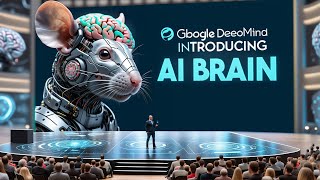
Harvard and Google DeepMind built an artificial neural network that controls a virtual rat in a physics simulator. The network's activity patterns matched real rat motor cortex recordings, and researchers can now run experiments on the digital brain that would be impossible on living animals.
Chapters
In this video, we will be talking about one of the most incredible breakthroughs at the intersection of neuroscience and artificial intelligence. Researchers from Harvard University and Google DeepMind have achieved something really astonishing. They've created an artificial brain for a virtual rat that can control the rat's movements in an ultra realistic physics simulation. This groundbreaking work, which was published in the prestigious journal Nature, opens up huge new possibilities for understanding how real brains work and how they control complex behaviors. It could also lead to more advanced and adaptive robots in the future. So let's break down exactly what this Harvard DeepMind team has accomplished and why it's such a game changing achievement. Alright, so the first monumental task was constructing an accurate biomechanical model of a rat's body in a sophisticated physics simulator called Mujoko. This virtual rat had to obey the laws of physics with factors like gravity, force, friction, and the musculoskeletal mechanics of a real rodent's body coming into play. The researchers drew from a vast dataset of high resolution motion data recorded from real rats engaging in all kinds of natural behaviors and movements. This gave them an incredibly rich source of information to build and validate their virtual rodent model. But having an anatomically accurate rat body was just the first step. The team then had to create an artificial neural network that could learn to control this virtual body's biomechanics and and replicate the diversity of movements seen in the biological data. This is where Google DeepMind's expertise in machine learning came into play in a huge way. The DeepMind researchers collaborated closely with Harvard to apply advanced deep reinforcement learning techniques to train the artificial neural network which would serve as the virtual rat's brain. Specifically, they used an approach called inverse dynamics modeling, which is how our own brains are theorized to control complex movement. When you reach for a glass, your brain doesn't manually move each muscle. Instead, it rapidly calculates the desired trajectory and translates that into the required forces and torques to make it happen smoothly. The virtual rat's neural network was fed reference motion trajectories from the real rat data as inputs. Through deep reinforcement learning, it learned to output the precise pattern of forces that could actuate the virtual body's joints and musculature to successfully recreate those trajectories in the physics simulation. What makes this even more remarkable is that the neural network could generalize what it learned to produce realistic rat behaviors and movement sequences that it was never explicitly trained on. Just like a biological brain, it exhibited broad generalization capabilities. Now, with this virtual rat brain successfully Controlling the biomechanical model, the researchers could then probe the activations and dynamics within the neural network and to gain insights into how real rat brains might control movement. Stunningly, they found that the patterns of neural activity in the virtual brain lined up incredibly well with neural recordings made from motor cortex and other brain regions in behaving rats. This suggests the deep learning algorithm discovered internal models and motor control principles similar to those employed by biological brains. One of the key properties the virtual brain exhibited was the ability to spontaneously transition between different operational regimes based on context, closely mirroring how rodent brain dynamics are observed to switch between distinct patterns for different behaviors like grooming, running, or rearing. The researchers could also analyze how the network dealt with redundancy. Since there are typically multiple ways to achieve a given movement trajectory, how did it choose the optimal solution? The virtual brain appeared to implement a minimal intervention strategy to make only the minute corrections needed, avoiding unnecessary expenditure of energy or forces. Now this aligns with theories of optimal feedback control that neuroscientists believe biological motor systems evolved to implement. The virtual rat's brain was discovering these principles from scratch simply by trying to generate naturalistic movement. Another powerful insight came from analyzing how variability or noise in the neural activations mapped to variability in the virtual rat's kinematics and dynamics. There were clearly structured patterns in how neural fluctuations caused specific types of movement deviations. This kind of variability signature is essentially invisible from just looking at the overall movements, but a window into it could shed light on the neural coding strategies used by the brain. Having a fully observable and controllable virtual system made these insights possible. Alright now, while there's still much more to explore, it's clear this virtual rat brain has opened up a new paradigm for investigating motor control and broader brain function that was simply intractable before. Rather than being limited to just recording neural signals during behavior, neuroscientists can now probe and perturb an accessible model of the entire brain body environment. Control loop in Simulation It's a new frontier of what some have dubbed virtual neuroscience. This virtual rat platform provides a convenient sandbox for testing theories about how neural circuits implement specific computational processes like state estimation, predictive modeling, optimizing costs and rewards, and orchestrating coordinated patterns of movement. Even more powerfully, it allows constructing simulated neural networks with arbitrary architecture, connectivity patterns, neuron properties, and learning rules, then seeing how they give rise to emergent dynamics and behavioral capabilities. It's an unprecedentedly transparent window into the neural mechanisms behind both overt actions and the COVID cognitive processes supporting them perfectly controlled experiments and causal manipulations become possible in a way that's vastly more difficult with biological specimens alone. There are also exciting opportunities to use these kinds of virtual brain body models to simulate neurological conditions or injuries. By introducing targeted perturbations or lesions, it could provide a powerful new way to gain insights into brain disorders and test putative therapies or neural prosthetics in silico before animal trials. And then even if we go beyond the neuroscientific implications, this advancement also has immense potential for revolutionizing robotic control by reverse engineering how biological intelligence emerges from distributed neural dynamics. While classical control theory has given us robots that can perform specific pre programmed routines, modern AI and deep learning has already shown an ability to generalize and respond to open ended real world environments in more flexible, intelligent ways. However, most existing robots are still incredibly clumsy and inefficient compared to even a simple animal nervous system's ability to coordinate dexterous movement using distributed sensor motor control loops deeply entangled with the physics of their embodiment. By studying how the virtual rat brain coordinates its virtual biomechanics, roboticists may be able to abstract out the core principles and neural architectures responsible for this biological intelligence and port them into new robotic platforms. We could see robots that dynamically adapt their control strategies in response to their environments, develop realistic general movement skills, optimize force and energy expenditure like animals do, maintain robust operation despite sensor or mechanical failures, and ultimately become far more versatile and capable autonomous systems. Alright, now I want to talk about nuclear fusion, which is a hot topic lately. And while you might be wondering what nuclear fusion simulation has to do with any of this neuroscience stuff, well while it may seem unrelated on the surface, there are deep connections in terms of the tools and approaches being used. As part of their work on studying massively complex scientific phenomena, the Researchers at Google DeepMind have developed Torax, an open source differentiable tokamak core transport simulator implemented using advanced machine learning frameworks. Like jax, Torax can simulate the flow of particles, heat and electrical currents inside the core of an experimental nuclear fusion reactor, which is an extraordinarily complex coupled system of non linear differential equations describing magnetohydrodynamic plasma physics. Like the virtual rat brain work, a key innovation in Torax is its tight integration with powerful machine learning techniques to solve these kinds of incredibly high dimensional physical modeling challenges. Specifically, Torax leverages JAX to enable just in time compilation for lightning fast compute times as well as automatic differentiation to be able to compute gradients of the entire plasma simulation pipeline. This allows using gradient based optimization methods to calibrate the parameters and and couple data driven machine learning surrogate models like neural networks trained on gyrokinetic turbulence simulations into the core physical calculations. So in essence, Torax combines high fidelity physics modeling with state of the art machine learning in a differentiable programming framework, an approach very similar in spirit to what enabled the virtual rat brain breakthrough. Both are exemplars of a powerful new paradigm for tackling the mind bogglingly intricate problems in computational neuroscience, biophysics, plasma physics and many other domains of complex systems analysis. In fields like materials science and chemistry, we could virtually prototype new materials by simulating their atomic and molecular dynamics using physics constrained machine learning models. This would speed up the design and discovery of novel compounds with customized properties for things like energy storage, catalysis and quantum computing. Similarly for aerospace engineering, virtual models with AI could drive breakthroughs by optimizing aircraft and propulsion system designs through realistic simulations of aerodynamics and turbulent fluid flows. Combined with learned surrogate models, the possibilities even extend to fundamental physics. Projects like the virtual muon experiments at Fermilab are using differentiable simulation and AI to analyze massive particle collision data, enabling new insights into the nature of matter and forces at the subatomic scale. As these virtual modeling capabilities improve, we might even be able to create digital twins or simulations of entire cities, societies, economies and ecosystems. Essentially massive multiplayer simulations to play out scenarios and policies before the real thing straight out of sci fi. Of course, as these virtual world simulations become hyper realistic, they raise profound ethical questions about preventing self awareness or existential risks like what are the implications of virtually replicating conscious minds? Deep issues we'll need to tackle. But there's no doubt that the rise of virtual modeling and AI accelerated simulation is a pivotal shift for understanding and engineering complex systems across science, technology and even social systems. A new age driven by cutting edge simulations and AI. Alright, don't forget to hit that subscribe button for more updates. Thanks for tuning in and we'll catch you in the next one.










