Google Introducing New AI - VideoPoet: The Future of AI in Multimedia
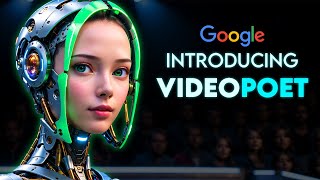
Google released VideoPoet, an AI tool that generates videos from text, images, or existing videos. It can stylize footage, fill in missing parts, and convert audio, with uses in digital art, film, and interactive media.
Chapters
So Google introduced a new AI tool that is absolutely mind blowing. It's called Video Poet, and it's an AI model specifically designed for video generation. It can create amazing videos from text, images, or even other videos. It can also do things like video stylization, video inpainting and outpainting, and video to audio conversion. So VideoPoet is a large language model similar to the ones used for text, but it's trained on a vast collection of videos, images, and audio clips. It operates using a technique known as autoregressive language modeling. This method works by generating content one piece at a time, with each new piece depending on the ones before it. For instance, given the word hello, an autoregressive language model predicts the next word, like world, based on how likely it is to follow hello. It continues this process, adding words one after another. In the case of Video Poet, this process is applied to videos. It treats videos as sequences of tokens, similar to how text is treated. But instead of word tokens, it uses video, image, and audio tokens. These tokens are small elements of multimedia content. Video Poet creates videos by generating these tokens sequentially, each informed by the previous ones, resulting in coherent and realistic videos. It can take various inputs such as text, images, or other videos, convert them into these multimedia tokens, and then produce a video by generating and assembling these tokens in a logical sequence. Now, the tool uses two state of the art tokenizers for this purpose, Magvit V2 and SoundStream. Magvit V2 uses convolutional neural networks and transformers, while SoundStream employs a recurrent neural network and a quantization module. These tokenizers efficiently handle complex multimedia content. So incorporating these into its architecture, VideoPoet converts any input like text, images, or videos into tokens. Then its autoregressive language model generates new output tokens based on these inputs. Finally, the tool reassembles these tokens back into videos, images, or audio using the inverse functions of Magvit V2 and Soundstream, allowing it to create dynamic videos from various inputs. Now, this tool is actually capable of various tasks. For example, it can create videos from text if you give it a sentence or a story, like a dog chasing a ball in the park, it will make a video showing exactly that, complete with realistic movements and sounds. It can also turn images into videos. Give it a photo or a drawing, such as a person smiling, and it will create a video of the person smiling naturally. Another cool thing VideoPoet does is video stylization. It can apply different artistic styles to a video. Say you have a cityscape video and you want it to look like a painting. It can do that, adding artistic effects. It's also good at video in painting and outpainting, where it fills in or extends parts of a video. For example, if you have a video of someone walking against a green screen and want to change the background to a beach, it seamlessly blends it in. It can even turn videos into audio clips. If you have a video of someone talking, it can create a clear audio clip of their voice. What's really impressive is how Video Poet handles complex motions in videos, making them up to 30 seconds long with smooth and realistic transitions. The videos are consistent, logical, and mostly free of errors. They can even be creative and unique without losing realism. The examples of videos created by this tool look professional and are quite astonishing. Seeing how good VideoPoet is at creating these videos, I'm sure you'll be as impressed as I am now. Apart from its ability to generate videos, this tool has some cutting edge features that enhance its capabilities. One key feature is zero shot video generation. It can create videos from any input right away without needing any specific training or adjustments for that particular task. This is possible because it's been trained on a huge variety of videos, images and audio from many different areas and styles. Another feature is its multimodal generative learning objectives, so it can handle and create content that combines different forms like video, image and audio. It achieves this through specific learning goals designed to understand how these different types of content relate and interact with each other. For instance, it has a cross modal objective that helps ensure the output matches the input across different forms. It also uses a self attention objective which helps create outputs that are both coherent and varied within the same form. These goals enable Video Poet to learn and generate content that is not only diverse, but also rich in expression. Finally, Video Poet can create longer videos up to 30 seconds, which is longer than what's typical for this kind of model. It does this using a hierarchical structure that breaks the video into segments and works on each one individually while keeping the overall flow and quality consistent. It also has a memory mechanism that holds information from previous segments and uses it for generating subsequent ones. Now in the real world, this tool has many uses in digital art. It helps artists create unique and expressive animations, illustrations and paintings. For film production, it's useful for editing, post processing, and adding special effects, helping filmmakers enhance their storytelling. It also plays a role in interactive media like games and virtual reality, where it can create responsive, adaptive and immersive content. However, Video Poet isn't without its challenges. It faces technical difficulties, especially in maintaining consistency in long videos and generating realistic motions. To overcome these, it uses a hierarchical architecture and a memory mechanism for temporal consistency, and employs a universal tokenizer and language model for high fidelity motions. Talking about what's next for Video Poet and technologies like it is really interesting. It is already an advanced tool with a lot of promise for the future, but it could grow and get even better in several ways. Firstly, it could get even more data to learn from, including different types like text, speech and music. Then it could be doing more kinds of tasks across more fields. Right now, it can turn text or images into videos, add styles to videos, and even convert videos into audio. In the future, this tool might be able to take a long video and turn it into a shorter version that includes all the main points. And there's the creative side of things. Video Poet can already make unique videos from inputs like text, pictures or other videos. But if it starts using new methods like adversarial learning, reinforcement learning or meta learning, the videos it creates could be even more groundbreaking and captivating. So what's your take on Video Poet? Do you find it fascinating, a bit overwhelming, or perhaps even intimidating? Feel free to share your thoughts. If you liked learning about this. Don't forget to subscribe and stay tuned for more exciting AI and tech updates. Thanks for tuning in and see you in the next one.










