Google & Microsoft Unveil New Futuristic AI Health Systems!
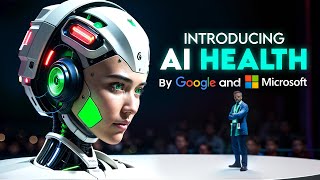
Google and Microsoft announced new AI systems for healthcare, focusing on data management, patient care, and operational efficiency. The video examines how these tools work and raises ethical concerns about their deployment in medicine.
Chapters
Two of the biggest tech companies in the world, Google and Microsoft, have just announced some new AI initiatives for the healthcare industry. Google and Microsoft are going head to head in the race to revolutionize healthcare with AI. And essentially it means that we are getting closer to a future where AI can help us improve our health, our well being and our quality of life. So what exactly are these new AI initiatives and how are they going to impact the healthcare industry and us as patients? Well, that's what I'm going to explain in this video, but before I do that, make sure you hit that like button and subscribe to my channel if you haven't already. Alright, so healthcare is a huge and complex sector that deals with massive amounts of data, from electronic health records and medical images to lab results and prescriptions. And this data is not only diverse and voluminous, but also sensitive and critical for making life saving decisions. However, a major issue is that this data is often stored in separate systems that don't talk to each other. This makes it difficult for healthcare professionals to quickly access and study the data. Because of this, patients and medical providers face challenges like sometimes patients need to complete the same forms at different doctor visits or wait a long time for test results. Also, medical reports and bills can be hard to understand. If you've experienced any of these, you'll know the challenges I'm discussing now. Google and Microsoft have an answer. On October 10, both companies introduced new AI projects to help healthcare groups gain better understanding and enhance the experience for patients and doctors. First, let's talk about Microsoft. Microsoft introduced a new data and analytics platform for healthcare called Microsoft Fabric. This platform was first unveiled in May of this year, but now it has been previewed with select customers like Northwestern Medicine, Arthur Health and SingHealth. Microsoft Fabric is designed to unify data and insights through one common architecture and experience. It allows healthcare organizations to combine data from various sources such as electronic health records, images, lab systems, medical devices, claims systems and more. And it provides a secure and governed way for organizations to access, analyze and visualize data driven insights across their organization. What does this mean for you? Think about being able to see your whole medical history in one spot. Every test, prescription, diagnosis and treatment, all in order. Now picture your doctors accessing this info easily from anywhere, without digging through different systems. Plus, they can also view insights from broader health data or clinical studies. This is what Microsoft Fabric does. It lets healthcare professionals see a complete picture of a patient's health and decide based on facts. It also helps patients know more about their health and be more involved in their care. Northwestern Medicine's CIO Doug King, speaks highly of Microsoft Fabric. He says that Northwestern Medicine, being one of the largest health systems in the US has many data sources such as electronic health records, imaging systems, and genomic data. The challenge is that these sources are often isolated and difficult to combine. Microsoft Fabric helps them by creating a unified data platform. This platform makes it simpler and quicker to access and analyze data. As a result, they can enhance clinical results, increase operational efficiency, and boost patient satisfaction. Sounds pretty cool, right? But that's not all. Microsoft also introduced some new AI solutions that leverage the power of Microsoft Fabric and Azure AI to provide more advanced capabilities for healthcare. Let me tell you about some of them. First, there's the Azure AI Healthbot that assists both healthcare workers and patients. This chatbot can help in scheduling appointments, verifying insurance and checking symptoms, among other tasks. It gathers information from an organization's data and sources like the FDA and NIH. Plus, it ensures the information provided is both credible and accurate. Another tool, Text analytics for Health, extracts vital medical information from diverse unstructured data, including clinical notes and research papers. It recognizes terms like symptoms and diagnoses and understands their connection connections. This tool also works in several languages, including English and Chinese. It helps health professionals quickly process and gain insights from large volumes of text. Lastly, Azure AI Health Insights offers detailed analysis and visualization of health data. For instance, the Patient Timeline model gives a chronological overview of a patient's medical history, spotlighting major events. The Clinical Report Simplification model converts intricate medical jargon into patient friendly language. Additionally, the Radiology Insights model identifies mistakes in radiology reports and suggests potential corrections or next steps. Microsoft's AI solutions for healthcare seem promising, but what about Google? Let's talk about it. So Google also announced a new AI project for Healthcare on October 10th. This project is part of Google Cloud that has been working on applying AI to healthcare and life sciences for a while now. But this new project is something different. This project is focused on providing doctors and other providers with the ability to find patient data more easily and efficiently. It uses generative AI to create a unified search interface that can access data from multiple sources such as electronic health records, images, lab results, prescriptions, etc. It also uses natural language processing to understand queries in plain language and provide relevant answers. The project also aims to help doctors and other providers with some of the clerical tasks that often take up a lot of their time and energy. These tasks include things like documenting visits, coding, diagnoses, billing, insurance, etc. Google said that these tasks often lead to extra work and burnout among healthcare workers, and they want to use AI to automate some of these tasks and make them easier and faster. Google said that they are still in the early stages of using AI in the medical field, but they are already seeing the potential for better healthcare experiences and accelerated development in life sciences. They said that they are working with partners like Mayo Clinic, Ascension, HCA Healthcare and others to test and improve their AI solutions. I believe we're entering a period where AI will significantly influence healthcare, providing us greater access to our health data and more control over decisions. It offers the potential for care that's more personalized to individual needs and may even provide increased chances to participate in medical research. However, it's essential to recognize the risks. We'll need to be cautious about how our data is managed and shared. It's vital to ensure the advice from AI systems is accurate and consider the ethical aspects of AI in healthcare. As patients and citizens, it's up to us to champion our rights While both Google and Microsoft are making notable advancements in AI for healthcare, it's essential to consider the industry dynamics. Are we witnessing the beginning of a collaborative effort where both giants pool resources for the common goal of revolutionizing healthcare? Or is this a budding rivalry in the making? Historically, these tech titans have had their areas of competition, from search engines to cloud services. However, healthcare, being as critical as it is, has presents an arena where collaboration might offer more significant benefits than rivalry. Pooling knowledge, data and resources could expedite breakthroughs. On the flip side, healthy competition could foster innovation, pushing each entity to outdo the other, leading to rapid advancements. Whichever route they choose, the ultimate beneficiary will hopefully be the global patient community, as long as the focus remains on delivering optimized patient centered care. What's your take on this? Are you optimistic about these AI advancements by Google and Microsoft? Do you think they'll improve healthcare? And can AI ever truly substitute human medical professionals? Share your thoughts below. I hope this video provided some insight. If you found it informative, please like and share. And to keep up with more content on AI, don't forget to subscribe and turn on notifications. Thanks for watching and I'll see you in the next one.










