Google Unveils 12 New AI Tools - 3 Will Freak You Out!
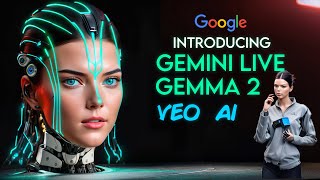
Google announced 12 new AI tools at their developer conference, including Project Astra for real-time video understanding, AI teammates that work alongside you, and Veo, a video generation model. The speaker weighs the potential against privacy concerns and questions whether these tools will actually work as promised.
Chapters
You think you understand how powerful AI is, think again. Because the bombshell announcements Google dropped at IO this year are about to completely redefine what this technology is capable of. Their annual developer conference was an absolute banger, packed with game changing AI tech that'll make your head spin. So let me break it down for you. First up, they unveiled Project Astra, a mind blowing AI agent that can literally perceive the world around you through sight and sound in real time. So basically, this thing will be watching your every move, listening to your conversations and reasoning it all.
I see a speaker which makes sound.
What is that part of this speaker called?
That is the tweeter. It produces high frequency sounds.
But here's where it gets wild. Project Astra can process all those video frames and audio inputs, stitch them together into a chronological sequence of events, and store that data for swift recall later on. Do you remember where you saw my glasses?
Yes, I do. Your glasses were on the desk near a red apple.
Like if you need the specific time your roommate spilled that tub of salsa all over the couch, Astra will deliver the precise timestamp along with images to prove it. Of course, the privacy implications here are concerning, to say the least. Having an AI essentially spy on your entire life. 24. 7. That's some black mirror type stuff right there. But hey, Google assures us it'll all be above board and secure. We'll just have to wait and see on that one. Moving right along, Google also teased these new AI teammates that'll integrate directly into their workspace suite. Basically, you'll have your very own virtual assistant helping you crush it at work. They demoed one particularly slick use case where the AI automatically organized all your expense receipts from emails into a tidy spreadsheet. But that's just the tip of the iceberg. Apparently these AI teammates can also answer questions based on the context of your emails, meetings and other workplace data. So essentially, the world's best note taker, permanently on your team. The real showstopper though Google's new Veo video generation model, this bad boy can craft stunning 1080p videos from text, image or video prompts alone. Go ahead, describe the trippiest, most outrageous scenario you can imagine. VEO will bring that fever dream to vivid cinematic life before your very eyes. But don't just take my word for it. They also launched an accompanying tool called Videox that lets creators storyboard and direct entire video sequences using veo's capabilities. Of course, I can already see the deepfake masters rubbing their hands together in anticipation. But hey, That's a debate for another day. I'm just here to marvel at the tech. Speaking of marveling, let's talk Google Search and all the fresh AI goodness they're injecting into it. Google claims their new AI overviews will condense search results into concise contextual summaries tailored to your query. Instead of parsing links yourself, their AI will theoretically synthesize the useful info into clean overviews. Sounds great in theory, but I need to see if it actually delivers in practice before getting too excited. Even more intriguing is their plan to add video search capabilities. You could show Google's AI a clip of something like a busted faucet and it would analyze the visuals to provide relevant fix it guides. As someone who's clueless about repairs, that could be a game changer for quick DIY help. But again, I'm staying skeptical until I see their video analysis chops proven out. Google's hyping these AI search upgrades hard, but I'm reserving full judgment. The overviews and video search sound awesome if they work as promised, but big tech has a habit of overselling revolutionary features before, so I need to test drive this myself first. Now let's dig into those meaty Gemini model updates because there's a lot to unpack here. So here's my take on those updates from Google. Pumping up the context window to 2 million tokens is a big deal for Gemini's memory capabilities. In theory, this AI should be able to retain and recall way more contextual information from your conversations and queries without making you constantly re explain things. Sounds great on paper, but I'm curious if that expanded memory will actually work seamlessly in practice. What's even more intriguing though, is Google claiming they've broadly supercharged Gemini's performance, from coding skills to logical reasoning to visual perception. If that's truly the case, you it would represent a massive leap for their already impressive language model, but I need to see legitimate third party benchmarks and testing before fully buying the hype around these sweeping AI capability upgrades. Alright then there's Imagen 3, the latest evolution of Google's Text to Image generator, which I gotta say is already blowing my mind with its previous iterations. This new version promises even more astonishingly photorealistic visuals transcribed directly from written prompts. We're talking I can't believe this isn't a real photo levels of detail here. On top of that visual wizardry, Google's souped up Gemini is getting optimization updates like Gemini 1.5 Flash, a leaner, meaner version, laser focused on blazing fast performance with a still respectable 1 million token context window. They're also launching Gemma 2, the open source spiritual successor to their existing AI models that'll run smoothly on just about any GPU or TPU setup you can throw at it. This is significant news for enthusiasts and hobbyists who are eager to delve into advanced machine learning applications. But maybe one of the coolest things Google announced that I didn't expect them to roll out so soon is Gemini Live, an experience that'll let you converse with their AI in real time using just your natural speaking voice. With Gemini Live, you simply tap the voice icon in the app and you're set for a chat with cool audio effects on a full screen. You can speak comfortably at your own pace, interrupt to ask questions or get more information, and pick from 10 different voices. It's similar to what OpenAI did in their spring update with the new GPT4. So now I'm curious which model will perform better and feel more natural. This is undoubtedly the direction AI assistants are heading, so whichever company masters this voice interaction approach will likely dominate the field. Lest we forget, there's also gems on the horizon for all you Gemini Advanced subscribers. These custom AI personalities will basically let you mold your virtual assistant into whatever you need, whether it's an always chipper mood buddy or a brutal no nonsense taskmaster that whips you into shape. At this point you're probably wondering how Google still has any more bombshells to drop, but trust me, they kept them coming. Android is about to get a massive AI overhaul with features like built in on device natural language processing that understands your speech, vision and more in real time without stealing your data. So essentially your smartphone's about to become a bonafide AI co pilot and it'll all happen locally on your device for maximum privacy. Sure beats having to constantly ping those cloud servers. There's just so much ground to cover here. From Gemini agents that can break down complex planning tasks into steps, to TPU hardware chips that make AI blazingly fast, to AI generated search results that cut out the cruft to zone in on exactly what you need. Honestly, I could spend hours gushing about every little announcement and update Google threw our way. Between the language leaps, visual breakthroughs and overall experience upgrades, it's shaping up to be one heck of an AI powered future. One where our digital assistants become true Renaissance robots capable of comprehending our world just as vividly as we do. Now reasonable people might look at all these AI capabilities and understandably get a little freaked out. We're rapidly approaching a point where artificial intelligences can match, maybe even exceed, human facilities in key areas. Where does that leave us? Fleshy meatbags in the grand scheme of things. But you know what? I'm just going to stay hyped about all the incredible conveniences and possibilities AI assistants like Gemini will unlock. From superhuman coding capabilities to flawless note taking to generating entire multimedia landscapes from mere thought, it's going to revolutionize how we work, learn, create, and experience the world around us. Sure, there's still plenty of ethical minefields and societal impacts to hash out, but I have faith that as a species, we're smart enough to navigate those choppy waters. For now, though, I'm just going to sit back and eagerly await a future where AI is my ever present digital sidekick, making my life exponentially more efficient, productive, and downright magical. So what did you think of Google's latest AI showcase? Are you as stoked as I am about our cybernetic co pilot future? Or more of a skeptical doomsayer on the issue? Let me know in the comments below. If you like this breakdown, do me a solid and smash that like button. Subscribe for more hot AI takes and ring that notification bell. I'll be sure to fill you in on all the latest AI breakthroughs, updates and advances as they drop.










