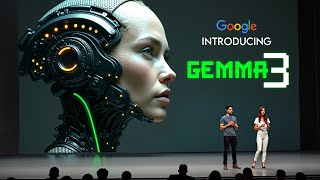
A narrated YouTube overview (by LARRUZ) of Google DeepMind's Gemma 3 family: lightweight, deployable multimodal LLMs (4.1B, 4B, 12B, 27B) with text and vision capabilities via a Siglip vision encoder (frozen 400M backbone producing 256 visual tokens). Key features: support for 140+ languages, up to 128k token context windows using a mixed local/global attention scheme (≈5:1 local:global with 1024-token sliding windows), official quantized releases, function-calling/structured outputs, and broad optimizations for GPUs/TPUs/CPUs (Gemma CPP). The 27B instruction-tuned variant scores an Elo of 1,338 on LMSYS chatbot arena and competes with top open models; Shield Gemma 2 is a 4B image-safety checker. DeepMind offers an academic program with $10,000 in Google Cloud credits for researchers. The video discusses benchmarks, deployment paths (Hugging Face, Kaggle, Ollama, Vertex AI, Cloud Run, Gen AI API), and safety/mitigation steps (data filtering, RLHF, memorization testing).
Questions this video answers
4.1B, 4B, 12B, and 27B parameters.
Up to 128,000 tokens.
A frozen 400 million-parameter backbone that converts images into 256 visual tokens.
An Elo score of 1,338.
Approximately 5:1 local-to-global layers with a 1,024-token sliding window for local layers.
Chapters
Google DeepMind has just rolled out their brand new Gemma 3 models. These models build on a lot of the same research that went into the Gemini series, but they're designed to be super light, nimble and easy to deploy on a single accelerator, whether that's a GPU, a TPU, or even some other hardware like AMD GPUs or a Jetson Nano. They call it the most capable model you can run on one device, but it still packs a major punch when it comes to performance. The reason it's getting so much buzz is that it brings a mix of advanced text and visual reasoning capabilities, has built in support for 140 plus languages, and even handles a massive context window of up to 128,000 tokens, which is seriously big for an open model. But also lately we see it becoming a norm. Now, part of what makes Gemma 3 special is that it's not just about text anymore. We're talking true multimodal, so you can actually feed it images, short videos or text and it'll parse those inputs like a pro. It's using a vision encoder technique called Siglip, which has a frozen 400 million parameter vision backbone that converts images into a series of 256 visual tokens. These tokens then get fed into the language model portion, letting Gemma3 respond to questions about pictures, identify objects, or even read text that's embedded in an image. One of the helpful things they introduced is a so called pan and scan trick that cuts up images into smaller crops to preserve detail, especially when dealing with non square formats or images that have text in them. It helps preserve all that sharpness without stretching or squashing the image into a one size fits all shape. They've released Gemma 3 in 4.1B, 4B, 12B and 27B parameters. By B I'm referring to billions of parameters. Of course the biggest One is the 27B version and it's the star of all sorts of comparisons. In fact, they looked at how it scores on the LMSYS chatbot arena. This is a platform where human raters do blind side by side comparisons, producing something called an Elo rating. Gemma327B ended up with an Elo score of 1,338, which puts it way above older open models like Deepseek V3O3 mini or the 405B membership version of Llama 3. The Elo scores make it super clear that although Gemma 327B is relatively small compared to some of those massive 70B or 400B or even mixture of experts models. It competes seriously well in terms of user preference. Interestingly enough, Gemma 3 introduces a pretty different architecture under the hood to reduce that massive memory overhead you often see when you push Context windows toward 128k tokens. The big trick is that it uses a bunch of local self attention layers interspersed with fewer global layers in a ratio of around five to one. So you might do local self attention for five layers, then global attention for one, and so on. That drastically reduces the memory footprint because not all layers have to attend to the entire 128k tokens. For local layers they're basically working with a sliding window of 1024 tokens rather than 128k and that means your KV cache doesn't blow up. The result is that you can have ultra long context without requiring an insane system with dozens of GPUs just to hold the memory. They've shown that by using five to one local to Jobo layers with that 1024 sliding window, you you cut memory overhead to around 15% instead of something like 60% if every layer had to be global. Another new thing is that they're shipping Gemma 3 with official quantized versions. Quantization means taking all those 16 bit floating point weights and compressing them down maybe into int 4 or some special float 8 representation so the models fit into much smaller memory footprints. They do a short round of quantization, aware training and knowledge distillation, which helps preserve the model's accuracy even though it's using fewer bits. Quantization is huge for running these big models on smaller hardware, so that's a big plus if you don't have an ultra high end GPU or if you want to host it on say a CPU in certain situations. Now Gemma 3 still uses the same sentence piece based tokenizer as Gemini 2.0 with 262k vocabulary entries to cover 140 lengths languages. They rely on knowledge distillation from bigger teacher models, though smaller teachers can work for short training runs. The model also supports function calling and structured outputs so it can natively generate JSON or run function signatures without hacky prompts. They carefully filtered training data, applied RLHF and tested the models for memorization risks or personal data leakage, finding low violation rates and minimal advanced harmful capabilities. Despite these safeguards, developers must still handle safety responsibly when deploying open models like Gemma 3. On the hardware side, the official line is that Gemma 3 has been optimized for Nvidia GPUs Google Cloud TPUs AMD GPUs via ROCM and for CPU execution with something called Gemma CPP. If you're on an Nvidia system, you'll appreciate that they've got direct optimizations from the Jetson Nano to the top tier Blackwell chips. It's even featured in the Nvidia API catalog so you can do rapid prototyping from there. Meanwhile, if you prefer running everything in the Google Cloud, you could spin it up on Vertex AI, on Cloud Run or through the Google Gen AI API. And if you just want to toy around with it on your local machine, you can download the weights from Kaggle Hugging Face or Ollama. Now one more piece that came out simultaneously is Shield Gemma 2, a specialized 4B parameter image safety checker that uses the Gemma 3 architecture. It'll let developers scan images for three categories of content, dangerous stuff, sexual content or violence. So it's basically an out of the box solution to keep your pipeline free of images you don't want in your data set or user feed. You can further customize that if your personal or regional guidelines differ, which is a big plus for developers who want to tailor it to their own safety standards. And since it's built on the Gamma 3 foundation, it should run efficiently on the same hardware or frameworks that you're already using. The other big push is an academic program around Gemma 3. Google DeepMind is offering $10,000 worth of Google Cloud credits to academic researchers who want to do serious research with these new models. That application's open for a few weeks, so if you're in academia and want to harness a 27b parameter model for something new, that might be an awesome opportunity. They're talking about fueling the so called Gemma verse, that broader ecosystem where thousands of variations of Gemma have popped up in the past year. AI Singapore's Sea Lion V3 and Nexa AI's Omni Audio are just a couple of examples. They mention where where the open nature of Gemma models has let people build really specialized derivatives for everything from language translation to advanced audio processing. The technical report that came out sheds a lot of light on how they tested Gemma 3. They mentioned standard benchmarks like MMLU, LiveCode Bench, BirdSQL Math and a variety of multilingual tasks. The 27B instruction tuned version of Gemma 3 is in the same performance league as the best open models. One chart in the technical report shows it's even on par with or above older Gemini 1.5. In certain tasks they rely on improved post training or instruction tuning that uses a multi step approach mixing advanced knowledge distillation from a large teacher model plus reinforcement learning methods that incorporate code execution feedback. This approach is what drives up the performance on math coding, reasoning and conversation. They also tested more intensively around vision tasks such as Doc vqa, Info VQA and Text vqa, demonstrating big improvements when you properly handle images at a higher resolution with that pan and scan method. Some tasks saw a big jump after you apply pns, which is nice for reading text out of images or dealing with complicated aspect ratios. Of course, they do emphasize that if you want to use these models or their code you you can do so via your favorite frameworks. If you like hugging face, you'll find Gemma 3 there. If you prefer Jax, Keras, Pytorch or Vllm, you've got that option. They're also shipping new recipes and code bases for training and inference, so if you want to do your own fine tuning, you can. That includes a function calling workflow, structured outputs, and the ability to handle 128k tokens of context. They say you can run it in your local environment if you've got a decent GPU or do it on the cloud if that's your style. They're just trying to make it super flexible for a wide variety of use cases. They've also indicated that these new Gemma 3 models are trained responsibly, which means they tried to follow a risk proportionate approach. The more powerful the model gets, the more they evaluate it. Gemma3 apparently got a specific check around misuse for making harmful substances and they concluded the risk was low. They also are continuing to refine their approaches, so presumably with each new version they'll improve.