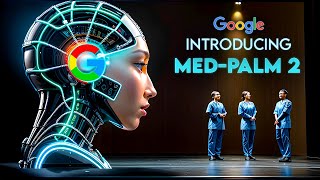
A short narrated YouTube explainer (LARRUZ, July 14, 2023) about Google’s MedPaLM 2 — a healthcare-specialized version of PaLM 2. The video describes MedPaLM 2’s medical capabilities (diagnosis support, document summarization, multilingual support), reports benchmark performance (85.4% MedQA USMLE, 72.3% MedMcQA), and notes real-world testing at institutions such as the Mayo Clinic and NIH. It also highlights benefits (efficiency, accessibility, research acceleration) and outlines ethical and social concerns—particularly trust, transparency, data privacy, bias, and limits of clinical reliability.
Chapters
AI is revolutionizing our world and all types of industries, including healthcare. This field, which impacts everyone, is quite complicated and filled with data and challenges. So that's why AI will play a very important role in it. AI can support doctors and other medical professionals in improving their decisions and patient care, even saving more lives. Now, Google has been creating and using AI solutions in many areas for a long time. They've also put a lot of money into healthcare AI to enhance health results and make it more accessible for all. One of their most ambitious projects in this domain is MedPalm2, a new medical AI that they just unveiled at Google I O 2023. MedPalm2 is a powerful language model that can understand and generate natural language in the context of medicine. It can also perform reasoning and inference based on medical knowledge. So MedPalm2 is a special type of AI designed specifically for the medical field. Google's been in AI tech for a while now. They've built top tier AI models like Google Search, Translate, Photos Assistant and Bard. Now MedPalm 2 is a healthcare focused version of Palm 2, a giant neural network that learns to use language from billions of words across sources. It also manages code, math, logic and several languages. But Palm 2 isn't just one model or product. It's a family of models, models of various sizes and complexities, from the 1 trillion parameter unicorn to the 100 million parameter gecko. It's also a platform adaptable for different purposes and domains, one of which is healthcare. Google understood that healthcare needs specialized knowledge not easily captured by general language models. And it's an area where AI can hugely improve lives. Therefore, they created MedPalm 2, a healthcare focused version of Palm 2 based on Otter, another model in the Palm 2 family. MedPalm 2 isn't Google's first medical AI. They had MedPalm earlier based on Palm 1. While impressive, MedPalm had its shortcomings. It was only trained on English data, struggled with complex medical questions and lacked ethical and social understanding vital for healthcare. That's why they developed MedPalm 2, an improved version of MedPalm, overcoming these issues and adding new capabilities. It's unlike general AIs such as Palm 2 or GPT 4 as it's educated on vast, varied medical data virtual from reliable organizations. This AI is honed for specific medical tasks like diagnosing diseases, planning treatments, patient education and medical research. It improves its precision by learning from medical experts feedback. It caters to several languages and can translate between them, taking into account cultural and regional nuances. It's also programmed with ethical values respecting user privacy, and can clarify its decision making process. Upgraded from MedPalm, the new version processes a wider range of medical data, performs better on medical tasks, supports more languages, and can tackle complex medical inquiries. MedPalm2 is a standout AI model with several impressive features. It can ace US medical licensing exams, achieving 85.4% on the MedQA dataset from the USMLE and 72.3% on the international MedMcQA dataset. This AI excels in summarizing medical documents, sifting through large health data, and answering complex medical questions clearly and concisely. So if you ask about any disease symptoms, it can provide a detailed response. Moreover, MedPalm2 is multilingual and culturally adaptable, capable of translating and responding accurately across languages and dialects. Whether you're asking in Spanish or English with an Indian accent, it delivers precise information. Now let's see how it works in real life and how it benefits people so this is not just a theoretical model that exists in Google's labs. It is actually being tested and used in real world settings by real people. One of the places where it is being tested is the Mayo Clinic, one of the most prestigious healthcare institutions in the world. The Mayo Clinic uses MedPalm2 to help its doctors and medical staff with their work. For example, Med Palm 2 can help doctors with summarizing medical records, finding relevant information from research papers, and answering patient queries. It can also help patients with understanding their conditions, finding reliable sources of health information and asking questions about their treatments. And it is not only being tested at the Mayo Clinic, but also at other hospitals and healthcare institutions around the world. Google has partnered with various organizations to Deploy and evaluate MedPalm2 and in different settings and scenarios. It is being used by the National Institutes of Health NIH to support biomedical research and innovation. It is also being used by various universities and medical schools to train and educate future healthcare professionals. It is set to change healthcare significantly. It boosts the quality of services by supplying accurate medical information, helping doctors in their duties, and facilitating communication between all involved parties like patients and policymakers. Efficiency wise, it lessens the burden and cost of healthcare delivery, smoothens operational processes by automating tasks, and speeds up the discovery of new treatments by analyzing vast health data. It also enhances accessibility by reaching more people, overcoming language and geographical barriers, and offering scalable solutions. It also encourages people to manage their health by offering customized interactive experiences. But it's crucial to explore its potential challenges, limitations and risks. To be honest, this AI isn't a cure all for healthcare and can't replace doctors. It has limitations like struggling with rare conditions or personalized treatment suggestions. It might become outdated, inconsistent or even harmful if misused. But this medical AI is just starting its journey and will keep growing in the future. Google aims to make it more user friendly and affordable, while also including more languages and cultures. They plan to boost its accuracy by using more data and getting more feedback. Google also wants to help healthcare firms tailor MedPalm2 to their needs now we find ourselves facing a major concern once more trust. We must consider whether it's safe to entrust something as crucial as our health to an artificial intelligence model, especially when we're aware that it's backed by a giant profit making corporation like Google. Can we confidently believe that their intentions are noble as we understand every artificial intelligence model is directed and programmed according to the desires of its developer. This implies that we would be depending on Google and any other companies that participate in building these healthcare AI models for our health related matters. This raises some important questions that we need to address before we embrace these AI models as our medical advisors. How transparent are these models about their sources of information, their methods of reasoning and their limitations? How do they handle sensitive data such as our medical records, our personal details and our preferences? How do they ensure that they are not biased or influenced by external factors such as advertisements, sponsors or political agendas? How do they respect our autonomy and dignity as human beings and not treat us as mere objects of analysis and prediction? These are some of the ethical and social challenges that we need to overcome before we can trust these AI models with our health and well being. I'd love to hear what you think about this, so please share your thoughts in the comments section below. Your feedback is very important to me. If you liked this video and you'd like to see more of similar ones, don't forget to hit the like button. Also, subscribing to my channel and enabling the notification bell will ensure you won't miss any of my future videos. Thanks for taking the time to watch and I'll see you in the next video.