Google's NEW AI Model Redefines Reality in Virtual Spaces
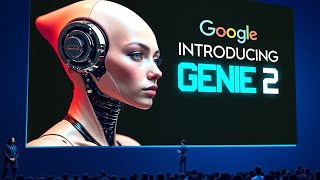
DeepMind's Genie 2 generates 3D worlds from a single image with basic physics and object permanence for about 60 seconds, while Tencent's open-source Hunyuan Video creates photorealistic videos from text or images but struggles with English prompts and needs 60GB of GPU memory to run locally.
Chapters
Walking into a virtual world that literally builds itself as each step is taken, or watching a quick idea become a polished video scene without a massive production crew. This is the kind of future hinted at by Google's new AI model, Genie 2. Meanwhile, Tencent's Hunyan video is giving us a taste of Hollywood level visuals without the Hollywood budget. All completely open source. So let's talk about it. Alright, let's start with Google. DeepMind's Genie 2 if you're not familiar with world models, they're basically AI systems that create and simulate entire environments in real time. Genie 2 is a significant leap from its predecessor, which was stuck in two dimensions. Now we get full 3D worlds generated as you or another AI agent move through them. It's not a game engine though, it's a diffusion model that outputs frames as you explore. Think of it like walking forward in a virtual world and having the scenery appear right before your eyes as if it's being rendered on the fly. This approach allows for the dynamic creation of complex scenes, and even though it's still early days, it offers a window into how future AI driven simulations might evolve. It can even depict basic interactions with environmental elements like water, smoke and simple physics effects, showcasing how these digital worlds could one day feel more reactive and natural. Genie 2 can handle multiple viewpoints, third person, first person, isometric, and it only needs a single image prompt to get going. That prompt can come from Google's Imagine 3 model, or even a photo snapped in real life. Once it starts generating frames, the model tries to maintain internal consistency. It can remember where objects are even after they're out of sight, then reconstruct them accurately when they come back into view. This solves a big problem previous models like Oasis had, but where the environment would forget key details whenever they left the camera's perspective. However, this model isn't perfect. DeepMind admits it can maintain a consistent world for up to around 60 seconds. Beyond that, visual artifacts begin appearing, details degrade, and the illusion of a stable environment breaks down. Most demo clips are shorter, around 10 to 20 seconds, so we don't yet have sustained long duration sequences that feel fully coherent. It's also unclear exactly how Genie 2 was trained, and only that it utilized a large scale video data set. At the moment, DeepMind isn't releasing the model publicly, viewing it instead as a research tool for training and evaluating AI agents. In fact, DeepMind specifically notes that Genie 2 could be used to train and evaluate their own SIMA algorithm, indicating how integral it could become in the development of other advanced AI systems. It could also help artists and designers rapidly sketch out concepts, acting as a creative prototyping engine in in the long run, DeepMind believes that world models like Genie 2 could be crucial in pushing toward artificial general intelligence as they let AI learn in diverse, ever changing simulated settings. What's Particularly compelling about Genie 2 is how it hints at a broader future for AI in fields like game development, virtual cinematography, or even VR training simulations. With a more mature version of such a tool, you could imagine developers rapidly spinning up environments that shift based on a player's actions while preserving certain narrative beats or artistic elements. Future iterations might overcome the short time limit, enabling minutes or even hours of consistent generation. The hope would be that scaling the data set, refining training methods, or incorporating more advanced memory mechanisms could lead to more stable, richer and and far longer lasting worlds. Over time, these models may integrate with traditional game engines or be guided by human designers who provide narrative structures and style parameters. This could produce a hybrid creation pipeline where the raw building blocks of the world are quickly generated by AI, and humans refine and shape the final product to maintain that emotional resonance and handcrafted charm. Alright now, let's take a closer look now at Tencent's Hunyuan video, which has quietly entered the scene. While OpenAI has been teasing Sora for ages, Tencent quietly launched its own solution and made it open source. They claim Honyuan Video rivals or outperforms top notch models like Runway Gen 3, Luma 1.6 and several leading Chinese video generators. According to human evaluations, its results hold up strongly in terms of image quality and motion consistency. Early tests even suggest it can match or surpass the quality of other commercial heavyweights, including Lumalab's Dream Machine and Cling AI, placing Hunyuan Video in the top tier of available solutions. Hunyun Video's architecture is interesting. It uses a decoder only multimodal large language model as its text encoder rather than the standard clip or T5XXL setups. This approach helps it follow instructions better and grasp fine details. It also employs a token refiner that takes a simple prompt like a man walking his dog, and automatically enriches it with more details to produce higher quality output. This refinement can add elements like specific lighting conditions, intricate scene setups or subtle attributes of the subjects, ensuring the final output feels more nuanced and complete than what a brief initial prompt might suggest. The result is more vivid, descriptive generations without a user needing to write a long prompt. Tencent went all in with size, giving Hunyan video 13 billion parameters and training this beast isn't simple. They used a multi stage approach, starting with low resolution image training at 256 pixels, then scaling up and mixing images and video over time. By gradually increasing resolution and length, they achieve stable convergence and good results. The final product can generate text to video, turn still images into moving scenes, create animated avatars, and even produce audio for video content. Now running Hunyan video locally is tough. You need a huge GPU with at least 60gb of memory. That's more than most gaming PCs have, but since it's open source, developers can work around this. There are cloud services like Fall AI offering pay per video solutions and the official Hunion video server sells credits. If you're willing to pay a bit, you can access it without top tier hardware. It's worth noting that early testers report a generation time of about 15 minutes per video, which while not instant, is still a practical turnaround for producing high quality AI generated sequences. Early tests are promising though. Videos can look photorealistic with smooth motion and can depict humans, animals and environments with surprising accuracy. One minor drawback? It's not as strong with English prompts compared to some commercial models. But because it's open source, the community can improve it over time. By releasing Hunyuan video openly, Tencent is challenging not only models like Runways and Lumas, but also setting the stage for competition with upcoming solutions like OpenAI's Sora. This openness matters. For years, the biggest breakthroughs often came from private labs that didn't share their code. Now Tencent's giving developers the full model, which can accelerate innovation. Startups, researchers and indie creators can tweak and fine tune it, close any language gaps and maybe even push quality beyond what Tencent achieved. Think of it as a community driven R and D approach to video generation, comparing Genie 2 and Hanyuan video. Genie 2 focuses on generating entire 3D worlds for agents to move around in real time, mainly for training or testing AI. Hanyuan Video focuses on generating video content, photorealistic sequences and animated scenes, and more. Genie 2 is about environments and interactable spaces, while Hunyun Video is about producing high quality video from text or images. Both represent important frontiers in how AI can create visual content on demand. Where does OpenAI's teased Sora fit? OpenAI's been on a roll with ChatGPT image models and various improvements, but Sora remains a no show. Meanwhile, Tencent just released a tool that might match or surpass what we've seen from commercial generators. This could prompt OpenAI to move faster or offer something more groundbreaking, we'll see how OpenAI responds. Will Sora arrive with a splash, or has Tencent already raised the bar too high? As these models evolve, we'll find out what direction the industry takes. Until then, keep an Eye on Genie 2 and Hunyuan video. These are signs that the future of AI generated worlds and video has already begun. All right, let me know what you think in the comments and if you enjoyed this. Make sure to like and subscribe for more AI updates. Thanks for watching and see you in the next one.










