Googles New Humanoid Robots Are Incredible - Gemini 2 Robotics
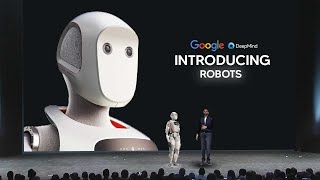
Google integrated Gemini 2.0 into humanoid robots, giving them better reasoning and dexterity across different tasks. The robots can generalize what they learn to new environments, opening up possibilities for real-world applications.
Chapters
Google have actually brought us a really stunning update to how they're advancing robotics. And in this video, I'll dive deep into one of the new models that they've embedded into humanoid robotics that really progresses the field. So essentially in this video, what you're going to see is how Gemini 2.0 is integrated into robotics and how this is progressing with the Apptronic platform and integrating robotics into the real world. It's truly interesting because these robots are now at the stage where they're able to do a lot more than previous iterations. I'm sure some of you may have seen go Google's previous ones before, but the update here is truly, truly impressive. With the ability of these robots to reason about the physical world, we're bringing.
Gemini 2.0's intelligence to general purpose robotic agents in the physical world to be helpful. Robots need to be interactive, responding live to your actions and your voice. They need to be dexterous to complete your most complex tasks. And they need to be general to understand things in your 3D world. And all of these capabilities need to work across different physical forms. We're bringing this together in Gemini Robotics, our most advanced vision language action model. Gemini Robotics is interactive.
Can you put the bananas in the clear container?
Notice how we move the objects. And the model reacts and replans on the fly.
And you put the grapes in that clear container.
Our model's low latency means it can respond live to rapidly changing conditions and instructions. This same model can generalize to all kinds of applications where you can collaborate with the robot live. Gemini Robotics is dexterous. High dexterity tasks are some of the biggest challenges in robotics.
I can fold the orange square into an origami fox.
That sounds fun. Why don't we try that?
Sure. Did you know that the word origami comes from the Japanese words ori meaning to fold and kami meaning paper?
These capabilities are enabled by Gemini 2.0's spatial understanding of detailed aspects of things in your world.
I can point to where the eye should be drawn on the fox.
Most importantly, Gemini Robotics is general. It uses Gemini 2.0's world understanding to generalize across a vast range of real world tasks.
Can you flip the red die so that it matches the number on the green die?
Many robots can execute predefined actions, but these movements are not predefined. The robot is reasoning both about what it sees and and how to move. It figures out how to make the red die match, just like we asked. And this generalization goes even further. This same Model can generalize to tasks like this one that it's never been trained to do.
Pick up the basketball and slam dunk it.
Keep in mind, these are objects the robot has never seen before. But by leveraging Gemini 2.0's understanding of concepts like basketball and slam dunks, the robot figures out the task. We're now inviting more partners to join our trusted testers program where we're working together to build the next generation of robotic AI agents.
Now, one of the key features of Gemini Robotics was the fact that this can actually perform tasks without specific training, which means that it can do it zero shot or with only a handful of demonstrations, which is what they call few shot. Now this is really important because traditionally robotic systems usually require extensive task specific training. Gemini's method reduces the amount of data needed for a robot to adapt significantly. And this makes it so much easier and faster to teach robots new tasks. And the crazy thing about this is that it can even generalize to tasks it has never seen before. This is something that I do think is really, really important a lot of the times. Many critics of robotics and AI do say that these models and systems aren't able to generalize outside of their training data. And with this kind of progress, this means that now robot won't have to be purely trained in a simulation that's exactly like their physical world in order to function effectively. They'll simply be able to use the model that's embedded within them to analyze the environment and make decisions quite like how humans make decisions on a day to day basis.
Help me get organized. Let's start by putting the pen with the other pencils.
Okay, I will move the pen with the other pencils.
Pick up the basketball and slam dunk it.
Okay, I will pick up the basketball and slam dunk it through the net.
Good job.
Now in the interactive update, they talk about how this can respond to not only new environments, but but rapidly changing environments. So this is where we have the robot actually allowing itself to understand and dynamically update where it's moving things, as well as being able to do that as things move around in that environment. So in this clip you can see this human is able to move different things around and the robot is able to analyze in real time where the objects are and then fulfill and complete its tasks. I think that this is something that is once again really important because in the real world, the real world is constantly changing. As you're crossing a street, cars are moving by, and sometimes in your environment, things are moving around you. Maybe you Have a pet, maybe someone's moving the table or something. And you will need to constantly be aware of your surroundings in order to be remarkably effective. And seeing the robot do this in real time is something that is really, really impressive. And one of the key things here that I think is even more impressive, that most people may have not picked up on, is that this is in one time speed and is fully autonomous. Many times before with robotics demos, we've often seen these demos at 5 times speed due to the slow nature of the policies. But clearly Google have managed to do something innovative when it comes to the efficiency, because what we can see here is that this is relatively fast and even for humans. So I would say that this update is showing us just how quickly the pace of robotics is going.
Can you put the bananas in the clear container? Can you put the grapes in the clear container? Can you put the grapes in the pink container?
Hey, can you erase the whiteboard for me?
Now, one of the most important things for robotics is the ability to have fine motor skills and coordination. And in this demo, we can see that Google Gemini is able to do this with a remarkable level of efficiency. The robot is able to do very complex and very intricate tasks, such as placing glasses into a holder, such as also using the Apollo robot to place these pieces of the game set onto the board, and also being able to fold paper in a really precise manner. And I think that this is really important because the scale of what you can do with the robotics platform is often limited by the hardware. But if you can take very, very basic hardware, like these two grippers in robotics, and you're able to complete a wide variety of tasks, it does mean that in the future, when you do have something that has more degrees of freedom, it's quite likely that you're going to be able to do a wider range of tasks, leading to more applications and probably even more than humans are initially used to. So I do think that this is going to be something that is really, really important, because maybe in the future we may actually see robots do things with their hands that humans really just can't do. And I think that is going to be a real shocker when that does occur in the future. Now, something really interesting that I found to be probably one of the most important features of the Gemini platform is the fact that this can swiftly adapt to new robot platforms, and it can be moved to humanoid robots by arm industrial robots, and it can do this all with minimal data. Now, the reason that this matters so much is that deploying robotic Intelligence across different types of hardware platforms is often quite challenging. And Gemini's approach shows impressive adaptability, enabling the same model to generalize quickly to new robot shapes and capabilities. And they've demonstrated that, you know, successfully adapting Gemini robots from a bimanual robot to a humanoid robot with five fingered hands, and this allowed it to quickly execute intricate manipulation tasks. So this is clearly something that across the board will advance the field of robotics. Imagine you're able to put one unified model into a robot and it's immediately able to be used pretty much just like a software update. And I think across the industry this week alone, we've seen many different robots show us that their hardware limitations aren't as big as we thought. And with the continual progression of these internal models, we're likely to see more generalization across the board. Now, Gemini Robotics Robotics also introduced Gemini Robotics er, which is a vlm, a vision language model with an unprecedented ability to deeply understand the physical environment through enhanced embodied reasoning. And this matters a lot because traditional robots mostly perform isolated tasks in pre programmed settings. And Gemini Robotics ER allows robots to inherently reason about spatial concepts, object affordances, for example, where it wants to grasp 3D spatial relationships and trajectories intuitively, much like humans do naturally. So where this was proven is that Gemini Robotics ER demonstrates state of the art performance in those benchmarks, which we hadn't seen before. And I think this is really important because it shows us that Google is at the frontier of advancing robotics. So let me know what you thought about this update from Google. I think this is one of the most underrated things I've seen so far. I do think that the AppTonic platform is really cool and I can't wait to see more updates from Google as they've had pretty impressive updates in the past that have truly stunned the Internet.










