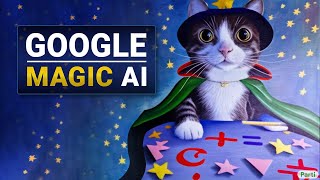
A short YouTube commentary (Two Minute Papers) by Dr. Zsolnai presenting and reacting to Google’s new image-generation model, Parti. The speaker compares Parti to earlier systems (OpenAI’s DALL·E2 and Google’s Imagen), highlights Parti’s strengths (autoregressive approach, better handling of text and long prompts, improved object-count control), shows example outputs, and notes how capabilities improve with roughly 50× increases in model size. The video ends with benchmark/prompt suggestions and a sponsor mention (Lambda GPU Cloud pricing claim).
Questions this video answers
July 30, 2022.
An autoregressive model (explicitly contrasted with diffusion-based models).
About 50 times larger model size produced markedly better results (speaker cites ~50× increase).
Lambda: $1.10 per hour vs AWS: $4.10 per hour (claimed 73% savings).
Chapters
Dear fellow scholars, this is two minute papers with Dr. Zsolnai. I cannot tell you how excited I am by this paper. Wow. Today you will see more incredible images generated by Google's newest AI called Party. Yes, this is not from OpenAI, but from Google. So what is going on here? Just a few months ago, OpenAI's image generator AI called Dall E2 took the world by storm. With that, you could name almost anything. Cat, Napoleon, a teddy bear on a skateboard on Times Square, a basketball player dunking as an explosion of a nebula. And it was able to create an appropriate image for it. It is also good enough to be used in our own thumbnails. However, there was one interesting thing about it. What do you think the prompt for this must have been? Hmm, not easy, right? Well, it was a sign that says deep learning. Oh yes. This was one of the failure cases. Please remember this now. We always say that in research, do not look at where we are, always look at where we will be. Two more papers down the line. That is the first law of papers. However, we didn't even make it to two more papers down the line. What's more, we barely made two months down the line. And scientists at Google came up with an amazing follow up paper. It was called Imagen. Imagen was absolutely incredible as it could now finally synthesize text properly. It could also understand when we say a couple of glasses on a table and won this little linguistic battle against OpenAI's Dall E2 and all this just two months after it. That is absolutely amazing. But hold on to your papers because you won't believe this one. I certainly didn't when I saw it first. Just about one month after Imagen, here is an even newer paper on AI image generation called Party. That is fantastic. Welcome to our world, little AI. But why does this exist? Well, this is why. I'll explain in a moment, but first let's have a look at what it can do through three of my favorite examples, and then we'll discuss why it exists. 1. Let's start with the banger and recreate the legendary Napoleon Cat with the method. This is Dall E2's solution. And let's see the new one. I cannot believe it. This is at least as good as Dall E2's legendary solution. And I have to say, maybe even a touch better. What a time to be alive. 2. A crocodile made of water. As someone who has spent some time researching controlling fluid and smoke simulations, this one is highly appreciated. 3. A detailed Athenian vase with Egyptian Hieroglyphics and more. I love how Parti was able to bring all of these concepts together into one coherent solution. This may be subjective, but if someone told me that a person made this, I would say that person is quite creative. But creativity in a machine. How cool is that? Now remember this image? I said that this is why party exists. So what is going on here? Well look, the two previous techniques used a diffusion based model. This means that when we ask it something, it starts out from noise and over time it learns to organize these pixels to form a beautiful image that matches our description better. Now look. Aha. This party technique is not a diffusion based model. It is an autoregressive model. What does that mean? It means that it uses no diffusion. It does not create a piece of noise and refine it into an image. No sir. Instead it thinks of an image as a collection of little puzzle pieces. Why? Well, this hopefully helps with two other shortcomings of Dall E2. One is generating a specific number of objects that did not work too well before. And it can also deal with super long prompts much longer than previous ones. You got me excited now. You know what, let's test that right now together lets add this prompt. Oh my goodness. Now that is a long prompt. Who can paint this? Almost nobody. In fact it is the description of Van Gogh's Starry Night. Without saying that we are looking for Starry Night, I am itching to see this. And oh wow. All of them are lovely. Now we have two more really spectacular things about this paper. One, we can witness how it learns to draw these beautiful images as we increase the model size, which roughly tells us how capable the AI is. We can take a smaller model and ask it to create a kangaroo with sunglasses and a sign that says hello friends and we get this. Well that is a start. It can't really write yet and the details are lacking. But when we use the same architecture with the difference that we increase the model size to be about 50 times bigger, we get this. Oh my goodness. It not only learned to write, but the quality of the output is also leaps and bounds better. What do you think? What results would another 50 fold increase result in? That must be something truly incredible. Let me know in the comments below. Alongside the paper, scientists at Google also released a bunch of prompts as a benchmark for testing Future Image Generator AIs. And yes, there are some good ones in there. But if I may make some recommendations, I would love to see some of these prompts of mine in such a benchmark for instance, the Fox Scientist, the Scholars and the Cyber Frog are very well received by you fellow scholars, and it would be super cool to be able to compare how new, more elaborate AI models are able to deal with these. I also put a text version of these in the video description if someone is interested. So it's the age of beautiful AI generated images is now here. Does this get your mind going? What do you think? Let me know in the comments below. If you're looking for inexpensive cloud GPUs for AI, Lamda now offers the best prices in the world for GPU Cloud compute. No commitments or negotiation required. Just sign up and launch an instance and hold on to your papers. And because with Lambda GPU Cloud you can get on demand a 100 instances for $1.10 per hour versus $4.10 per hour with AWS. That's 73% savings. Did I mention they also offer persistent storage? So join researchers at organizations like Apple, MIT and Caltech in using Lambda Cloud instances, workstations or servers. Make sure to go to lambdalabs.compapers to sign up for one of their amazing GPU instances today. Thanks for watching and for your generous support and I'll see you next time.