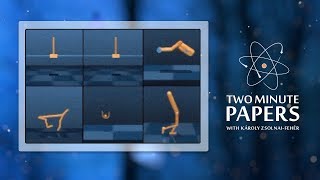
PlaNet is a reinforcement-learning model that learns to plan from raw pixels and can solve six different tasks with one agent. It's 50 times more sample-efficient than standard deep RL and can predict long sequences from just five frames.
Chapters
Dear fellow scholars, this is two minute papers with Today we are going to talk about Planet, a technique that is meant to solve challenging image based planning tasks with sparse rewards. Okay, that sounds great, but what do all of these terms mean? The planning part is simple. It means that the AI has to come up with a sequence of actions to achieve a goal. Like pole balancing with a cart, teaching a virtual human or cheetah to walk, or hitting this box the right way to make sure it keeps rotating. The image based part is big. This means that the AI has to learn the same way as a human, and that is by looking at the pixels of the images. This is a huge difficulty bump because the AI does not only have to learn to defeat the game itself, but also has to build an understanding of the visual concepts within the game. DeepMind's legendary Deep Q learning algorithm was able to learn from pixel inputs, but it was mighty inefficient at doing that and no wonder. This problem formulation is immensely hard and it is a miracle that we can master any solution at all that can figure it out. The sparse reward part means that we rarely get feedback as to how well we are doing at these tasks, which is a nightmare situation for any learning algorithm. A key difference with this technique against classical reinforcement learning, which is what most researchers reach out to to solve similar tasks, is that this one uses models for the planning. This means that it does not learn every new task from scratch, but after the first game, whichever it may be, it will have a rudimentary understanding of gravity and dynamics and it will be able to reuse this knowledge in the next games. As a result, it will get a head start when learning a new game and is therefore often 50 times more efficient than the previous technique that learns from scratch. And not only that, but it has other really cool advantages as well, which I will tell you about in just a moment. Here you can see that indeed the blue lines significantly outperform the previous techniques shown with red and green. For each of these tasks, I like how the plot is organized in the same grid as the tasks were, as it makes it much more readable when juxtaposed with the video footage. As promised, here are the two really cool additional advantages of this model based agent. The first is that we don't have to train six separate AIs for all of these tasks, but finally we can get one AI that is able to solve all six of these tasks efficiently. And second, it can look at as little as five frames of an animation which is approximately 1/5 of a second worth of footage that is barely anything, and it is able to predict how the sequence would continue with a remarkably high accuracy and over a long time frame, which is quite a challenge. This is an excellent paper with beautiful mathematical formulations. I recommend that you have a look in the video description. The source code is also available free of charge for everyone, so I bet this will be an exciting direction for future research works and I'll be here to report on it to you. Make sure to subscribe and hit the bell icon to not miss future episodes. Thanks for watching and for your generous support and I'll see you next time.