Google's Quantum Chip Just Broke Reality (You Won't Believe What It Can Do!)
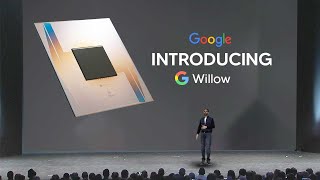
Google's Willow quantum chip adds more qubits while reducing errors, reversing a longtime engineering problem. On one benchmark, it solves in minutes what classical supercomputers would take 10^25 years to finish. It's not yet powerful enough to break Bitcoin.
Chapters
So something crazy just happened in AI Google announced a new quantum chip called Willow. And it's actually completely changing the game in two mind blowing ways. First, let me explain what makes Willow different from your regular computer, your phone, your laptop, even the most powerful supercomputers. They all work basically the same way, like a fast super calculator, using ones and zeros. But here's the difference. With Willow, it actually uses the weird rules of code, quantum physics, which are the same rules that govern how atoms work. Now, here's where it gets really interesting. Most people think that when you make computers bigger or more complex, they're more likely to make mistakes. Like how a longer chain has more chances to break, right? And that's exactly what made quantum computers so tricky to build in the past. But Willow, it actually does something that scientists have been trying to achieve for almost 30 years. And when you make computers bigger or more complex, they tend to get messier. Kind of like how a bigger house has a lot more things that can go wrong. And with regular computers, the more parts mean more chances for errors. And that's just how things usually work. But with Willow, it completely flips this rule on its head. Instead of getting worse with size, it actually gets better at fixing its own mistakes the bigger it gets. It's like having a house that becomes easier to clean the more rooms you add. It actually sounds impossible, but that's exactly what Google has managed to do. And this image illustrates one of Willow's biggest breakthroughs. So let me just break this down for you guys. Think of it like building an increasingly larger teams of workers, which are the qubits, who can catch each other's mistakes. The three by three grid, which is of course in red, is like a team of small workers that can handle fixing one mistake at a time. It's basic proof that the system works. The 5x5 grid is scaled up to 49 workers, which can now handle two mistakes simultaneously. And it shows the system works better as it gets bigger. And the 7 by 7 grid is a big team of 97 workers that can handle three mistakes at once. And it proves that bigger equals more reliable and not less. And the revolutionary part is that normally when you add more qubits, which are, you know, in this case workers, you get more errors. But Willow does the opposite. The bigger the grid gets, the better it handles errors. It's kind of like having a team where you add more people and you reduce mistakes instead of creating chaos. The yellow connections between the colored squares show how the qubits work. Together to catch and correct errors. Kind of like how a safety net that gets stronger as it gets bigger. Now, with all of that being said, why is this even a big deal? Well, imagine you had a car that got better gas mileage the larger you made it. That's not how things are supposed to work usually. Usually, bigger cars use more gas, not less. But in Willow's case, making it bigger actually makes it more efficient and more reliable. And the really exciting part is that it's not just a small improvement. They managed to show that Willow can keep its quantum properties even as it scales up. And in the quantum world, keeping things quantum is incredibly hard because these systems are super fragile. It's like trying to keep a soap bubble intact. The bigger you make it, the more likely it is to pop. But Willow somehow gets more stable instead. And what's crazy about all of this is wait until you hear about how fast this works.
With the random circuit sampling benchmark, the results are pretty surprising. By our best estimates, a calculation that takes Willow under five minutes would take the fastest supercomputer 10 to the 25 years. That's a one with 25 zeros following it. Or a timescale way longer than the age of the universe. This result highlights the exponentially growing gap between classical and quantum computation for certain applications.
Now, one of the biggest fears that many people have is the fact that this could potentially crack bitcoin. But that isn't actually true. When you actually think about what bitcoin is, it's like trying to break into a massive bank vault, which, with millions of possible combinations, Current computers would need centuries to try all of these combinations. Now, Willow, Google's new quantum computer is incredibly powerful, but in a very specific way. It's like having a race car that can only drive on one specific track. Sure, it's blindingly fast on that track, but it can't drive on regular roads. To break bitcoin, you'd actually need a quantum computer that's quite like a Swiss army knife with way more tools, which are thousands of more qubits, than Willows105. You'd actually also need a lot better precision. Willow still makes way too many mistakes and specific capabilities that Willow doesn't have. It's kind of like Willow is amazing at solving complex puzzles in record time. But breaking bitcoin security is a completely different game, like trying to use a Ferrari to crack a safe. No matter how fast that Ferrari is, it's just not the right tool for the job. And I wanted to actually include this in the video, because I saw the fact that there were numerous people who were stating that, look, it's completely over for Bitcoin. And that just simply isn't the case. Now, one of the most interesting things that I actually saw was this. And I didn't see most people talking about this, but this is a mind bending concept. Okay, so when Google's Willow quantum computer solves a problem in five minutes, that would take a regular supercomputer 10 septillion years, it raises a fascinating question. How is this even possible? Where is all that computation actually happening? One explanation, first proposed by the physicist David Deust, is that quantum computers might actually be tapping into the parallel universes to do their calculations. So this is how you can kind of visualize that or even think about that. Imagine you need to solve a maze. A regular computer would try to solve one path at a time, like a person walking through a maze. Now, basically, what a quantum computer does is that it tries all possible paths simultaneously, as if copies of itself in parallel universes were each trying different paths. And then somehow the right answer emerges in our universe. And this creates something like a giant quantum parallel processing system, where the computation isn't just happening in our universe, but across many universes at once. It's like having infinite versions of yourself solving the same problem in slightly different ways and then getting the answer from all of them at once. Now, this isn't proven. It's a theoretical explanation for how quantum computers can perform certain calculations so impossibly fast. And. But the fact that Willow can do calculations that would take longer than the universe has existed suggests something rather strange and fascinating is happening behind the scenes. Now, you might be also wondering what exactly is next. Basically, you can see we've got the quantum roadmap. Now, the milestone number one is beyond the classical. This is where you're proving classical computers can do things regular computers can't. Willow has already achieved this by doing calculations that would take regular, regular supercomputers 10 septillion years. Like proving you can actually build a plane that actually flies while everyone is still making cars. Now, Milestone 2 is where you've got quantum error correction. Current quantum computers are very error prone, like a car that breaks down every few miles, and they're working on making the qubits, quantum bits, more reliable. It's like developing an engine that can self repair while running. And the breakthrough with Willow that we recently had, showing that adding more qubits actually reduces the errors instead of creating more, is basically where you can think of it as you know, more backup systems, you know, fewer mistakes. Now this is where we start to get into the future. Milestone three, building a long lived logical qubit. The current qubits that we have die really quickly and they're trying to make qubits stay stable for much longer. Basically like developing a battery that lasts for months instead of minutes. Then of course, the logical gate is where you're building the building blocks of the quantum calculations. And without reliable gates, complex quantum programs won't work. And once you have all of these parts, you've got the engineering scale up. It's like going from building one perfect engine to building thousands. And of course, that's when we to milestone six, the final quantum computer that can solve real world problems combines all previous milestones into one working system. Like having a complete aircraft carrier instead of just a prototype jet. And this is where we get to that sci fi stuff where we have superintelligence, artificial superintelligence, some crazy, crazy stuff. I think this entire thing is just showing us how quickly the AI space, the quantum space, is completely moving. And I can't wait to share more progress when Google have more to offer. So with that being said, if you enjoyed this video, I'll see you in the next one.










