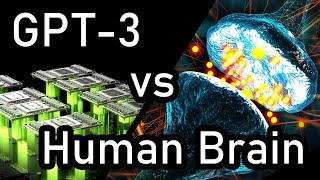
GPT-3 has 175 billion parameters versus the brain's estimated 100 trillion to 1 quadrillion synapses. A 100-trillion-parameter model would cost $2.6 billion to train in 2020, but algorithmic efficiency improvements could drop that to $5 million by 2032.
Chapters
The human brain has at least 100 trillion synapses, and it could be as high as 1000 trillion. And a synapse is a channel connected to neurons through which an electrical or chemical signal is transferred and is the loose inspiration for the synapses. Weights parameters of an artificial neural network GPT3, the recently released language model from OpenAI that has been captivating people's imagination with zero shot or few shot learning, has 175 billion synapses or parameters. As mentioned in the OpenAI paper, the amount of compute that was used to train the final version of this network was 3.14 times 10 to the 23rd flops. And if we use reasonable cost estimates based on Lambda's Tesla V100 Cloud instance, the cost of training this neural network is $4.6 million. Now, the natural question I had is if the model with 175 billion parameters does very well, how well will a model do that has the same number of parameters as our human brain? Setting aside the fact that both our estimate of the number of synapses and the intricate structure of the brain might require a much, much larger neural network to approximate the brain, but it's very possible that Even just this 100 trillion synapse number will allow us to see some magical performance from these systems. And one way of asking the question of how far away are we is how much does it approximately cost to train a model with 1 trillion parameters? So GPT3 is 175 billion parameters and $4.6 million in 2020. Let's call it GPT4HB with 100 trillion parameters. Assuming linear scaling of compute requirements with respect to number of parameters, the cost in 2020 for training this neural network is $2.6 billion. Now, another interesting OpenAI paper that I've talked about in the past titled Measuring the Algorithmic Efficiency of Neural Networks, indicates that for the past seven years, the neural network training efficiency has been doubling every 16 months. So if this trend continues, then in 2024 the cost of training this GPT HB network will be 325 million, decreasing to 40 million in 2028 and in 2032, coming down to approximately the same price as the GPT3 network today at 5 million. Now, it's important to note as the paper indicates, that as the size of the network and the computer increases, the improvement of the performance of the network follows a power law. Still, given some of the impressive Turing test passing performances of GPT3, it's fascinating to think what a language model with a hundred trillion parameters might be able to accomplish. I might make a few short videos like these, focusing on a single simple idea on the basics of GPT3, including technical, even philosophical implications, along with highlighting how others are using it. So if you enjoy this kind of thing, subscribe. And remember, try to learn something new every day.