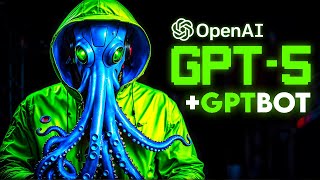
This is a short single-speaker YouTube explainer (creator: LARRUZ) that first introduces OpenAI's newly announced web crawler, GPT Bot — describing what it collects (public, non-paywalled pages), content filters (excludes PII and policy-banned material), and how site owners can opt out using robots.txt (example lines: "User-Agent: GPTBot\nDisallow: /", or allow/disallow per-directory). The video then turns to speculation about the expected next-generation model, GPT5: notes a USPTO trademark application filed in July 2023, recalls GPT-4's scale (stated here as 175 billion parameters), and reports common expectations that GPT5 could be much larger (potentially trillions of parameters), more multimodal, and more widely integrated. The narrator offers an informal release-timing guess (based on past short gaps between GPT-3.5 and GPT-4) but emphasizes uncertainty. The clip closes by summarizing the AGI debate (some rumors claim GPT5 could be AGI by end of 2023; most experts are skeptical) and listing possible benefits (productivity, creativity, personalized services) and risks (misinformation, manipulation, ethical concerns), followed by a viewer call-to-action.
Chapters
OpenAI has just launched a new web crawler called GPT Bot, and they confirmed that they are also planning to release the next version of their language model, GPT5, which could potentially achieve artificial general intelligence, or AGI. But before we dive into the details of GPT5 and its implications, let's first talk about GPT Bot and what it does so GPT Bot is a web crawler developed by OpenAI and and it's designed to browse through the Internet and collect text data from various web pages. This collected text data plays a critical role in enhancing the performance and capabilities of OpenAI's advanced language models, including GPT4 and GPT5. Actually, the reason behind ChatGPT's ability to write such an amazing content lies in the vast amount of text data gathered from the Internet, all thanks to GPT Bot. It's like a vast library of information that the models use to understand and respond to your requests. And if you wonder how it chooses the web pages it explores and what it avoids, well, it adheres to specific rules and guidelines to make sure the data it gathers is both high quality and respectful of people's privacy and rights. To illustrate, GPT Bot exclusively explores web pages that anyone can access without needing to get past a paywall or log in with a username and password. It intentionally steers clear of pages that compile personally identifiable information, such as individuals, names, addresses, phone numbers, or email addresses. Furthermore, it filters out content that would breach OpenAI's policies, like content containing hate speech, violence, or pornography. But what if you're a website owner and you prefer that GPT Bot not crawl your site at all? You have the option to do that. You can insert a specific line into your site's robots.txt file to instruct it to steer clear of your site. The line would look like this User Agent GPT Bot disallow This command tells the bot not to explore any page on your site. Alternatively, you can tailor this to allow or prohibit certain directories or pages on your site. For instance, user Agent GPT Bot allow Blog disallow Private slash this directive tells GPT Bot to explore only the blog pages of your site, but not the private ones. Essentially, this bot holds huge significance in the AI community because it enables OpenAI to gather more data, allowing for the development and training of more powerful language models. These models can perform incredible tasks related to natural language processing, like generating text, summarizing long pieces of information, translating between languages, answering complex questions, and more. The continued growth and refinement of this technology depend on the valuable information collected by GPT bot leading us to the exciting potential of upcoming innovations like GPT5. Now, GPT5 is the expected next major language model from OpenAI, following the previous releases of GPT 3.5 and GPT4. Although very little is known about it yet, there are some clues that indicate that OpenAI is working on it and planning to release it soon. For instance, OpenAI has filed a trademark application for GPT5 with the US Patent and Trademark Office in July 2023. The application covers a wide range of software related to language models and AI. The application is currently awaiting examination by the USPTO. But what can we expect from GPT5 in terms of capabilities and features? Well, based on the previous versions of GPT models, we can assume that GPT5 will be a massive improvement over GPT4 in terms of size, accuracy and versatility. For example, in terms of size, GPT4 consists of 175 billion parameters. This number is already substantial when you compare it to the majority of other language models out there. Now GPT5 is anticipated to have an even larger number of parameters, potentially reaching into the trillions. What does this mean for us? Essentially, GPT5 could store more information and have a greater memory capacity than any human being, making it an incredibly powerful tool when it comes to accuracy. GPT4 has already demonstrated remarkable performance in various natural language processing tasks and benchmarks. This includes areas like natural language understanding, natural language generation, question answering and more. But GPT5 is expected to go beyond these achievements. It could reach new heights in terms of accuracy and fluency, producing text and speech that is even more similar to human communication. Versatility is another area where GPT5 is poised to excel. GPT4 can currently manage multiple types of input and output, such as text, speech, images and code. GPT5, however, might take this further, broadening its multimodal capabilities. It could also synchronize with other third party platforms and tools like social media platforms, search engines and productivity tools, for example Microsoft Office. This enhancement would make GPT5 more adaptable and useful across various applications and industries. Now, a question that many might be pondering is when will GPT5 be released? This is indeed a complex question to answer, primarily because OpenAI hasn't provided any official timeline or announcement concerning GPT5's launch, but we can attempt to make some informed predictions based on the release patterns of past models. GPT 3.5 was unveiled in November 2022, followed by GPT 4 in March 2023, leaving around a four month gap between these two models. If this trend continues, we might see GPT 5 sometime soon, possibly before the end of this year. However, it's essential to recognize that these are just educated guesses. The ever changing landscape of the AI ecosystem could bring unexpected surprises or delays that might alter GPT5's release date one of the most fascinating and debated questions surrounding GPT5 involves whether it will reach the level of Artificial general Intelligence or AGI. To understand this, we first need to know what AGI is. It's a theoretical concept of AI that can learn and comprehend anything a human being can. This isn't to be confused with what we have now known as artificial narrow intelligence, where AI can only perform certain specific tasks or functions. AGI represents a more advanced level of AI, one that isn't confined to certain functions. There have been early reports and some gossip suggesting that GPT5 could reach AGI by the close of 2023. People are making this claim because they believe GPT5 will generate text and speech so lifelike that it will be impossible to tell apart from human communication. They also think it will respond to any question or prompt a human can handle. But the majority of experts and researchers consider this idea far fetched and too soon to predict. They emphasize that we're probably still many years away from AGI and that GPT5 will encounter various obstacles and restrictions, particularly in generalization, reasoning, understanding, common sense and ethical considerations. So what would happen if GPT5 does reach AGI? This is a complex subject, but let's try to summarize it on the positive side. GPT5 could potentially enhance productivity and creativity by speeding up processes that use AI, freeing humans from monotonous tasks. This could lead to advancements in various fields such as education, entertainment and communication by offering tailored and engaging content and services. Conversely, there might be significant risks. GPT5 could cause harm to human society and principles by disseminating false information, propaganda, or engaging in manipulation. Ethical concerns and moral dilemmas might arise as well, challenging human self respect, individuality and freedom. Now I'd love to hear your views on GPT5 and its possibility of achieving AGI. Is this something you believe can happen or do you find it unlikely? Is it a step forward or a potential problem? Share your thoughts in the comments below. If you found this video interesting, please like it and share it with your friends. Remember to subscribe to my channel for more in depth analysis of AI advancements. Thanks for tuning in and I'll see you in the next video.