Groundbreaking AI News This Week: OpenAI, Google & Adobe's Explosive New Developments!
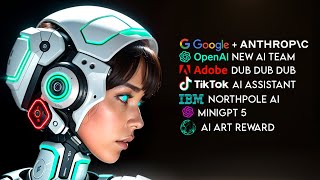
A narrated weekly roundup (YouTube) summarizing major AI developments across industry and research, including Google’s large new investment in Anthropic, OpenAI’s new safety-focused Preparedness team, Google Maps’ Immersive View rollout, TikTok’s Creative Assistant, an S4IK artist award blending AI and art, Adobe’s Project ‘Dub Dub Dub’ for voice-preserving dubbing, an automated AI system for supernova discovery, the open-source Video Crafter tool, UC’s Mini GPT-5 multimodal model, and IBM’s North Pole AI chip. The video provides brief descriptions, claimed impacts, dates or timelines when given, and links several items to broader trends in AI safety, creative tools, and infrastructure.
Chapters
It's been a packed week full of cool updates in the AI world. Today I'll tell you about the biggest and most interesting AI news from this week. We're looking at Google's hefty investment in AI firm Anthropic OpenAI's new team tackling AI dangers Google Maps Cool immersive view feature TikTok's AI powered creative assistant for content creators the SFer IK Artist Award blending AI and art Adobe's innovative project dub Dub Dub, an AI system discovering Supernova, the easy to use video crafter tool, UC's versatile mini GPT5 model and IBM's groundbreaking North Pole chip for AI efficiency okay, first, Google has recently decided to invest an additional $2 billion in the AI company Anthropic, which competes with OpenAI. This new investment is on top of the $550 million Google already invested in Anthropic earlier. The new funding is different from a previous deal where Google $500 million and promised to add another $1.5 billion later. Anthropic has also made a deal worth over $3 billion with Google Cloud a few months before this latest investment. Before Google's decision, Amazon had committed up to $4 billion to Anthropic, hoping to advance in the AI field against other tech companies. Amazon has already put in $1.25 billion, which could turn into a company share, and plans to possibly invest another $2.75 billion by early 2024. Anthropic was founded by Dario and Daniela Amodei, former engineers at OpenAI. They left OpenAI due to disagreements about safely developing AI. Previously, Anthropic received funding from Sam Bankman Fried of FTX, but after FTX's downfall, it looked for new investors, including tech giants like Amazon and Google. Anthropic is working on an AI chatbot named Claude Stock, similar to OpenAI's ChatGPT, and has gathered $7 billion this year to develop more advanced AI systems. Alright now. OpenAI is forming a new team called Preparedness to tackle potential dangers of artificial intelligence. This team will look into risks from advanced AI, like chemical, biological and cybersecurity threats. They are concerned about how AI might be misused and are working on strategies to ensure AI is safe and beneficial. OpenAI is aware that while AI has many advantages, it also comes with significant risks. They're now hiring people with various technical skills for this team and have launched a challenge to encourage finding ways to prevent the misuse of AI. This initiative reflects growing concerns in the AI field about the technology's power and the need for stringent safety measures. Now, Google Maps has recently upgraded with a new Immersive View feature. This AI powered tool transforms flat images into 3D views of landmarks, remote view restaurants and buildings, providing a more detailed perspective of various locations. It's now being integrated into navigation for 15 cities including London, New York and Tokyo, enhancing the experience for driving, walking and cycling routes. Unlike traditional satellite or street view modes, Immersive View offers a 3D image of the entire route. It even allows users to see the route at different times or weather conditions using a slider. Powered by AI, Google Maps is also becoming more search friendly, allowing general queries like artsy things nearby. This will display local attractions or specific user uploaded photos tagged in locations. For using Immersive View, simply select it in the Google Maps app on a compatible city. Additionally, the Lens and Maps augmented reality feature, which shows nearby facilities like ATMs and cafes, is now available in 50 more cities okay next TikTok has introduced a new AI tool, the TikTok Creative Assistant for Brands and Creators to use in the TikTok Creative Center. With a TikTok for Business account, this assistant offers smart guidance for creating TikTok content. It's loaded with TikTok specific knowledge to provide relevant advice for creating ads or videos. The tool is versatile. It helps newcomers learn the basics of TikTok content creation, assists in researching successful TikTok ads, and aids in brainstorming and refining video scripts. The idea is to use artificial intelligence to continually inspire and assist in making effective TikTok content. You can start with suggested prompts from TikTok, but these are flexible. You control the final output using editing or discarding the AI's suggestions as needed. Alright next S4IK, a part of the multifaceted Azulik brand, is introducing the first S4IK artist award to promote artificial intelligence in art. This award offers $100,000 and a two month creative residency at Azuliq OME in Mexico. Here the winner can access advanced digital tools and local artisans for creating AI based art. Runners up also get art residencies. The award is a response to the growing intersection of AI and art applications are open until November 17, 2023. The award aligns with the opening of a new Sfer Ik Museum project in Tulum envisioned by Azulik's founder Roth. This outdoor art space, part of the Azulik Basin, will open in 2024 and feature the winning artwork. Roth sees this initiative as a fusion of natural, ancestral and artificial intelligence, marking a new era of global collaborative creativity. The Sfer Ek Tulum and the Artist Award represent a commitment to pioneering in art, architecture, technology and hospitality okay now Adobe revealed a new AI feature called Project Dub Dub Dub at their Adobe max conference in October 2023. Aimed at revolutionizing video dubbing. This feature, still in development, can dub videos automatically while keeping the original speaker's voice. This is part of Adobe's move to include more language AI tools in their products. Adobe's Zeyu Jin showcased this feature by dubbing voices into various languages and translating movie scenes without changing the original actors voices. The technology, which is based on speech to speech translation, is still in its early stages and it's not clear if Adobe is using its own AI or external models. The response to this new feature has been mixed with some people concerned about the dubbing's clarity and timing. Despite this, many see its potential for improvement. This innovation is Adobe's way of helping brands reach global audiences by making videos more accessible across different languages. This approach is becoming increasingly common in the tech industry as companies seek new solutions for localization needs. Adobe is working alongside other big tech firms to integrate AI into creative and multilingual tools, although they note that Project Dub Dub Dub is not yet ready for release. Next an international team led by Northwestern University developed a new AI system that automates finding, identifying and classifying new supernova stars in the sky, replacing hours of human work. Previously, researchers spent over 2,200 hours examining supernova candidates. Now this AI tool speeds up discoveries and reduces human error. The leader, Adam Miller, mentioned that for the first time, an automated system involving AI and robots detected a supernova and confirmed it with another telescope. His colleague Nabil Rehemtullah emphasized this as the first fully automatic supernova classification. They tested this system BTS bot on a new Supernova SN2023 Tik. The system independently handled the analysis, showing effectiveness in real world conditions and allowing researchers to focus on other tasks. Alright Next New AI tool videocrafter is a free and open source tool powered by diffusion models, a type of machine learning, enabling it to generate high quality images and videos from text descriptions. It's perfect for those new to video editing as it simplifies creating professional looking videos. To use Video Crafter, you just write a description of the video, adjust settings like resolution and hit generate. It creates a video from your words which you can then edit and save in formats like MP4, MOV and AVI. It's versatile, ideal for various video types from educational to promotional or music videos. This user friendly tool is expected to change how videos are made, offering a straightforward approach for anyone, regardless of their video editing skills. For installation and usage, their GitHub page provides all the necessary information. Video Crafter opens up new possibilities in video production, making it accessible and easy for everyone. Next, the University of California researchers have developed Mini GPT5, a new model that excels in both understanding and generating text and images. This model stands out because it uses generative Vokans, a unique feature that helps it learn from images, a capability lacking in earlier text focused models. Mini GPT5 combines these visual tokens with text, enabling it to create contextually relevant image captions. It's designed through a two step process, first, aligning text with quality visual features from large data sets, then ensuring coordination between text and visuals. This approach surpasses previous methods, balancing text image focus and optimizing training efficiency. Additionally, the model is enhanced with special training techniques to understand instructions better and excel in new tasks. The team's future work aims to expand its applications, overcoming the limitations of older models that treated image and text understanding separately, accessible and easy for everyone. And finally, IBM has unveiled North Pole, a new computer chip that significantly boosts the speed and efficiency of AI, particularly in image recognition. This chip is 22 times faster than current options. Traditional AI systems like ChatGPT often slow down due to their reliance on Internet data, but North Pole addresses this issue by using edge computing, which processes data closer to where it's needed. North Pole's design mimics the human brain, allowing its memory blocks and CPUs to interact quickly, ensuring rapid responses. While it outperforms competitors like Nvidia GPUs in speed and processing, North Pole is not suited for training large AI models such as ChatGPT. The research team is exploring ways to enhance its capabilities by linking multiple North Pole chips. Overall, North Pole represents a significant advancement in AI, promising faster and more efficient processing, especially in image recognition. Its current limitations notwithstanding, its potential for future improvements positions it as a game changer in AI technology. Alright, that concludes this week's AI News. If you enjoyed this video, don't forget to hit the like button, subscribe to my channel and click the Bell icon to stay updated on all my future uploads. Thanks for tuning in and I'll catch you in the next one. Sam.










