Grow Your Career in the Industry as an ML Practitioner
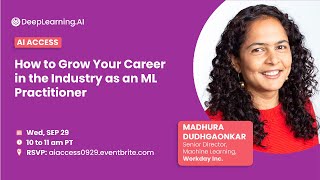
This content is a recorded YouTube session (AI Access series) titled "Grow Your Career in the Industry as an ML Practitioner" (Sep 29, 2021), hosted by Ishita Chaudhary with speaker Madhura Dudgaonkar (ML leader at Workday). Madhura presents multiple real-world career stories, a three-pillar career-growth framework (define goal & why; assess the gap & plan; execute and iterate), and actionable advice on how to stand out (do non–happy-path projects, competitions, share work). The session includes a long Q&A covering when to get a master’s/PhD, differences between DS and MLE roles, T-shaped skill advice, MLOps importance, switching to management, and getting first industry experience.
Questions this video answers
September 29, 2021
About seven years
"about 265 billion transactions" and "55+ million users"
July 2010
Chapters
Sa. Foreign.
Hi everyone and welcome. My name is Ishita Chaudhary and I'm the Product marketing manager at DeepLearning AI. Welcome to how to Grow your Career as an ML Practitioner, an event in our AI Access series. We appreciate you taking the time to join us today. Before we start the event, allow me to show you how you can participate in today's Q and A session. Let me start sharing my screen. Give me one second. All right. I hope you can see my screen now. If you're on the YouTube page, just scroll down to the description box under the video. If you are new to our discourse community or haven't yet joined, please click on this link. This is an invite link. You can go ahead and create your account. Once you've created your account or if you're already a member of our discourse community, just click on this link and you will be directed to the Careers category page. On this page to post a question that you want our speaker to answer, just click on New topic and you can start typing your question here and click on Create Topic. If you'd like to go back and upvote others questions, you can simply click on an existing topic and click on Vote to upvote the question. At the end of this event, we're going to see which questions have the most upvotes and our speakers gonna pick them up one by one. If you want to see which questions are getting the most votes, you can just sort by votes and see the most upvoted questions. By the end of this event, I hope you'll be able to get the answers you want to all the questions you have. So go ahead and start adding your questions to our discourse community. Okay, I hope that was helpful. If you have any queries, please ask in the YouTube live chat and our moderator will help you out. I'm going to stop sharing my screen now. All right, now let me start by introducing our fantastic speaker for today. Madhura Dudgaonkar is a machine learning leader at workday. With over 7 years of applied ML expertise with an emphasis on search recommendations and personalization, her teams have developed multiple products that span classic models, advanced deep learning and state of the art transformer architectures like bert. In addition to her experience with ML and systems engineering at Sun Microsystems, Adobe and now Workday, Madhura has led efforts to build career frameworks for software and machine learning engineering profiles and help thousands shape their careers. She's truly a thought leader in applied machine learning. We're privileged and honored to have Madhura Join us today to talk about how to grow your career as an ML practitioner. Welcome, Madhura. And handing it off to you.
Thank you, Ishita. Good morning, good afternoon, good evening. Wherever you are in the globe, I hope you can hear me. Okay? And I promise you, you are going to walk away from this hour with very practical tips and insights on how you might craft your journey and how you might make progress on your own growth path within the ML domain. Let's dive right in. Meet Shauna. She has a bachelor's degree in computer science with machine learning specialization. She got her first job as a machine learning engineering at a startup and at about three years being at the startup, she ended up securing a machine learning engineering job at a very well known tech company. On the surface it might seem like she had a very straightforward and easy path and she's cruising through her journey. But the truth could be, couldn't be far from that. She met with multiple challenges along her journey and even though the name is fake, the stories that I'm going to walk through and the challenges and the actions these people take are very real. For her, one of the most challenging phases was when she was trying to find her first job. She started with applying for some of the well known tech companies that didn't go anywhere. Most of the time her resume went into a black hole. She didn't hear back from most of them. She might have gotten one or two screens but they didn't go anywhere. Then the next step she tried was trying to see which companies she had some connections at and tried applying through them. That also didn't yield much results. And the specific thing that she did which worked for her was she was doing projects on the side. And one additional thing she did was enter a Kaggle competition. She didn't win the competition, but she was placed. Her team was placed in the top 10%. She ended up sharing the experience from that through a blog post which got attention from one of the meetups and they invited her to speak at their meetup just to share learnings from her experience. At that meetup is where she met the hiring manager for the startup where she ended up finding her first job. We are going to walk through multiple of these career stories and some of them are people that I have personally seen and worked with over the last seven years at workday and some of these are people that I have mentored from the industry that were not at workday. We'll work through some of the challenges they saw and what they did in the face of it. Then I'll share a very simple framework that should help each one of you in crafting and making progress on your own journey, regardless of what scenario you are personally dealing with. And then we'll end the session, as Ishita mentioned, with your questions, let's talk about Jedi. He was a data scientist in a team within a large organization where the team mainly focused on doing internal data science projects. So the expertise needed for that team was mainly just data science and they didn't have to worry about engineering, deploy production, none of that. It was internal machine learning models for their product management teams, for their marketing teams. There was a reorg at the company and this team moved into the central machine learning org. All of these data scientists that moved from this team were moved over to machine learning engineering roles and many of them went along and continued on that role. But with Jedi, he was in a very senior position. He was at that point in his life where he really enjoyed doing data science. And after a couple of quarters of trying to build out the engineering, systems engineering skills, what he realized was with his life where it was at, he wasn't able to find enough time to fill the gap between where he was and where he needed to be and he decided to just move back to what he really loved and was an expert at. He found another team within the company which needed just data science expertise and we're not looking for people with engineering background. He moved over to that team and he's thriving over there and it has been a win win for both that team and Jedi. Let's talk about Amita. Now. She has a major in linguistics. Her entry into the industry was in a data analyst role at a financial firm and with the way her situation was, she didn't really have the time to do any work outside to build up her expertise. So the way she tackled that challenge and made progress towards the senior MLE role was by taking the initiative, doing research and proposing innovative projects for first of all their own team and she got traction on them. It was a win win for the team and her and she ended up proposing some projects that needed collaboration from their machine learning teams and she ended up working in a cross functional environment with those folks. Over time she ended up moving over to that team and officially did projects that did end to end training, deploy, operating them, iterating over them, and reached a senior MLE position. Don't get me wrong, it wasn't a easy road. Even though she learned on the job, it was a multiple year journey for her. But she was able to get through it and her interest, passion and just love for learning kept carrying her through. And then there's Darren. He has been a software engineer. He thought he wanted to be Emily. When DJ Patel said data science is the sexiest job of the century. And he asked his manager whether he can be moved if he can move to a machine learning team. And he ended up moving to a machine learning team. He contributed as a software engineer with some of the projects. He was one of the high performers on the team and his manager supported his wish to pursue MLE path. But after being on that development path, what he realized he kept gravitating towards the engineering task. He kept wanting to do the engineering pieces of the puzzle. And as all of you know, 80% of what is required to do end to end ML products is engineering. So he realized he could just use his existing strengths, be part of the ML domain, learn it as a hobby and get familiar with it. But he doesn't really necessarily need to go to the MLE role and he chose to stay as a software engineer within the machine learning team. In Claude's case, he was another software engineer who had almost a decade of experience doing product engineering. He also wanted to move. He also ended up taking similar first steps as Darren. He moved over to a machine learning team, killed it over with his software engineering expertise and his manager supported his desire to move in machine learning engineering role. And a year passed what they realized that the way the team schedules were, the deadlines and the number of software engineers versus mles. He never found enough time where he could put pull enough backlog from the ML task from the team and he couldn't make enough progress on his learning goals. And Claude wanted to go faster towards his goal. So the action he took in in the face of this challenge was he chose to just break out of the industry, applied for masters, went and did his masters in machine learning one and a half years and then came back in the industry to be a machine learning engineer. For all of these stories, what's common is nobody had it easy regardless of which path they chose and where they ended up being. What is very unique and different is the actions that these people chose. The path these people chose in the face of the exact same challenge, if you notice, it has been very unique to their own personal situation. And I want you to remember that when you're going through your journey, your path is going to be very unique. You might face similar challenges as others, but the path that's right for you might be very different than path that was Right. For somebody else. Let me give you a little bit of a backdrop to share my own career story. I moved from software engineering leadership to machine learning leadership at Work Day about seven years ago and a couple of things that have really helped me get where I am because I did it at Workday. I became part of the journey when Workday was just starting our efforts to build the ML products ML platform. So we were really at zero and being able to be part of the journey and learn along the way where we went from zero to N, that has been tremendously helpful in me just understanding the field at a, at a very different level. And the other big piece that I love about having gotten the opportunity to do it here is if you see Workday provides applications in a lot of variety of domains. Financial management, human capital management, analytics, benchmarking, planning. And what that has allowed me and a lot of my colleagues to do is we got to use all of the ML techniques, all of the subdomains in order to be able to ship products in these variety of domains. And the other really interesting piece for all of us has been World Day. Products are used by some of the largest and biggest enterprises that we've all heard of. And we have access to clean structured data from about 265 billion transactions that happen that are done by 55 plus million users. It consists of image, text, video media and we use it in a responsible, ethical, compliant manner. But it's been really nice to be able to have access to these unique domains and these unique data sets to solve some of the problems for our customers. And as I was saying, we have thousands of models in production where some of them have used the classic machine learning techniques like linear regression, decision trees and all the way up to the cutting edge and deep learning. Our vision algorithms, document parsing services, recommendation services, graph neural network, and we use transformer architecture transfer learning for some of our NLP solutions. Our journey, even though it began as a team in San Francisco, Pleasanton, we intentionally decided to have a distributed location strategy so we could go reach the talent pools wherever they might be. And over the last seven years we've expanded in Boulder, Colorado, Portland, Oregon, up north in Canada. The big office is Victoria, but we also have people in Toronto. I believe there is somebody in Montreal now and we have presence in Dublin, one of the biggest dev centers that Workday has in Europe. And we are hiring in all locations. So please ping me if anything I mentioned about the Workday ML interest you in terms of my journey in this backdrop, I got my first step mainly because stars were aligned. I was at the right place at the right time. That has been true for many people that have entered this field and have made progress, especially people that don't come from the traditional PhD ML heavy background I was a Software Engineering manager in the UI Platform team when Workday's MLFER started about two years into my job at Workday and I ended up working with the leaders from the startup that we had acquired to start our ML journey. After working with them on a couple of projects, they asked me if I wanted to join them. I jumped at the opportunity and I'll share a little bit more as to why it was the right thing for me and over the last seven years I've had the pleasure of experiencing wide and deep ML domains. I would say I built my proficiency mainly in search recommendations, NLP personalization areas, but I've had exposure to anomaly detection and some of the other techniques also, which has been really helpful and let me share a story that is a parallel to how my journey going and growing into the ML domain has felt like in 2006 March, one of my friends asked me if I wanted to go climb Mount Shasta with them. I hadn't really done mountaineering before. I loved hiking, I loved being outdoors, and this moment was similar to when the ML leader asked me if I wanted to join the learning journey and be part of their leadership team. And I said yes for that Shasta trip for the same reasons I did to them. A leader. I love taking on impossible tasks, I love new experiences, I love stretching myself, and I love the thought of continuous learning and the process of continuous learning. So I went on the trip. To my surprise, over that weekend I summited Mount Shasta. It was I was probably the worst climber on the mountain. I was the slowest for sure. I reached the summit around 3pm and if anybody does mountaineering an audience, you all know how stupid that is. But I didn't know any better and some of my early years in ML felt similar to this. I just kept doing things, but I didn't really have a sense of skills, expertise, or how I should be approaching things. The one thing was sure though, I was exhilarated by this whole experience. I wanted to keep going and I kept going. I kept doing mountaineering. I climbed Shasta, Whitney, some of the 14,000ft mountains multiple times over the next three years and in March 2009 another one of my climber friends told me he signed up for Denali and asked me if I wanted to join him. It was an outrageous thought. Believe me, we were both at the same expertise level when it came to mountaineering. Denali was way out of our league at that point. And to put this in perspective for you, one of the people I know that has done seven summits had mentioned to me that Denali was the hardest of the seven summits for him and even harder than Everest. So that gives you an idea of how outrageous a thought this sounded like to me. So I said, no, I'll cheer you from the sidelines. He went, didn't summit. But what that did for me was I also thought of going through that experience and seeing how far I could get. So I signed up for next year. I spent the whole next year training like there was no tomorrow. I wanted to go and really prepare, at least from my side and let the mountain and weather decide, however far I got to experience the whole mountain. And even I climbed multiple mountains. The training schedule was six days a week, cardio and some weight training. And Even during the 17 days of expedition, the way I approached it was, let me enjoy that next day. Let me see how far I can get. Let me see how far I can push myself physically and mentally. And believe it or, on July 2010, I was standing on top of Mount Denali, one of the proudest and happiest moments of my entire life. And I don't think my journey with mountaineering is done yet. I've climbed five of the seven summits. I still have two more that I wish to go after at some point. And my journey, growing in my career with an ML has felt similar. I still feel like it's still in progress. I still have a lot to go, a lot to learn, and a lot more miles to cover. And now I'm going to get into the framework that has helped me during my journey and also something I've seen my mentees and people have guided. It's been helpful for them. There's three, really three pillars to the overall framework. The first pillar is spending time on your goal, and the why. The second piece of the puzzle is assessing the gap between your goal and where you are, and based on that gap, coming up with a plan that's unique for you. And the third piece is really execution and checks along the way and iteration. Same as you trade on your models when you're building them out. Let's dive a little bit deeper into each of these pillars. The first one, your goal. As you all know, there is multiple ways, or I hope you know, there are multiple, multiple ways to contribute to the ML ecosystem in the industry. This is probably just a small sample of things you can do to be in the ML domain. On the left side if you see there is the practitioner tracks the main ones data analyst plus I'm referring to jobs that do SQL reporting, analytics and some level of data science modeling may be time series forecasting, linear regression and then there are the tracks that require more advanced data science and engineering expertise. So data scientists, research scientists. If you are really trying to push the boundaries for any of the ML subdomains, that would be the thing for you. Or machine learning engineer which are mostly people that are applying machine learning to build ships, operate iterate on products. And then on the right hand side there are the other flavors that you could go after. There is ML product management, machine learning developer, advocate, machine learning trainer, internal training or external training if you're at one of these cloud companies. Or you could do some of the traditional engineering disciplines just within mlr. All of these require you to get to know ML domain and build and learn. Just depends on what do you want your day to day activities to be like on your role and your goal should be based on which activities are giving you energy as you go through them. The other piece I would call out for the first pillar is definitely spend some time on figuring out your why for your goal. If your why is oh I want to, I think I can make more money if I go after this. You probably won't last long in this journey. Larger the gap, harder it's going to be if you come from that background. And the only thing that I've seen work for people is finding a why that's tied to your intrinsic motivator. In my case, my need to want to stretch myself constantly and I love continuous learning and those two have been the whys that have kept me going and that allow me to enjoy not just the destinations but the journey itself. The second pillar is about assessing the gap and planning your own path. If you're dealing with a scenario where you're trying to land that first job, talk to a lot of people in different companies that are in your desired role and make sure the only thing that you're pulling from those conversations is what challenges they faced, what were the skills and what kind of experience was most helpful for them and what things help for them to get past the challenges. Keep in mind the path you carve and the plan you make should be unique to what makes sense for you after you have all these conversations and if you're dealing with a scenario where you already Have a job and you're trying to move into a different profile or you're trying to grow to become senior in your own job profile. The key player for this particular piece here is your manager. Get your manager's input to figure out what does that team look for. They will have understanding of the career frameworks associated with whichever role you're trying to go after and they can help you figure out what is the best way for you to go after your learning. Go after your goal and what kind of plan might make sense for you. So definitely leverage your manager to tackle the creation of your plan. And the third piece, straightforward. Execute on it, iterate along the way and get to your goal. I know I'm making it sound easy, it's not going to be easy, but keep at it. The iterate part is important. Another part that's important is do checks along the journey to see whether the learning, the process, the roadblocks and you having to tackle them is it are most days still energizing for you? Are you enjoying most of it? And are there less number of days where you have one of those black patches? But just do that self check and then if most of it is positive and you're enjoying it all the process, then you're probably on the right path and continue and if it doesn't feel right, then go back to the drawing board, figure out maybe it's a different goal that makes sense for you and then keep cycling through that the three pillars based on your experience. And we're going to go into the Q and A section next. I picked one of the questions to kick us off. Kick us off. That was pre submitted by the audience. Somebody asked how do you stand out? I am rephrasing. But whoever is facing the challenge of resumes going in black holes or not making progress on whatever it is that you're trying to go after. And if you're looking for some tips on what you can do on how you can stand out. Some of the things that I've seen work for some people is they did non Happy Path projects. And when I say non Happy Path projects, if you do just courses and online learning, you're only going to experience Happy Path projects. Your learning won't be as deep if you were to do your own unique project where you figure out your data set, you wrangle with your data, you deal with the cleaning and munging and everything else that comes along in the beginning with it and trying to work through all of the challenges that might not be part of your coursework. Happy path project that'll give you a lot of learning. I've seen some people participate in Kaggle competitions like we were talking about a story earlier that has helped them. I've seen some people participate in conference challenges and when I say conference challenges, some of these well known tech companies that have advanced ML products many times like Netflix's Million Dollar Challenge, they'll put up challenges in general or at conferences where they give you a data set and you need to give it a shot to see what you can achieve with it. And everything that you do that is unique and non happy path that furthers your learning any of these things. The additional piece of the puzzle I've seen that has worked for others to get attention is share, teach, showcase the experience that you've had while you're doing these things, the learnings from it and hopefully you help others along the way. And the side benefit would be you might get attention from some of the companies, some of the hiring managers and there are different ways I've seen people do the sharing. Some of them do blogs if you like writing or over time if you start liking writing. Some of these do podcasts, some of them I've seen they do sessions and share their learnings in ML communities and it could even just be you don't have to present, it could just be. I've seen some people just be active person in the community who's answering other people's questions as they come up. That could be a good way if you're not in the mood for spending time on writing a blog post. So you could just be there on the community slack channels and answer questions and believe me, you will be noticed and as an expert and someone that knows what they're doing and one of the other things you could do is go present things at meetups. These are some of the ideas and one thing that is certain regardless of which path you choose to stand out, it is going to be extra work. Be willing to put in the effort necessary and make this part of your project plan that we were talking about. If audience has additional suggestions the things that have worked for them, feel free to share it with the group. Hopefully collective wisdom also is helpful for all of us and with that Ishita, we could open up for questions.
Absolutely. Thank you for that riveting presentation, Madhura. I'm confident our learners found the profiles you talked about extremely relatable. I especially loved hearing about how you tackled the physical and the professional challenges ahead of you. And I think you truly embody something that we believe strongly in, which is lifelong learning. Yeah, I'm inspired to pick up those running shoes again, let's say. I think you've already opened the floor for questions, but I can start us off with some of the questions we received from our learners on Discourse. So our first question from Discourse is from Derek Kim. The question is, for someone who wants to start a career in DL, is the DeepLearning AI coursework enough to get a foot in the door? I have a Master's in math and I'm wondering if I need to get a separate degree in machine learning.
If you already have a Master's in math and you've gone through some of these online courses, you could go for a master's. And the main reason that might work is if you get in at universities where companies come in for campus interviews, that would be a really straightforward way to get in, assuming you put in the work to prepare for the interviews and make. Make through that whole process. Make it through that whole process. So masters could work for that reason. And as we were talking about the earlier question, just doing most of the projects that you do anywhere, maybe masters or whatever else, they mostly are happy path projects. You'll. You'll struggle through some things, but it still won't push you enough. So I would suggest, whether you choose to do Masters or not, do start doing your own portfolio on the side and give one of these competitions or challenges a shot.
Right.
Your goal is not necessarily to win anything. Your goal is to learn and deepen your expertise. So you could go for the Masters. And the main benefit might be just getting access and exposure to those campus interviews and people that come in to hire. And you could go for that. But I would definitely suggest doing your own projects, competitions, conferences, in addition to that, even if you go the Master's route.
Sounds, sounds like great advice. Moving to our second question. This is from Ann Kwan 0412. How do I get industrial experience from someone who took lots of MOOCs? I've taken a few machine learning courses on Coursera and I've done a few personal projects. However, I feel like I lack a lot of industrial experience in machine learning. How do I prepare for this?
Try to get your first job in the industry. If you're already doing projects on your own outside of the MOOC projects, then the next best step for you is to try to get that first job. Don't worry too much about where it is, whether it's a branded company or not, which industry doesn't really matter. You just Want to get a real experience of end to end, taking something real at the company, struggling through the data nightmares and they're very real and they're there are a lot more frustrating than if you're not doing it, if you're doing it on your own, definitely just find that first job and don't worry too much about where it is. As long as you know within that team you will be able to take things end to end, ML services end to end, deploy, monitoring, operationalizing it and then the whole, the whole gamut of experience.
No, that's really good advice. Okay, moving to our third question. This is from 4C 1900. How wide is the gap between a machine learning engineer and a data scientist?
How wide? I'm not sure how to answer that, but I'll give it a shot. So the gap depends on where you are as a data scientist I would say and where you're trying to go within even the engineering discipline. So it could be as small as you need for your own self based on your own growth plan with your manager. Let's say if you're in a company and I've seen some people just do the minimal in terms of engineering where I want to learn how to push my models to production, I want to learn how I can instrument metrics for monitoring them in production. I want to learn some of the other pieces of engineering pieces. Just the minimal for me to be able to just push my models, do monitoring on them and get feedback back and to iterate over them. But staying with the minimal piece, that's completely fine if it works for you in your situation. Some people go way beyond where they learn about how our systems designed and how can I automate you go beyond. Just let me figure out some way cut and paste from somewhere, write a script to try to get this thing done versus just understanding how to design not only just systems but also how to write good services and how to automate things that shouldn't be manual. So you could go however far you want. I mean even in engineering it is quite wide and deep depending on all of the sub disciplines also.
No, yeah, I think absolutely you're completely correct. Like it depends on where you are and like what ultimately you end up doing. Like you could be someone who's experienced multiple aspects and diversify and or you know, completely go deep under like in one aspect.
Yeah. And in general I'm not sure if you've heard of this, but aim to be T. And when I say T, the top bar is where get the foundational Basic knowledge for the multiple disciplines that are involved doing something, and then pick one particular stream. In this case, the thing we were talking about, you could choose to build just shallow enough knowledge about all of the engineering DevOps, other disciplines that are involved. You could continue going deep in your data science and be one of the experts within that particular domain, and then you bring something to the table that others potentially don't. And even just within data science, there are so many subdisciplines to figure out which one you want to go deep in. That itself is a long road. But just figure out how do you want to create your concussion so that you are known for something, you have to be known for something. You have to be an expert in something and pick that thing that deep, the leg of your tee. And the rest can be surface level.
Yep, absolutely. Okay, moving on to our next question. This is from Nikumar, and they're asking, do you have any advice for people who are deciding to stay between staying a technical IC or going into management.
Even for this? It depends on what activities give you joy. And in terms of stories for this particular transition, some of the signals to look for to see whether you might want to try that path out is if you get a lot of joy helping other people, mentoring other people, if you care a lot more about where the team is going and how you can contribute and how you can make things better for everybody involved, those are generally good signals that you might enjoy the transition to management. So look for those and your manager and people around you generally can tell you if they're seeing the initial signals or not. And then if the signals are there, go at that path, find somebody that you admire and that you know is known for mastering that discipline. Because there are some very good leaders and there are some very bad ones also. So make sure you're learning from the right ones and go on that path. And even there, I've seen some people try to do the transition too early. They kept getting gravitated, they kept gravitating back towards their IC job and then realized, oh, maybe not time yet, and moved back and then again went at it when after a couple of years when they felt more ready, and then the second time around, it worked. I've seen one person do the back and forth twice before they finally did the third transition. And right now they're still in on management track. But let's see. So just be open to signals that you are seeing and course correct based on that.
Really solid. All right, moving on. The next question is from Shahid Heather, what is the value in machine learning operations knowledge as an ML practitioner?
If you want to be ML engineering part, then you definitely need to know at least the basics of how do you deploy models, at least within your team's environment and the operations pieces that are minimum for you to be able to do end to end for your services. You can go more if you have the time and energy and if you're interested in learning more.
Good. Our next question is. So the question is ML and data science or data engineer, which is the most sought after skill in the industry today?
They all are. There isn't enough people. So I will say this. So there is a lot of quantity of candidates and we see this day in and out for any position. For our open positions we get hundreds of applications and most of them don't make the screen. So the quantity is there and there is enough jobs for all of these disciplines and there's people looking for high quality talent for these positions. So you could choose any. There is enough demand. But the more important piece is are you that high quality candidate who actually brings deep expertise, who shows the passion, energy, the positivity, some of the softer skills that are hard for some people and are you overall a really good holistic candidate? So if you focus on just building that out and trying to get attention, getting exposure through some of the things we discussed, then you have a higher chance. But pick any of these, you could become a sought after practitioner in any of these positions.
Yep, absolutely. Our next question is from Salar. They say I have just completed my Masters in AI. I'm looking for an opportunity to start my career, but I feel I can't do that because I don't really have a real world experience in software development. What is the best way to enter the market? I know we've talked about this a bit, but anything else you think we can we can discuss here.
So hopefully some of the things that we talked about are helpful. But get that first job is the first thing, however you can. You will figure out the learning piece once you get on the job. Most of the people that I know, once they secured a job, the team was more than helpful to help them fill the gaps for whichever experience they were lacking or whichever skills they didn't have. So if you find the right company, the right culture, just finding that first job is the memo for you.
All right, our next question is from Emily. They say I moved recently from data science to machine learning engineer. What specific skills should I work on to progress my career as an mle? If I compare myself to a software engineer, then I lack skills related to traditional software engineering like systems design, etc. I just want to learn and progress my career as an MLE and don't want to be like Jedi by moving back to data science.
So you'll probably have to do the specific thing around engaging your manager. So wherever you are, it can be very confusing to figure out what all you need. And these career frameworks, I have built more than one, so I know this, they're intended to be generic and they're intended to cover everything. But in general the expectation is a person covers some of the ground from everything that's called out in the frameworks, which is why it's very key for you to get that decoder who's the manager to try to figure out, okay, what makes sense for you in terms of which skill set and how should you lay down your plan in terms of the learning and development. So definitely engage your manager. And another reason I say that is a key step. It also what is required to get to certain positions. It can vary manager by manager. So it's very important for you to talk to your own manager and then come up with your plan as to okay, what are the key things for me in terms of what you want to see? Sounds good.
All right, our next question is from Maha Eshad. How long should a person gain experience working in a software development firm before initiating their own startup yesterday?
If you can afford to, There is no timeline. The biggest thing is for your personal situation. When is the right time? That's probably the biggest factor. I would love to do a startup. My personal situation doesn't allow me to do that yet. I am going to do it someday, but it all depends on when your situation. So the right time is yesterday dependent on you.
Works for you. Yeah. Yeah. Our next question is from Captain Canada. How do we start an ML with data science foundations first? Sorry, I'm a little confused about this question. Let me just see if they have given us more details. Okay. In order to avoid an educational outcome. Sorry, I'm just gonna skip to the question. Do you think it's a good approach to aim to be a good data scientist or a good data analyst first so I can master the fundamental math, stats, Python packages and then embrace machine learning later.
Pick one. Doesn't matter. Seriously, doesn't matter. Just flip a coin. Pick one. Start your journey. If you get the signals that oh, maybe this is too much, then you can always shift.
Okay, start from something. Don't like it's not working out, switch to something else. You find your spot there.
Yeah. Don't get pulled into analysis Paralysis.
Absolutely.
And that is the biggest thing you want to start your journey. Don't think overthink. Oh, is this the right one? Figure that along. Figure that out along the way. As you reflect and as you get signals during your journey, there's never going.
To be one perfect point which will solve all your problems. Just something. All right, we have another question from Maha Isha. Is having machine learning skills enough to manage a machine learning project? If not, what should one do to achieve these other skills that are needed to manage an ML project?
So you are talking about moving to a manager position, I'm guessing.
Let me check their question one second. I don't have any other context for this. I think there.
Yeah.
Like how, who should. Like if you need to manage a machine learning project, do you just need ML skills or do you also need other skills? And how do you get those other skills if you need them?
It again depends on the scenario at say the companies that you're targeting or the kinds of projects you're attempting to do. If you're targeting, let's say internal data science projects, then you might need just preliminary or the classic techniques, linear regression. Some time series might be at play. If you're trying to do user facing products, consumer enterprise, where external users are using these systems, then you probably would need more of the DevOps engineering, at least some surface knowledge. And the one thing I would say is wherever you are, have a plan on building out the skills based on your conversations with everybody you know in that position. But at the same time attempt to get your first role if you can and continue your journey. So for example, in my case and figure out what strengths you can bring to the table. So in my case when I move to the machine Learning organization as ML leader, I knew nothing about ML0, but the leaders on the ML leadership team, they asked me to join them because I brought something to the table that they didn't have. None of them had worked at large organizations, none of them had shipped projects at scale before. So they weren't as familiar with systems engineering building cross functional project in large organizations and they weren't familiar with our company's tech stack and the nuances associated with it. So I brought a lot to the table and which is what helped me be confident in that transition because I knew I had a lot to give. So if you can find something, you can identify what is it that you can bring to the table and the story that we were discussing where the person was linguistics major. That was one of the strengths that came in really handy for their team because they were dealing with the NLP space. So that background was one of the strengths that helped her grow, progress, and stand out in a way.
That makes total sense. Yeah. Moving on to our next question, and I love how quickly we're able to like answer all these questions. I feel like we're answering a lot of common questions that our community has. Our next question is from gulmart89, asking all the hard questions. What are the daily workloads of a machine learning engineer or a deep learning engineer?
It depends. I'm just going to leave it at that. Depending on what stage your project is at, your team is at, and how much of learning path you yourself have, the load could be very varied.
Yeah, got it. Okay, moving on. We have another question from Salar. I have seen job postings of positions that require a PhD. How much of a benefit will a PhD be, especially when applying for senior positions? Or is it better to like enter the market and gain that experience?
If your goal or the path you want to go after is research science, I would say PhD is required. But again, PhD you will have to decide what subdomain or where are you trying to specialize. Right. So figure that out. And if that is the path you're trying to go after, then I would say PhD would be one of the things on your project plan. But if you're going for any of the other roles, a PhD is not necessary. Let me think so. Yeah, we don't. If I look at just ML Org today, there are some people that have PhDs, but a lot of them don't. So it's not required. I can say that with confidence.
Okay, great to know. Okay, I think we can move on to our last question. This is from Jaisal Rose. They're asking I'm overwhelmed about the skills to develop to become an entry level MLE or a data scientist. How do I prioritize learn these skills? Do you recommend courses or project platforms like Kaggle? How do I prepare ourselves for dealing with real world data?
The only way you can prepare yourself to deal with real world data is by doing a project that deals with real world data. Yeah, doesn't matter how great all of these courses are, none of them will give you that because they're not meant for that purpose. So it's just that additional piece that you need to find on your own.
Yeah, you're meant to learn what you can from these resources. And courses online and then take it and apply it on something that simulates it or is an actual. Using real world data so you can go through and see how to like clean the data, how to work with it. There's nothing there's. You can't really replace experience with anything else.
And I've seen some people come up with really weird and strange projects based on their passions. I know somebody who loves flute. So they recorded the notes from their own sessions, some practice sessions, and they did some experiments and some models on that. So just find something that you're passionate about and come up with some project associated with it. And that generally gets people energized. And the process itself is quite fun.
Yeah, absolutely. That's an interesting story. I recently read a learner story about how they wanted to write children's stories about AI and they took one of our courses because they're like, I can't really write a story for children if I don't understand the field myself. So I think people have different motivations to get into machine learning and AI, even if it's to write like a bedtime story for children about AI. I think that's interesting. I think we're all done for today. Thank you so much everyone for your great questions. This brings us to the end of today's event. Madhura, do you have any closing remarks before I kind of sign us off?
Yeah. So just a quick reminder, we are hiring. I'm going to put that plugin there to recap. Be familiar with these very basic framework and try to use it. If there's three things that I can leave you with, remember there are multiple role options. And also remember that for any role you choose, there are multiple ways to get to it and your path is going to look very unique compared to everybody else. And I'll go back to what Ishita mentioned earlier. One good thing to check with yourself is, is lifelong learning energizing for you? And if the answer for this is yes, this is the right domain for you, the industry and the domain is moving at a fast clip. And if you love fast paced learning and lifelong learning, this is the right place regardless of where you attempt to go. And the third piece, I hope it came clearly, but let's just explicitly call it out. There are no shortcuts to be a sought after practitioner in any of these roles that you have seen, especially the practitioner and more advanced it is, and it is going to be a multi year journey and you are going to go through days where you feel like you know nothing and you will never be able to get anywhere. I have seen those days myself. I still on some days and then there are days where you feel like oh my God I know so much if I look back at myself whatever six months ago and that'll keep you going. And the biggest piece to remember is make sure you're why of why you're going after something is tied to intrinsic motivator for you. And with that good luck on your journey. Don't forget to enjoy the process, the learning and the destinations along the way. That's the only way to do this successfully. Great.
Thank you so much Madhura for doing this with us today. We absolutely enjoyed it. I'm sure our audience enjoyed this as much as we did. For all our audience, thank you so much for joining us today. I know everyone is like across the world to different time zones so really appreciate you being here today. We are going to send up a follow up email with a survey for all our attendees today. Let us know if you have any ideas on how we can improve our future events. We're also giving out a 50% discount code for any of our online courses. Up to 200 people who submit qualifying responses. So keep an eye out for that survey email and make sure to submit your feedback. If you don't want to miss out on our future events, just sign up via the link in the description box below. And don't worry if you can't make a live event. You can always find the recordings on our YouTube channel. But yeah, we absolutely love it if you can make it for our live event because we want to see your questions, we want to see you talking in the live chat. We look forward to seeing you next time. And as always, keep learning.










