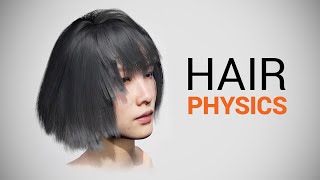
Dr. Zsolnai reviews a new computer-graphics method that fixes hair simulation problems: particles no longer disappear in fluids, sand grains separate properly around wheels, and hair strands collide correctly with surfaces and each other instead of sticking or clipping through.
Chapters
Dear fellow scholars, this is two minute papers with Dr. Zsolnai. Through the power of computer graphics research today we can write wondrous programs which can simulate all kinds of interactions in virtual worlds. These works are some of my favorites. And looking at the results, one would think that these algorithms are so advanced there is hardly anything new to invent in this area. But as amazing as these techniques are, they don't come without limitations. Alright, well, what do those limitations look like? Let's have a look at this example. The water is coming out of the nozzle and it behaves unnaturally. But that's only the smaller problem. There is an even bigger one. What is that problem? Let's slow this down and look carefully. Oh, where did the water go? Yes, this is the classical numerical dissipation problem in fluid simulations where due to an averaging step, particles disappear into thin air. And now hold on to your papers and let's see if this new method can properly address this problem. And. Oh yes, fantastic. So it dissipates less. Great. What else does this do? Let's have a look through this experiment where a wheel gets submerged into sand. That's good. But the simulation is a little mellow. You see, the sand particles are flowing down like a fluid and the wheel does not really roll up the particles in the air and the new one. So apparently it not only helps with numerical dissipation, but also with particle separation too. More value. I like it. If this technique can really solve these two phenomena, we don't even need sandy tires and water sprinklers to make it shine. There are so many scenarios where it performs better than previous techniques. For instance, when simulating this non frictional elastic plate with previous methods, some of the particles get glued to it. And did you catch the other issue? Yes, the rest of the particles also refuse to slide off of each other. And now let's see the new method. Oh my. It can simulate these phenomena correctly too. And it does not stop there. It also simulates strand strand interactions better than previous methods. In these cases, sometimes the collision of short strands with boundaries was also simulated incorrectly. Look at how all this geometry intersected through the brush and the new method. Yes, of course, it addresses these issues too. So if it can simulate the movement and intersection of short strands better, does that mean that it can also perform higher quality hair simulations? Oh yes. Yes it does. Excellent. So as you see, the pace of progress in computer graphics research is absolutely stunning. Things that were previously impossible can become possible in a matter or of just one paper. What a time to be alive. Perceptilabs is a Visual API for TensorFlow, carefully designed to make machine learning as intuitive as possible. This gives you a faster way to build out models with more transparency into how your model is architected, how it performs, and how to debug it. Look, it lets you toggle between the visual modeler and the code editor. It even generates visualizations for all the model variables and gives you recommendations both during modeling and training, and does all this automatically. I only wish I had a tool like this when I was working on my neural networks during my PhD years. Visit perceptilabs.com papers to easily install the free local version of their system today. Our thanks to Perceptilabs for their support and for helping us make better videos for you. Thanks for watching and for your generous support, and I'll see you next time.