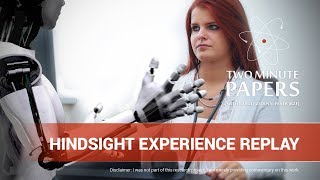
OpenAI's Hindsight Experience Replay lets reinforcement learning agents learn from failures by replaying past experiences with different goals. Instead of discarding a missed target, the system treats what the robot actually achieved as a success for an alternate goal, dramatically speeding up training.
Chapters
Dear fellow scholars, this is two minute Papers with Reinforcement Learning is an awesome algorithm that is able to play computer games, navigate helicopters, hit a baseball, or even defeat Go champions. When combined together with a neural network and Monte Carlo tree search, it is a quite general algorithm that is able to take on a variety of difficult problems that involve observing an environment and coming up with a series of actions to maximize a score. In a previous episode we had a look at DeepMind's algorithm where a set of movement actions had to be chosen to navigate in a difficult 3D environment efficiently. The score to be maximized was the distance measured from the starting point. The further our character went, the higher score it was given and it has successfully learned the concept of locomotion. Really cool. A prerequisite for a reinforcement learner to work properly is that it has to be given informative reward signals. For instance, if we go to a written exam, as an output, we would like to get a detailed breakdown of the number of points we got for each problem. This way we know where we did well and which kinds of problems need some more work. However, imagine having a really careless teacher who never tells us the points, but would only tell us whether we have failed or passed. No explanation, no points for individual tasks, no telling whether we failed by a lot or just a tiny bit. Nothing. First attempt we failed, next time we failed again and again and again and again. Now this would be a dreadful learning experience because we would have absolutely no idea what to improve. Clearly this teacher would have to be fired. However, when formulating a reinforcement learning problem, instead of using more informative scores, it is much easier to just tell whether the algorithm was successful or not. It is very convenient for us to be this careless teacher, otherwise what score would make sense for a helicopter control problem when we almost crash into a tree? This part is called reward engineering and the main issue is that we have to adapt the problem to the algorithm where the best would be if the algorithm would adapt to the problem. This has been a long standing problem in reinforcement learning research and the potential solution would open up the possibility of solving even harder and more interesting problems with learning algorithms. And this is exactly what researchers at OpenAI try to solve by introducing hindsight experience. Replay her or her in short, very apt. This algorithm takes on problems where the scores are binary, which means that it either passed or failed the prescribed task. A classic careless teacher scenario. And these rewards are not only binary, but very sparse as well, which further exacerbates the difficulty of the problem. In the video you can see a comparison with the previous algorithm with and without the HER extension. The higher the number of epochs you see above, the longer the algorithm was able to train. The incredible thing here is that it is able to achieve a goal even if it had never been able to reach it during training. The key idea is that we can learn just as much from undesirable outcomes as from desirable ones. Let me quote the Imagine that you are learning how to play hockey and are trying to shoot a puck into a net. You hit the puck, but it misses the net on the right side. The conclusion drawn by a standard reinforcement learning algorithm in such a situation would be that the performed sequence of actions does not lead to a successful shot and little if anything, would be learned. It is, however, possible to draw another conclusion, namely that this sequence of actions would be successful if the net had been placed further to the right. They have achieved this by storing and replaying previous experiences with different potential goals. As always, the details are available in the paper. Make sure to have a look now. It is always good to test things out whether the whole system works well in software. However, its usefulness has been demonstrated by deploying it on a real robot arm. You can see the goal written on the screen alongside with the results. A really cool piece of work that can potentially open up new ways of thinking about reinforcement learning. After all, it's great to have learning algorithms that are so good they can solve problems that we formulate in such a lazy way that we'd have to be fired. And here's a quick do you think eight of these episodes a month is worth a dollar? If you have enjoyed this episode and your answer is yes, please consider supporting us on Patreon. Details are available in the video. Description thanks for watching and for your generous support, and I'll see you next. Sam.