How A Bunch Of GRADS Took On Silicon Valley... And WON! (The Story of DeepSeek)
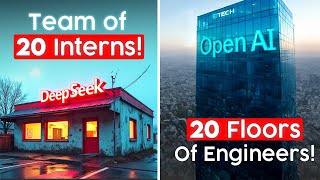
Narrated YouTube video telling the story of Chinese startups DeepSeek and Moonshot AI. It describes DeepSeek's founders and funding, their V2 model that reduced inference costs to about 1 yuan per million tokens via architectural changes (MLA and DeepSeq MoE sparse design), and Moonshot's Kimi K 1.5 which scores highly on math and coding benchmarks and supports a 128k token context. The video contrasts DeepSeek's efficiency-oriented, open-source strategy with Kimi K's multimodal, free-access approach and discusses market ripples, including price cuts from China's major tech firms and investor reactions globally.
Chapters
Did you know that the AI startup Deepseek, the one that shook up the AI world and sent shockwaves through America's biggest tech companies, is actually run by a team of fresh grads and undergrad interns? Their V2 model didn't just raise eyebrows, it started a price war in China, forcing giants like Tencent, Alibaba and Baidu to slash their own AI prices overnight. And their CEO, Liang Wenfeng has made a bold promise. Deepseek will always stay open source. His goal? For China to stop imitating US innovation and start leading it. At the same time, another AI challenger, Kimi K 1.5 from Moonshot AI, has been making waves of its own outperforming even GPT4O in math and coding benchmarks, proving that China's AI scene isn't just catching up, it's rewriting the rules. How did Deepseek pull this off? What's their secret? And where does Kimi K fit into this race? This is the story of Deepseek and the AI revolution happening right now. Deepseek emerged on the Chinese AI scene as a low profile startup with a surprising impact. It began attracting attention partly because it had a quant private fund called Huanfeng behind it, which had invested heavily in Nvidia A100 GPUs, and partly because it drove a sudden price war in the large language model space. Its model, DeepSeek V2, introduced a cost for inference that was so low, about 1 yuan per million tokens, that competitors felt pressure to slash their own prices. Tencent, Baidu, Alibaba and ByteDance eventually followed this move, even if it meant taking a loss. Observers compared Deepseek's approach to the discount oriented Pinduodua to calling it the AI Pinduoduo. Though Deepseek itself did not rely on subsidies or burn cash to offer its low prices, the secret hinged on a new model architecture that brought GPU memory usage down to a fraction of the usual baseline. MLA replaced the typical multi head attention mechanism by operating at only 5 to 13% of the memory footprint. The team also implemented a DeepSeq MOES sparse design that cut unnecessary computation or which allowed them to reduce their operating costs so effectively that they could turn a profit. While other companies struggled in global circles, analysts began to talk about Deep Seq as a mysterious new force in AI. Andrew Carr, a former OpenAI employee, adopted some of the training ideas in his own work, and Anthropic's Jack Clark described Deepseek's researchers as a group of extremely capable minds. He saw the company as part of China's drive to produce influential technology on par with its role in drones and electric vehicles. Deep Seq's founder, Liang Wen Feng, had always believed that chasing immediate applications was less valuable than pushing the boundaries of architecture. He had a background in advanced engineering and AI research, and he spent years in the background developing ways to scale up deep learning systems with minimal overhead. He felt that reliance on short term replication of foreign breakthroughs would perpetually keep Chinese AI labs behind the curve. He preferred to focus on fundamental changes, even if that meant risking time and resources on projects that might not pan out. Part of the company's broader goal is progress toward AGI, so they devote themselves to exploring the infrastructure and frameworks that might support generalized intelligence rather than merely shipping a ChatGPT clone. Moonshot AI, another newcomer in Beijing, took a different route by focusing on a multimodal large language model named Kimik 1.5. This model gained attention for outrunning GPT4O and Claude 3.0 Sonnet on metrics such as Math 500, where it earned a score of 96.2. It also hit 77.5 on AIMI and landed in the 94th percentile on CodeForces. Beyond these tests, it achieved impressive numbers on Math Vista and MMMU thanks thanks to strategies like rejection sampling, partial rollouts and length penalties. During its reinforcement learning phase, the developers equipped it with a 128k token context window, which means it can handle extremely lengthy input without losing track of earlier details. Because it supports text, image and code processing, users can feed it various forms of content in a single go. It manages up to 50 files at once, including PDFs, slides and documents, and it can even run real time searches on over 100 sites. The team at Moonshot made it freely accessible through their chat interface, which is located at Kimia. To use it, one can create an account, pick the offline or online mode, and toggle between normal Kimi and the Kimi K 1.5 loom thinking version. The offline mode is meant to analyze local inputs without searching the Internet, and the online mode brings in web results. DeepSeek R1, a newer release from DeepSeek came out soon after V2 and and caused just as much conversation in tech circles. Reviews pointed to strong performance in coding and reasoning tasks, along with a general open sort approach that aligned with DeepSeek's philosophy. Observers decided to compare Kimi K 1.5 with Deep Seq R1 on several practical tasks, beginning with image analysis. Each model received two images, each containing numeric data for various large language models. Kimik 1.5 managed to parse the text more accurately and identify the correct entries, while deepseqr1 ended up comparing values that had not been mentioned. For one of the models, both ended up mixing parameters to a degree, since neither stuck strictly to overlapping attributes in the images. Kimik 1.5 still looked stronger because it interpreted the data a little better. Then they tried web searching to locate red gowns under $200. DeepSeek R1 returned multiple links, though a few turned out to be irrelevant or not within the desired price range. Kimike 1.5 gave two direct links that fulfilled the request and posted supplemental options in a side panel, which made it more focused on the price and color constraints. Next, they tested how each model handled multiple files at once. Kimike 1.5 parsed at least two files out of three, then summarized them. Deepseek R1 stumbled and returned no effective unified summary unless given the file separately. Finally, the two models were tasked with generating HTML code for a Snakes and ladders game. Deepseek R1 came across as more advanced, with clearer modular features and a more playable interface, while Kimi K1.5 presented something simpler that allowed the tokens to stray beyond the boundaries of the board. Neither model managed to implement real snakes or ladders, so the code they produced stuck mostly to random movement on a board layout. Deepseek R1 was recognized for stronger coding output there. After the scores were tallied, Kimik 1.5 finished with three points and and Deepseek R1 finished with one. Although these tests were not exhaustive, the comparison showcased noticeable differences in their functionality. Deepseek R1 struggled with large combined file inputs but excelled at coding. Kimi K 1.5 performed better for tasks like web searching, basic image analysis, and summarizing multiple documents. Kimik 1.5 is also known for having no usage limits in its free tier, while Deepseek usually focuses on advanced architectural breakthroughs to reduce cost and keep usage fees low for enterprise scale clients. Deepseek R1 and Kimik 1.5 both follow an open source methodology, which they credit for speeding up progress across the AI community. The Deep Seq leadership believes that code secrecy only gives a fleeting advantage, so they choose to publish their breakthroughs convinced that true value comes from the team's deep knowledge rather than from locking up the code. Kimike 1.5 is also free, partly because Moonshot wants to encourage widespread development and attract outside collaborators. Users who want to explore these tools can Register@chat.deepseek.com for DeepSeek R1, or go to Kimi AI for Kimik 1.5. DeepSeek has a straightforward interface called DeepThink, while Kimmy's chat interface offers toggles for both online and offline modes. Kimike 1.5 can read up to 128k tokens in a single session, which makes it compatible with entire books or large data sets that require context. It handles chain of thought in a short or long format, which can be adjusted based on the user's preference for depth and step by step explanations. Kimi's math and coding accomplishments come from that combination of reinforced learning and specialized training sets that included partial rollouts and structured feedback. The math tests in particular, such as the Math 500 dataset, show that it can solve advanced problems with a high accuracy percentage that surpasses GPT4. Code Force's results place it in the 94th percentile, an indicator of how well it can generate or evaluate code. These feats are especially impressive because Moonshot AI started up in 2023, so it has not been around very long. Deepsea's story dates back a bit further, through the founder's roots in Guangdong and his time spent at Huanfang. The earliest rumblings about Deepseek involved the purchase of thousands of A100 GPUs, which seemed excessive until people realized the team was preparing to build enormous next level models. The Deep Sea V2 release stunned observers by delivering something that required only a fraction of the usual GPU memory load. The MLA design replaced MHA and DeepSeek MO S parse further trimmed compute requirements. Analysts said the new architecture likely matched the best American labs in efficiency, which gave Deepseek an edge in price competition. By the time Bytedance, Alibaba, Tencent and others responded, it was clear that DeepSeek's approach wasn't a short term tactic but but a fundamental difference in architecture. Liang Wenfeng referred to it as a strategy for bridging the gap between Chinese labs and Silicon Valley, rather than as an attempt to generate quick returns. His perspective mirrored how he worked on AI research at a quant fund for over a decade without seeking any major publicity. In interviews, he spoke about the importance of tackling problems that other teams avoided, such as rewriting the standard attention scheme from scratch. Observers see these developments as part of China's growing confidence in in AI moving from an era of merely following open source releases from the United States to a new period of parallel or even leading edge breakthroughs. Deepseek v2. Deepseek R1 and Kimi K 1.5 are not alone in that push. Other Chinese LLM startups exist and there are also the massive players like Alibaba's Kwen, Baidu's Er Ni and Tsinghua's Open Research Labs. What set Deepseek and Moonshot apart was the decision to share insights with everyone, pivot toward real architectural innovation and keep their user facing services accessible at a lower cost. Kimi's advanced handling of chain of thought, multimodal tasks and large scale context signals that these teams see a future in bridging text and visual understanding. In parallel, Deepseek invests in efficiency and cost reduction. One focuses on user friendly, broad application features while the other refines underlying computations until they reach minimal overhead. Both companies aim for AGI, or at least something closer to a general intelligence than a standard chatbot. One invests in new ways to store and process data with minimal hardware constraints and the other deepens an integrated approach to text, code and images. They share a belief that an AI revolution relies on more than just chasing quick apps for chat or short term revenue from enterprise subscriptions. Enthusiasts in the AI community are eager to see how far these methods can go and whether they will affect competition with well known models like GPT4 or Claude 3.5. In the long run, Deep Seek's meteoric rise triggered ripples well beyond China, causing United States tech stocks to see saw as investors scrambled to determine how new open source breakthroughs might affect established giants like Microsoft, Google and Meta. When deep seek version 2 drove inference costs down to nearly 1 yuan per million tokens, analysts on Wall street began questioning the sustainability of current pricing models in the West. Meta's dock, in particular dipped briefly after rumors circulated that Deepseek would eventually release a social platform plugin at a fraction of the cost. Microsoft Azure and Google Cloud, meanwhile, rushed to announce new AI pricing tiers, presumably to match the affordability that Deepseek had so swiftly showcased. A sudden drop in inference costs led hedge funds like Point72 and Renaissance to rebalance their portfolios, adopting a wait and see approach and giving fresh capital to open source AI projects that mirrored Deepseek's cost saving architecture. A substantial portion of the global developer community rallied behind Deep Seeking, seeing its fully open source release as a direct counterweight to big tech's walled garden approach. Forums like Hacker News and Reddit's R Machine Learning lit up with praise for Leong Wenfeng and his team, hailing their MLA and Deepseek Mosparse designs as genuine game changers. The loudest cheers often came from indie developers, small startups and academic researchers who felt locked out by steep GPU prices and and closed source solutions. They viewed Deepseek as the people's champion, putting advanced technology within reach without demanding massive budgets. In interviews, respected AI thinkers like Andrej Karpathy and Yann Lecun expressed cautious optimism about the changes Deepseek might bring, applauding its architectural contributions while acknowledging that large incumbents wouldn't simply fade away. Still, DeepSeek's message of innovation over imitation resonated strongly among a global audience that was eager to see open source AI dethrone entrenched Big tech gatekeepers. So far, the race is still wide open. OpenAI Anthropic and Cohere have each taken notice of Deep SEQ's rapid ascent, with some insiders hinting that upcoming versions of GPT and Claude might incorporate memory saving tricks inspired by MLA. Meanwhile, Kimik 1.5 continues to impress in coding and math benchmarks Even as DeepSeek R1 gains traction in enterprise coding workflows. Between DeepSeek's cost slashing breakthroughs and Moonshot AI's multimodal prowess, a new fault line has emerged. Open source community driven innovation versus legacy tech giants protecting their high minimum offerings While major players like Amazon, Baidu and Tencent juggle acquisitions and internal R and D to keep pace. It's clear that the world is beginning to frame this as a war between open source accessibility and corporate exclusivity. Whether Deep Seek's story becomes a lasting template for how to democratize AI or a cautionary tale if Big Tech finds a way to co opt its methods remains to be seen. For now, one thing is certain. In the ongoing AI revolution, Deepseek has proven that fresh ideas from a small team can reshape entire industries, leaving everyone else racing to catch up. Thanks for watching and I'll see you in the next one.










