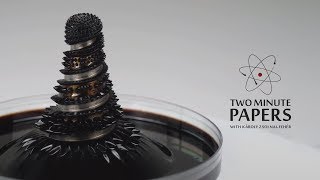
YouTube video (Two Minute Papers) presenting and commenting on a paper and experiments that simulate ferrofluids — magnetic fluids that respond to external magnetic fields. The narrator contrasts real-world footage (ferrofluid attracted to magnets, rotating magnets, climbing a steel helix) with simulation results, praises closeness of simulation to experiments, discusses computation vs. iteration trade-offs, and notes the paper's first author Libo Huang.
Chapters
Dear fellow scholars, this is two minute papers with you are in for a real treat today. Because today we are not going to simulate just plain regular fluids. No, we are going to simulate ferrofluids. These are fluids that have magnetic properties and respond to an external magnetic field. And you will see in a moment that they are able to even climb things. You see in the reference footage here that this also means if there is no magnetic field, we have a regular fluid simulation. Nothing too crazy here. In this real world footage, we have a tray of ferrofluid up in the air and we have a magnet below it. So as the tray descends down and gets closer to the magnet, this happens. But the strength of the magnetic field is not the only factor that a simulation needs to take into account. Here's another real experiment that shows that the orientation of the magnet also makes a great deal of difference to the distortions of the fluid surface. And now let's have a look at some simulations. This simulation reproduces the rotating magnet experiment that you've seen a second ago. It works great. What is even more, if we are in a simulation, we can finally do things that would either be expensive or impossible in the real life. So let's do exactly that. You see a steel sphere attracting the ferrofluid here. And now the strength of the magnet within is decreased, giving us the impression that we can bend this fluid to our will. How cool is that? In the simulation, we can also experiment with arbitrarily shaped magnets. And here's the legendary real experiment where with magnetism, we can make a ferrofluid climb up on this steel helix. Look at that. When I first seen this video and started reading the paper, I was just giggling like a little girl. So good. Just imagine how hard it is to do something where we have footage from the real world that keeps judging our simulation results. And we are only done when there's a near exact match, such as the one you see here. Huge congratulations to the authors. You see here how the simulation output depends on the number of iterations. More iterations means that we redo the calculations over and over again and get results closer to what would happen in real life at the cost of more computation time. However, as you see, we can get close to the real solution with even one iteration, which is remarkable. In my own fluid simulation experiments, when I tried to solve the pressure field using one to four iterations gave me a result that's not only inaccurate, but singular, which blows up the simulation. Look at this. On this axis, you can see how the fluid disturbances get more pronounced as a response to a stronger magnetic field. And in this direction you see how the effect of surface tension smooths out these shapes. What a visualization. The information density in this example is just out of this world, and it is still both informative and beautiful. If only I could tell you how many times I have to remake each of the figures in pursuit of this. I can only imagine how long it took to finish this one. Bravo. And if all that's not enough for you to fall out of your chair, get this. It is about Libo Huang, the first author of this paper. I became quite curious about his other works and have found exactly zero of them. This was his first paper. My goodness. And of course it takes a team to create such a work. So congratulations to all three authors. This is one heck of a paper. Check it out in the video description. Thanks for watching and for your generous support and I'll see you next time.