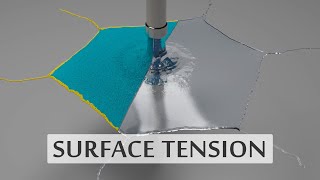
A new particle-based method simulates water droplets and soap bubbles by tracking three types of particles. The technique handles surface tension effects and runs at roughly 6.5 seconds per frame for a droplet on a plane, with demos showing fluid chains, membranes, and bubbles with holes.
Chapters
Dear fellow scholars, this is Two Minute Papers with Dr. Zsolnai. A computer graphics paper from approximately three years ago was able to simulate the motion of these bubbles and even these beautiful collision events between them in a matter of milliseconds. This was approximately 300 episodes ago. And in this series we always say that two more papers down the line and this will be improved significantly. So now once again, here goes another one of those two minute papers. Moments of Truth. Now, three years later, let's see how this field evolved. Let's fire up this new technique that will now simulate the evolution of two cube shaped droplets for us in reality, Mother Nature would make sure that the surface area of these droplets is minimized. Let's see. Yes, droplets form immediately, so the simulation program understands surface tension and, and the collision event is also simulated beautifully. A however, this was possible with previous methods. For instance, a paper by the name Surface Only Liquids could also pull it off. So what's new here? Well, let's look under the hood and find out. Oh yes, this is different. You see, normally if we do this breakdown, we get triangle meshes. This is typically how these surfaces are represented. But I don't see any meshes here. I see particles. Great. But what does this enable us to do? Look here. If we break down the simulation of this beautiful fluid polygon, we see that there is not only one kind of particle here, there are three kinds. With light blue, we see sheet particles. The yellow ones are filament particles. And, and if we look inside with dark blue here you see volume particles. With these building blocks and the proposed new simulation method, we can create much more sophisticated surface tension related phenomena. So let's do exactly that. For instance, here you see soap membranes stretching due to wind flows. They get separated, lots of topological changes take place and the algorithm handles it correctly. In another example, this soap bubble has been initialized with a hole and you can see it cascading through the entire surface. Beautiful work. And after we finish the simulation of these fluid chains, we can look under the hood and see how the algorithm thinks about this piece of fluid. Once again, with dark blue, we have the particles that represent the inner volume of the water chains. There is a thin layer of sheet particles holding them together. What a clean and beautiful visualization. So how much do we have to wait to get these results? A bit. Simulating this fluid chain example took roughly 60 seconds per frame. This droplet on a plane example runs approximately ten times faster than that. It only needs six and a half seconds for each frame. This was one of the cheaper scenes in the paper and you may be wondering which one was the most expensive. This water bottle took almost two minutes for each frame. And here when you see this breakdown from the particle color coding, you know exactly what we are looking at. Since part of this algorithm runs on your processor and a different part on your graphics card, there is plenty of room for improvements in terms of the computation time for a follow paper. I cannot wait to see these beautiful simulations in real time. Two more papers down the line. What a time to be alive. I also couldn't resist creating a slow motion version of some of these videos. If this is something that you wish to see, make sure to click our Instagram page link in the video description for more this episode has been supported by Linode. Linode is the world's largest independent cloud computing provider. Linode gives you full backend access to your server, which is your step up to powerful, fast, fully configurable cloud computing. Linode also has one click apps that streamline your ability to deploy websites, personal VPNs, game servers and more. If you need something as small as a personal online portfolio, Linode has your back. And if you need to manage tons of clients websites and reliably serve them to millions of visitors, Linode can do that too. What's more, they offer affordable GPU instances featuring the Quadro RTX 6000, which is tailor made for AI, scientific computing and computer graphics projects. If only I had access to a tool like this while I was working on my last few papers. To receive $20 in credit on your new Linode account, visit linode.compapers or click the link in the video description and give it a try today. Our thanks to Linode for supporting the series and helping us make better videos for you. Thanks for watching and for your generous support and I'll see you next time.