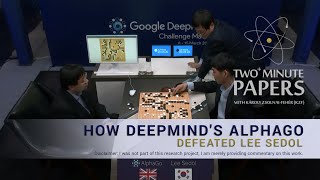
Károly Zsolnai-Fehér breaks down how DeepMind's AlphaGo beat world champion Lee Sedol using neural networks and self-play rather than handcrafted rules. The AI trained on millions of games against itself, not human expertise, marking a shift from task-specific engines like Deep Blue toward general machine learning.
Questions this video answers
March 15, 2016
Károly Zsolnai-Fehér
LARRUZ
Six months
Five matches played over five days
Chapters
Dear fellow scholars, this is two minute papers with a few months ago Alphagol played and defeated Fan Hui, a 2 dan master and European champion player in the game of Go. However, the next opponent, Lisa Dahl, is a 9 dan master and world champion player. Just to give an intuition of the difference, Lisa Doll is expected to beat Fan Hui 97 times out of 100 games. Google DeepMind had six months of preparation for this bout. Five matches were played over five days in my time zone. The matches started around 4am and the results would usually pop up exactly a few minutes after I woke up. It was amazing. I could barely fall asleep. I was so excited for the results and when I woke up I kissed my daughter and immediately ran to my computer to see what was going on. Most people were convinced that Lisa Doll was going to beat the machine five zero and I was stunned to see that AlphaG triumphed over Lisa Doll in the first match and then the second and then the third. Huge respect for both Google DeepMind for putting together such a spectacular algorithm and for Lisa Doll who played extremely well under enormous pressure. He is indeed a true champion. The game of Go has a stupendously large search space that makes it completely impossible to check every move and choose the best. What is also not often talked about is that processing through many moves is one thing, but judging which move is advant and which is not is just as difficult as the search itself. The definition of the best move is not clear cut by any stretch of the imagination. We also have to look into the future and simulate the moves of the opponent. I think it is easy to see that the difficulty of this problem is completely out of this world. A neural network is a crude approximation of the human brain, just like a stick figure is a crude approximation of a human being. In this work, neural networks are used to reduce the size of the search space and value networks are used to predict the expected outcome of a move. This value network basically tries to determine who will win if a sequence of moves is made to defeat AlphaGo or any computer opponent. Playing non traditional moves that it surely hasn't practiced sounds like a great idea. However, there is no database involved per se. This technique is simulating the moves until the very end of the game so non traditional weird moves won't throw it off. It is also very important to note that the structure of AlphaGo is not like Deep Blue for chess. Deep Blue was specifically designed to maximize metrics that are likely to lead to victory, such as pawn, advantage, king, safety, tempo, and more. AlphaGo doesn't do any of that. It is a general technique that can learn to solve a large number of different problems. I cannot overstate the significance of this. Almost the entirety of computer science research revolves around creating algorithms that are specifically tailored to one task. Different task, different research projects, different algorithm. Imagine how empowering it would be to have a general algorithm that can solve a large amount of problems. It's incredible. Just as people who don't speak a word of Chinese can write an artificial intelligence program to recognize handwritten Chinese text, someone who hasn't played more than a few games can write a chess or Go program that is beyond the skill of most professional players. This is a wonderful testament of the power of mathematics and science. It was quite surprising to see that AlphaGo played seemingly suboptimal moves when it was ahead to reduce the variance and maximize its chance of victory. Take a look at DeepMind's other technique by the name Deep Q Learning that plays Space Invaders on a superhuman level. This shot at first looks like a blunder, but if you wait it out, you'll see how brilliant it really is. A move that seems like a blunder at a time may be the optimal move in the grand scheme of things. It is not a blunder. It is a move from someone whose brilliance is way beyond the capabilities of even the best human players. There is an excellent analysis of this phenomenon on the GO Reddit. I've put a link in the description box. Check it out. I'd like to emphasize that the technique learns at first by looking at a large number of games by amateurs, but the question is how can it get beyond the level of amateurs? After looking at these games, it will learn the basics and will play millions of games against itself and learn from them. And to be emphasized, nothing in this algorithm is specific to go. Nothing. It can be used to solve a number of different problems without significant changes. It would be immensely difficult to overstate the significance of that. Shout out to Brady Daniels, who has an excellent GO educational channel. He has very fluid, enjoyable and understandable explanations. Highly recommended. Check it out. There's a link to one of his videos in the description box. It is a possibility that the first GO Grandmaster to reach 10 dance may not be a human, but a computer. My mind is officially blown insanity. One more cobblestone has been laid on the path to artificial general intelligence. This achievement I find to be of equivalent magnitude to landing on the moon. And this is just the beginning. I can't wait to see this technique being used for research in medicine. Huge respect for Demis Hassabis and Lisa Doll, who were both respectful and humble, both in victory and in defeat. They are true champions of their craft. Thanks so much for DeepMind for creating this rivetingly awesome event. My daughter, Yasmin, was born one day before this glorious day. What an exciting time to be alive. Thanks for watching and for your generous support, and I'll see you next time.